
“Someday, this war’s gonna end…” – Lieutenant Colonel Bill Kilgore (Robert Duvall), Apocalypse Now
As hostilities broke out in the Middle East, markets were initially rather resilient. This resilience was likely supported by the view that the conflict could be a short-duration bombing event, similar to past episodes, and by improving global economic data. In fact, markets went up on the first trading day after the bombs started flying. After three weeks, that resilience is fading, and the conflict is weighing more heavily on markets.
Nobody knows how this conflict will evolve, but there is no shortage of views out there. Three near-term events we believe would elicit a more dramatic market reaction include the destruction of energy infrastructure, the loss of American lives, and the prospect of boots on the ground. There have been very minimal American casualties, and the boots on the ground scenario still appears to be very unlikely at this time. However, there has been some energy infrastructure damage, which is contributing to more market weakness.
Our view from day one of this conflict was to see if markets showed enough weakness to create a potential opportunity. The general and very useful rule of thumb is that market weakness from geopolitical events is just about always a buying opportunity unless there is a recession coming. Given the current economic momentum, we continue to believe there’s enough resilience to absorb the hit from temporarily higher energy prices and disruption. That may change; that’s our view for now, but this doesn’t rule out continued weakness as the market multiple contracts due to uncertainty.
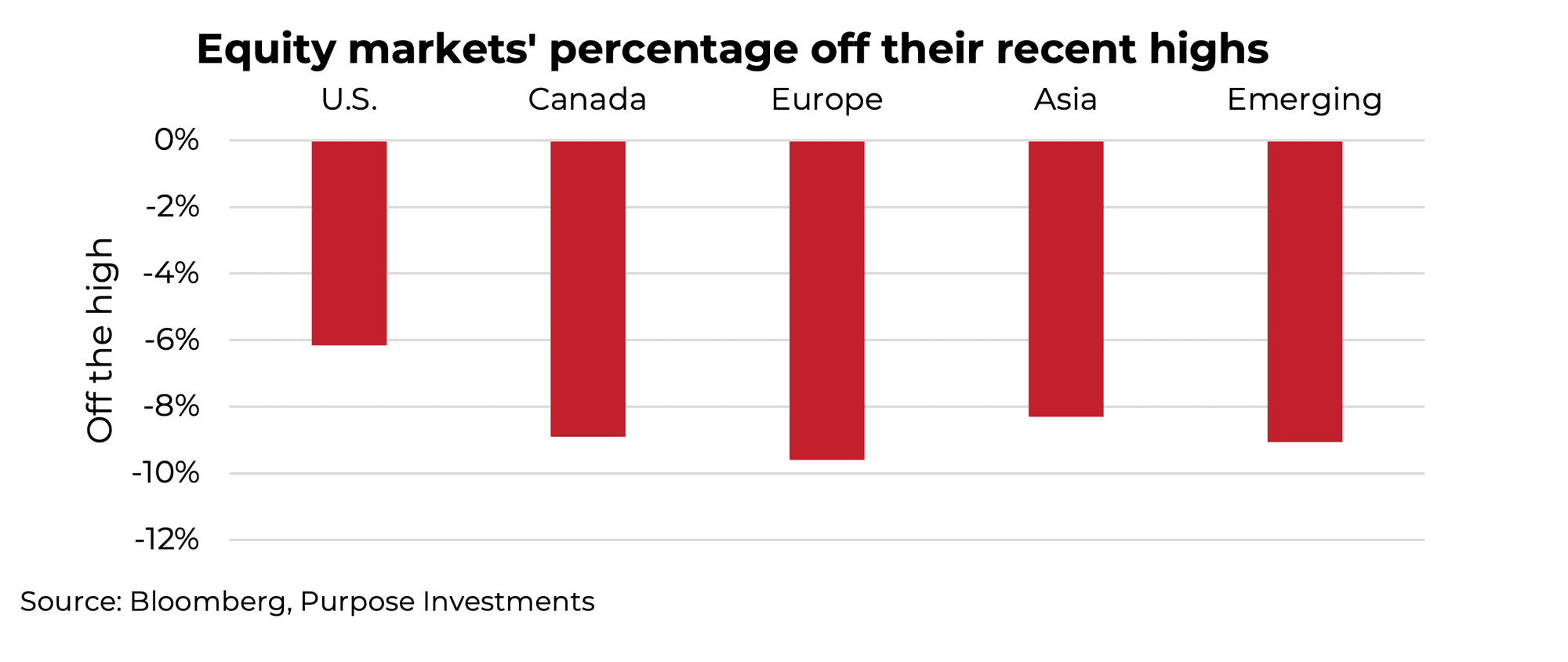
At the time of writing, the S&P is now down -6%, TSX -9%, emerging markets -9%, Europe -10% and Asia -8%. We wouldn’t call this a correction yet, but it’s getting close, with some markets proving more interesting than others. On one hand, the U.S. could pivot. President Trump does have a TACO reputation for a reason — when tariffs caused enough market angst, he pivoted. Could the same thing occur here? Gasoline prices, public polls on the conflict, midterms approaching: these are all factors that could elicit a pivot. Or things could get worse, either events in the Middle East or the impact on the economy. That is the uncertainty thingy.
Full disclosure: We do have a reputation for being early at times. But investing is like catching a train; it’s ok to arrive at the station early, but late, not so much. And given our defensive tilt coming into this period of weakness, that does provide optionality to be more tactical.
Without guessing at the war trajectory, here’s our rationale for doing some dip buying:
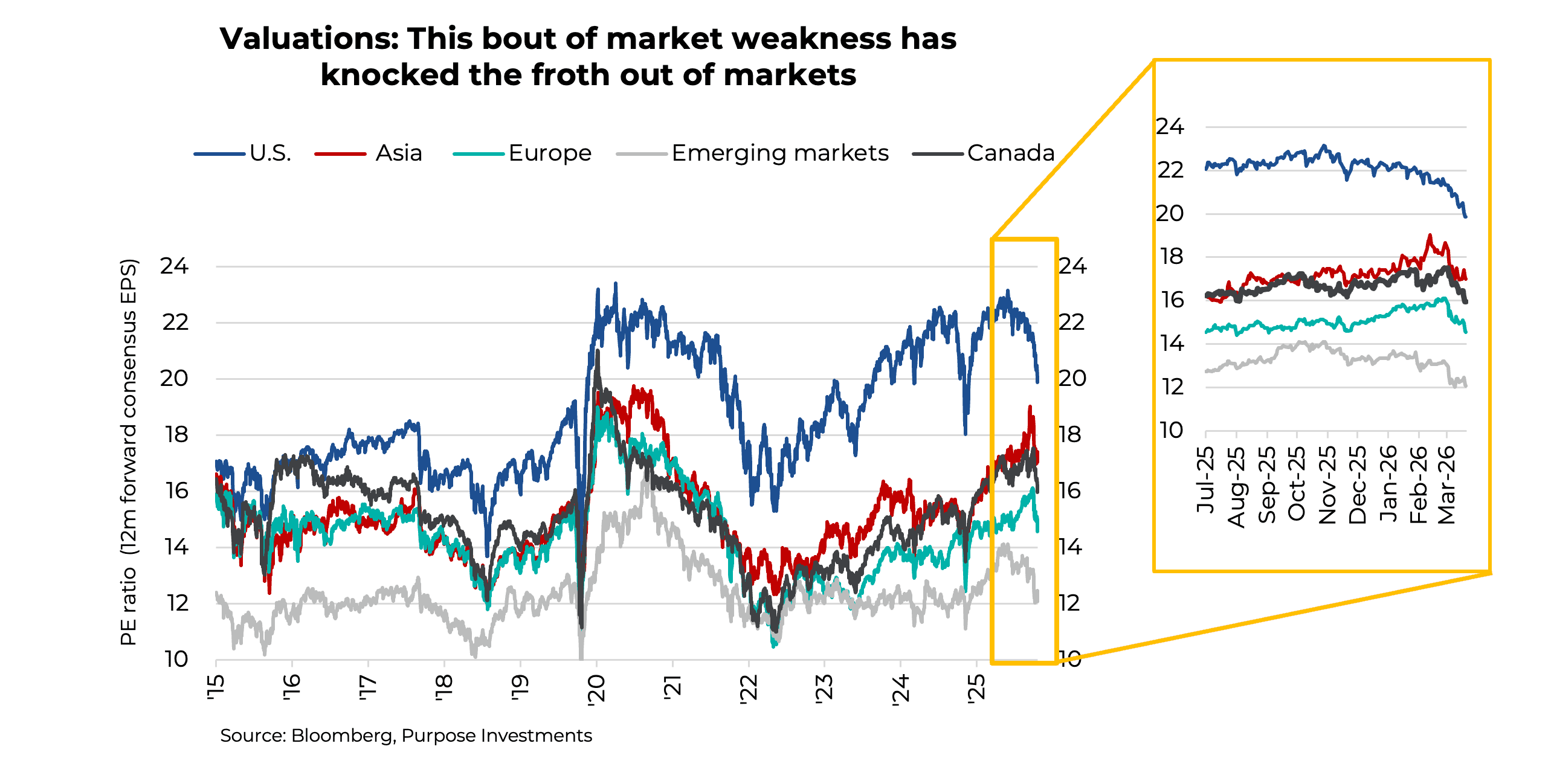
Valuations – This pullback has certainly knocked a good amount of froth out of the markets. The S&P 500 has just dipped below a 20x valuation for the first time since the tariff-induced market weakness last year. Generally, each market has seen its price-to-earnings fall by about two points. Europe is back below 15x, while emerging markets are back down to 12x. We’re not saying that’s cheap, but it’s certainly a pullback, and it presents more intriguing valuations.
Correction Watch – Let’s be fair: valuations are nice, but they never market tops or bottoms on a short-term basis. Dusting off our correction watch indicators — see the chart below — things are looking a bit more interesting. This is a basket of short-term sentiment indicators designed to measure oversold markets or capitulation. Not everything is flashing a ‘buy’ signal, but there’s enough to pique our interest.
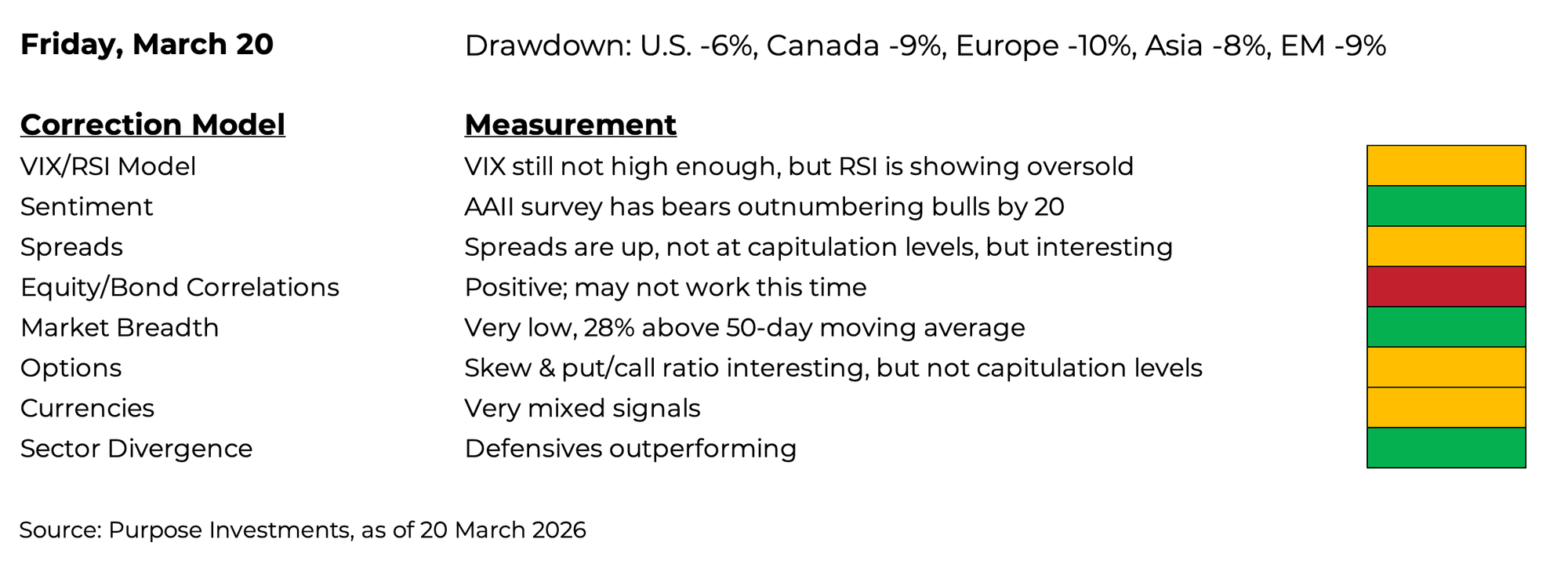
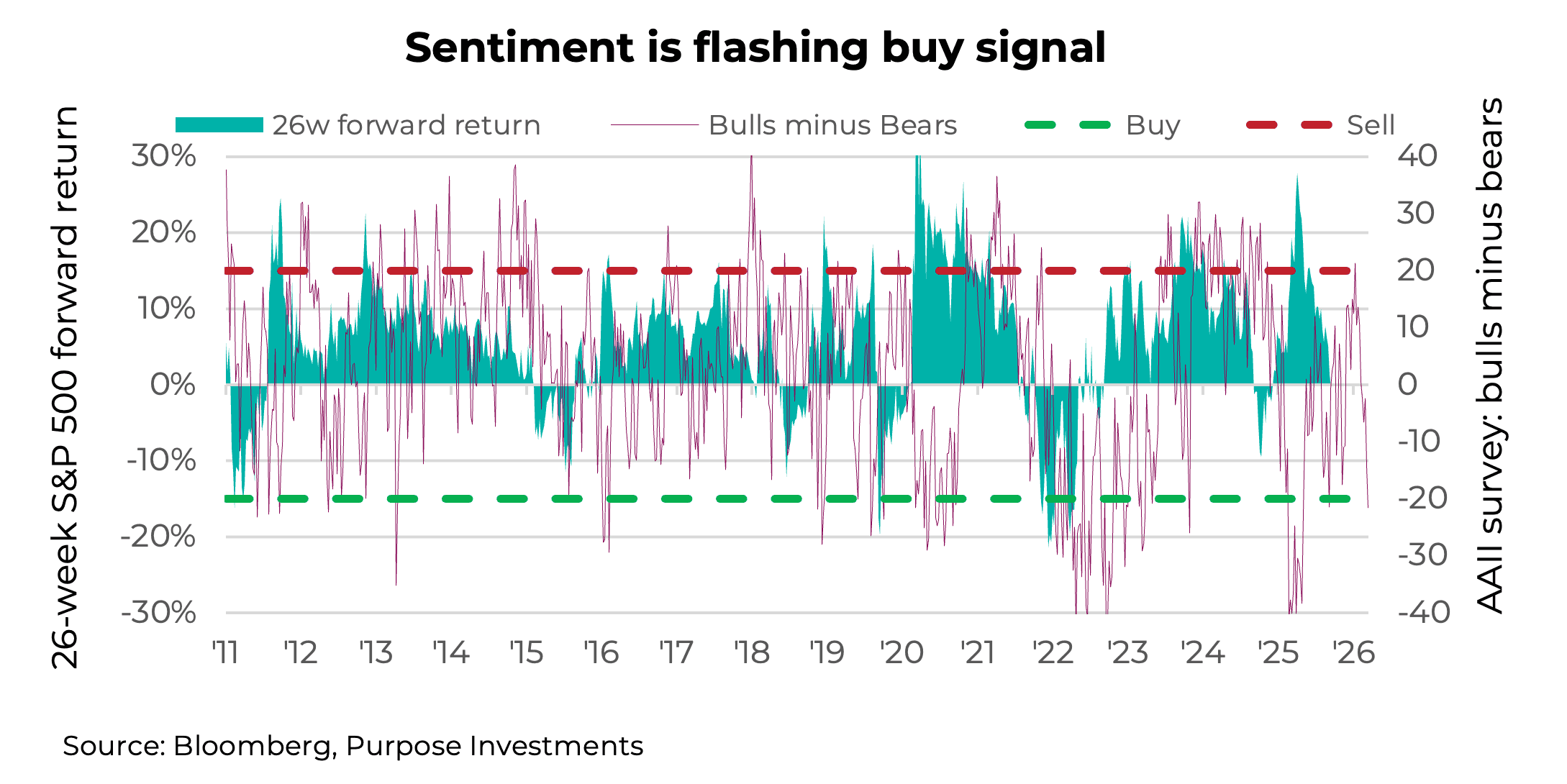
The VIX is up, but not enough. However, RSI for the S&P 500 is down to 32, which is bullish as an oversold signal, hence the yellow-coloured box. Sentiment, measured by the American Association of Individual Investors survey from this week, has 30% bullish and 52% bearish. A spread of over 20 is a bullish signal.
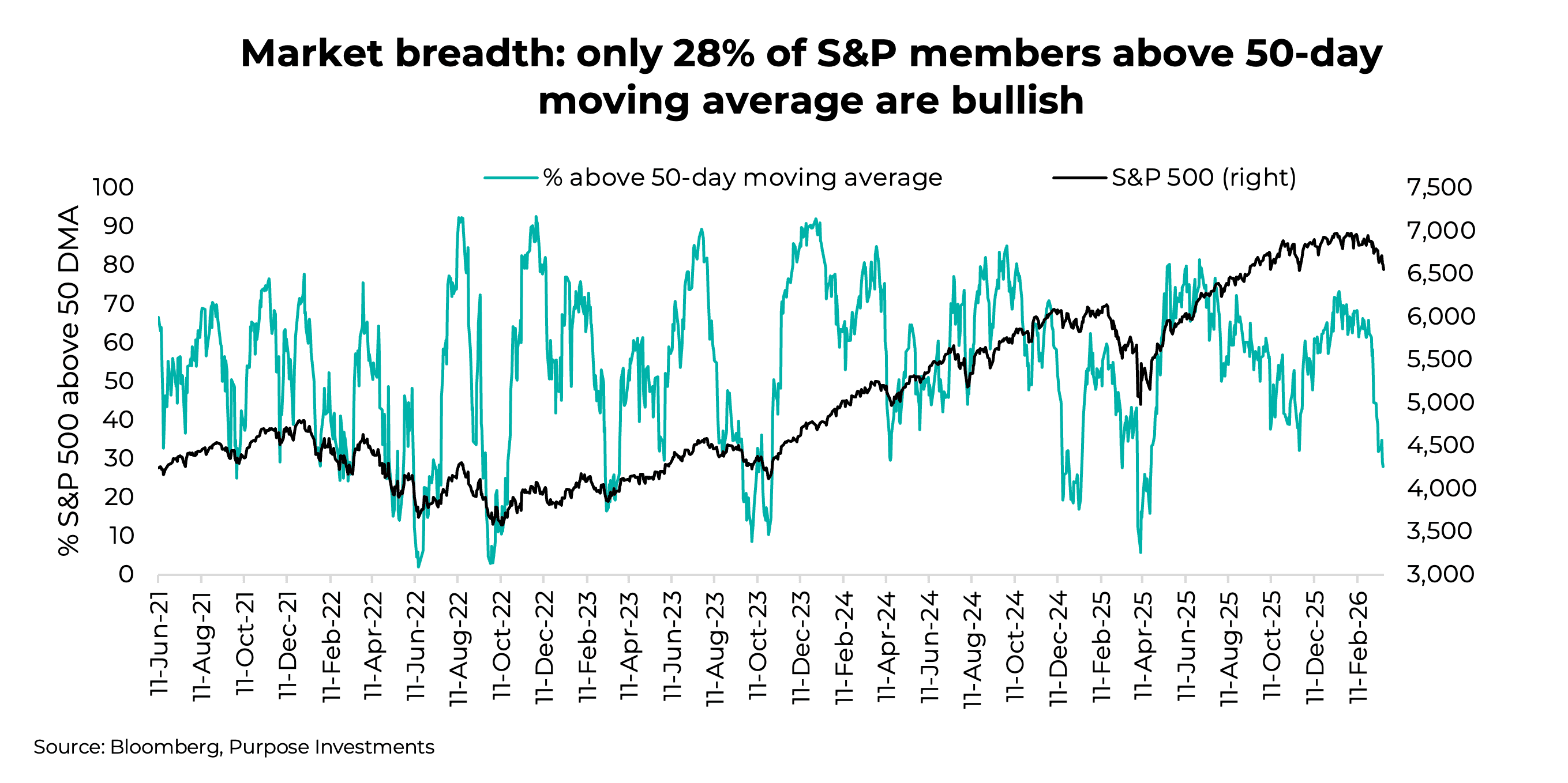
Corporate spreads have certainly risen from very low levels. This isn’t capitulation levels, but it is on the rise. Bond/equity correlations are positive, given the potential inflation impulse from high energy prices. A more entrenched risk-off market would see yields falling, so this signal is not encouraging. Market breadth, as measured by the percentage of S&P 500 companies trading in a bull trend, above their 50-day moving average, has fallen to 28%. That is getting close to capitulation levels.
Option indicators are elevated, but not to capitulation levels. This includes skew, a measure of how much tail insurance is costing investors, and the ratio of puts vs calls. Currency indicators are sending mixed signals. Sector divergence with defensives winning is positive, as this trend has been in place for a few weeks.
Final Thoughts
So here we are, with a few correction signals flashing ‘buy’ while most are not quite there yet. So are we early? Maybe. The risk of waiting for everything to align can lead to missed opportunities as well. Given that the pullback is more acute on the international equity side, that’s where we are nibbling. Our more cash-heavy and defensive starting point does make it easier to be opportunistic during these times of market stress. And for those who have limited international exposure, this could prove a good opportunity as well.
— Craig Basinger is the Chief Market Strategist at Purpose Investments
Get the latest market insights in your inbox every week.
Sources: Charts are sourced to Bloomberg L.P.
The content of this document is for informational purposes only and is not being provided in the context of an offering of any securities described herein, nor is it a recommendation or solicitation to buy, hold or sell any security. The information is not investment advice, nor is it tailored to the needs or circumstances of any investor. Information contained in this document is not, and under no circumstances is it to be construed as, an offering memorandum, prospectus, advertisement or public offering of securities. No securities commission or similar regulatory authority has reviewed this document, and any representation to the contrary is an offence. Information contained in this document is believed to be accurate and reliable; however, we cannot guarantee that it is complete or current at all times. The information provided is subject to change without notice.
Commissions, trailing commissions, management fees and expenses all may be associated with investment funds. Please read the prospectus before investing. If the securities are purchased or sold on a stock exchange, you may pay more or receive less than the current net asset value. Investment funds are not guaranteed; their values change frequently, and past performance may not be repeated.
Certain statements in this document are forward-looking. Forward-looking statements (“FLS”) are statements that are predictive in nature, depend on or refer to future events or conditions, or that include words such as “may,” “will,” “should,” “could,” “expect,” “anticipate,” “intend,” “plan,” “believe,” “estimate,” or other similar expressions. Statements that look forward in time or include anything other than historical information are subject to risks and uncertainties, and actual results, actions, or events could differ materially from those set forth in the FLS. FLS are not guarantees of future performance and are, by their nature, based on numerous assumptions. Although the FLS contained in this document are based upon what Purpose Investments and the portfolio manager believe to be reasonable assumptions, Purpose Investments and the portfolio manager cannot assure that actual results will be consistent with these FLS. The reader is cautioned to consider the FLS carefully and not to place undue reliance on them. Unless required by applicable law, it is not undertaken, and is specifically disclaimed, that there is any intention or obligation to update or revise FLS, whether as a result of new information, future events, or otherwise.


