
It’s 8pm on Sunday. My Polymarket wallet balance shows $134. Two weeks ago, it was $400. The AI I'd been working with had just told me, again, that the data 'supported live deployment.' It didn't.
Why I Started Poking at Prediction Markets
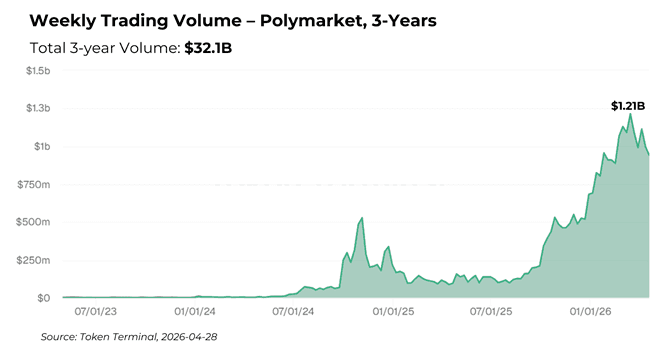
I’d been reading more about prediction markets, and the rapid expansion of users and total trading volume occurring there. This was a space where any market could be created, some illiquid, some very liquid. Obscure outcomes like “How much rain a city receives in a month” or “The # of times JD Vance claps at State of the Union”, all with live odds occurring, and settled in a similar style to an auction ending. The amount of money flowing through these markets is no joke. An estimated ~$24 billion in total volume was traded in April 2026 – up from $1.8billion just one year ago.
I’ve been using various forms of AI across platforms for the past 12 months. I’ve got some background in data analytics and coding. I looked at the platform and some of the markets, watched how things settled. Then asked the question: If AI is so smart, can it find market inefficiencies?
Then, like all successful traders have once done, I began looking where I could exploit an edge. After exploring a few different markets, I landed on 5-minute up/down crypto markets — you're betting on whether a cryptocurrency's price will be higher or lower five minutes from now. I thought for a trading algorithm they would be the perfect fit. High-frequency, low stakes per trade, mathematically tractable. I didn’t want to bet on hunches; I wanted a structured experiment with a tool that is supposedly capable of finding edges that humans can’t.
So, I chatted with AI about some potential strategies, fed it my ideas, and we came up with the first one we’d deploy. The end-state was meant to be a fully automated trading bot that ran without interruption while compounding wins.
Strategy 1: Expected Value Stacker
What it did: when a token in a 5-minute market reached a level of certainty (≥$0.97) with under 30 seconds left, I’d post a limit buy at that price. The market is essentially decided, and I would be capturing the last few pennies of certainty.
A win here was worth $0.03 for every dollar risked. A loss on the other hand was losing $0.97 for that same dollar of risk. That put my breakeven win rate at ~97%. I ran this on live data with no real money, trading the market 24/7 and it came back with ~98.8% win rate. Profitable on paper, and all I needed to do was let it compound – I’d found my edge.
So, what broke it? I wasn’t the only participant in this market. When I went live with real dollars, other bots were there (that I couldn’t see in back-testing). Suddenly 50,000+ tokens were stacked in the queue at the $0.97 price and my orders, sat in the back. The only fills I got were when somebody dumped through the bid - i.e., when the market was reversing and I was on the wrong side. Win rate dropped below 95%.
In the end I’d lost $176 as the trading bot bled out over a week. Not the start I’d hoped for, but I still believed I could pivot and win. I got back to conversing with the AI and came up with a new idea.
Strategy 2: Max-Pain Stacker
What it did: Aptly named this max-pain stacker for a reason. It would lose a lot, but when it won, it would win big. My logic was that if everyone is buying at $97c expecting the market to settle up, then I buy the opposite side at $3c banking on a reversal. The loss/win ratio inverts to 32:1 in your favor. You only need to be right ~3% of the time to break even. I ran the idea by AI and it concurred. The back test was even better than the pervious strategy, posting~9% win rate – triple what I needed to breakeven.
The live results were once again, less than stellar despite me applying three separate iterations. The win rate went from 2.8%, to 2.5%, finally to 2.3% ending with a net loss of $90. Every time I iterated, chasing the winning slice using the data I’d collected, my edge shrunk. This is a signature of overfitting, not a real signal. Ironically my AI fed this stat back to me three days after enthusiastically recommending the strategy.
Prediction Market Competition
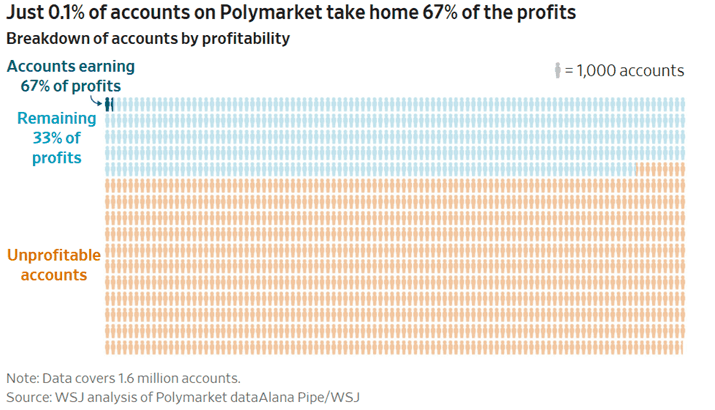
When looking at the overall Polymarket account data, it’s unsurprising that I couldn’t launch a profitable strategy. Bloomberg analysis of wallets active since 2025 found that over 100,000 accounts have lost at least $1,000, totaling $131 million in aggregate losses for those users. Those who profit are concentrated at the top – 0.1% of accounts received ~67% of the platforms total profit.
It’s worth noting that many of the profitable strategies operating on Polymarket appear to be executed through trading bots. The challenge is how rapidly the space has become crowded, and the speed edge that exists via professional money in play.
What the AI Did Well, And Where It Failed
It was able to spin up the infrastructure, connections, and write the code incredibly fast. It audited the information in minutes, processing tens of thousands of data points. I had a working prototype in under 2 hours, and without ever writing a single line of code. It also did a great job catching its own errors. When data contradicted previous conclusions, it dug in and called it out to me.
Where it dropped the ball was overstating edges and feeding back into my own assumptions. Confirmation bias was happening in real time, and it didn’t alert me. It confused back test signals with live signals. Things that appeared predictive in testing were not real signals when it came to real time application. Finally, it anchored on prior recommendations. It took me telling it that ‘I’ve bled a lot of cash’ to come through with a genuine we should pause suggestion.
Lessons for Advisors
AI is a brilliant analyst, not a brilliant decision maker. The numbers and math it came through with were correct. The interpretations however, were too confident. In the end, the judgement about what to do with the analysis remains fundamentally human. Context is key.
Hindsight bias is invisible until you go live. What was meant to be a near double-digit win rate looking at backwards data, turned out to be ~0% predictive in real time. AI didn’t catch this. I also didn’t catch this. A back test that uses data not strictly available at decision time is lying to you, and that lie is hard to see.
AI doesn’t replace skepticism; it amplifies what you bring. If you ask any AI “what’s the edge here?” it will find one. If you ask, “what could go wrong?” it will find that too. The output is reflective of the prompt. For things like investment decisions, the discipline that exists is in the questions asked, not the answers.
Closing Thoughts
AI agentic workflows are coming whether we like it or not. The question isn't whether to use them but how to implement them so the failure modes are catchable. The advisor's role doesn't shrink; it shifts. Less ‘what is the right answer?’ and more ‘what assumptions is the answer built on, and which one is most likely to break first?’
AI didn't lose me money. AI helped me lose money very efficiently. That is a useful distinction.
— Spencer Morgan is Director, Portfolio Strategy at Purpose Investments
The content of this document is for informational purposes only, and is not being provided in the context of an offering of any securities described herein, nor is it a recommendation or solicitation to buy, hold, or sell any security. The information is not investment advice, nor is it tailored to the needs or circumstances of any investor. Information contained in this document is not, and under no circumstances is it to be construed as, an offering memorandum, prospectus, advertisement or public offering of securities. No securities commission or similar regulatory authority has reviewed this document and any representation to the contrary is an offence. Information contained in this document is believed to be accurate and reliable, however, we cannot guarantee that it is complete or current at all times. The information provided is subject to change without notice.
Commissions, trailing commissions, management fees, and expenses all may be associated with investment funds. Please read the prospectus before investing. If the securities are purchased or sold on a stock exchange, you may pay more or receive less than the current net asset value. Investment funds are not guaranteed, their values change frequently and past performance may not be repeated. Certain statements in this document are forward-looking. Forward-looking statements ("FLS") are statements that are predictive in nature, depend on or refer to future events or conditions, or that include words such as "may," "will," "should," "could," "expect," "anticipate," intend," "plan," "believe," "estimate" or other similar expressions. Statements that look forward in time or include anything other than historical information are subject to risks and uncertainties, and actual results, actions or events could differ materially from those set forth in the FLS. FLS are not guarantees of future performance and are by their nature based on numerous assumptions. Although the FLS contained in this document are based upon what Purpose Investments and the portfolio manager believe to be reasonable assumptions, Purpose Investments and the portfolio manager cannot assure that actual results will be consistent with these FLS. The reader is cautioned to consider the FLS carefully and not to place undue reliance on the FLS. Unless required by applicable law, it is not undertaken, and specifically disclaimed, that there is any intention or obligation to update or revise FLS, whether as a result of new information, future events or otherwise.


