
At an investor event in the Fall of 2001, while working for a major U.S. investment bank and brokerage firm (miss the Bull), was when I first fielded the question of the sustainability of mounting government debt. How can deficits with subsequent rising debt levels be sustainable and how can we ever pay it back? That was the gist of the question. Fast forward 25 years, many trillions more in debt and the same question has certainly regained momentum with yields moving higher as of late. So, with government debt service cost globally sitting at about $2 trillion, is this why yields are moving higher and is a government debt crisis finally upon us?
Bond yields are up, with the 10-year U.S. Treasury yield nearing 5%. Canadian yields are not far behind. Taking a bit of a longer view, this does have yields nearing the upward bound of the range that has persisted over the past 4+ years. There are a number of factors contributing to this rise in yields. A recent survey by Bloomberg highlights the big four reasons or concerns including in order of importance from respondents: 1) Accelerating inflation, 2) Rising term premium/fiscal concerns, 3) Massive amounts of hyperscaler debt issuance, and 4) Fed rate expectations.
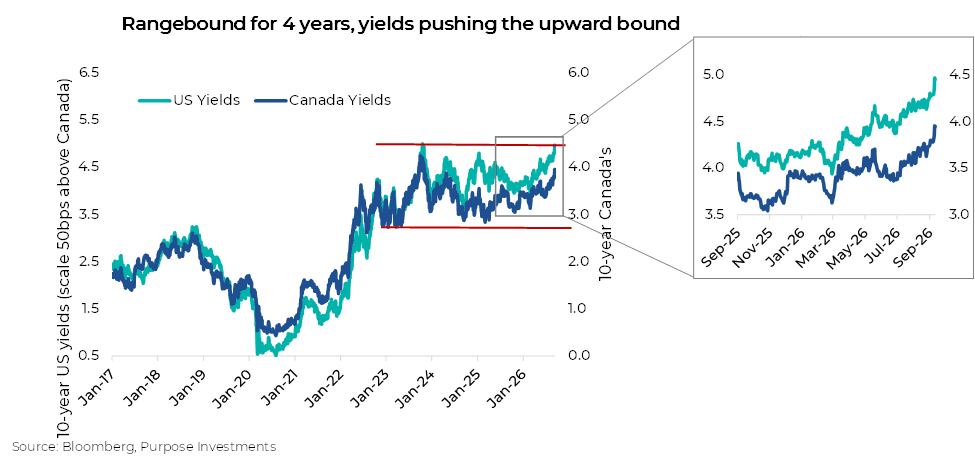
Let’s break them down one by one. Inflation has not gone away and while much lower than a few years back as the economy was emerging from the Covid induced reverberations, it is still a persistent risk. On the positive side wage growth has normalized, core U.S. CPI and service inflation has slowed. On the more worrisome side of the ledger, we do have diesel prices in the U.S. over $6/gal as the supply disruption from Hormuz continues to keep energy prices high. Add the gradual impact of tariffs to this. Maybe inflation accelerates as energy prices make their way through the economic machine, but for now it’s too early to get excited.
Fiscal concern is the headline grabber. No denying society has moved firmly into a spend more mindset, can’t even remember the last time anyone said the word ‘austerity’. The global economy is doing really well and yet governments around the world feel the need to spend more and more. The past decade of QE has given way to unrestrained fiscal spending, cemented during Covid. The solution to any problem is to spend more. Worried you might lose Congress in the Midterms; the U.S. government is toying with giving everyone $5k (that would be a mere $1 trillion). In Canada, worried about the impact of tariffs, the solution is to ramp fiscal spending to support industries. Not saying this is the wrong policy, we are not policy people, but the norm in the world has become to spend at the sign of any trouble.
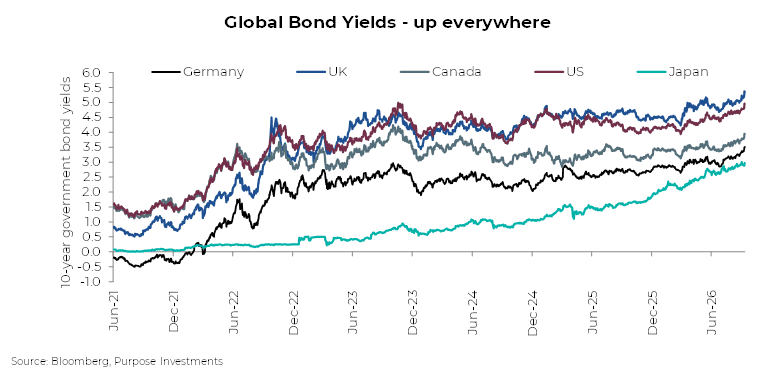
If bond yields are going up on fiscal spending sustainability risks, why are they going up everywhere? One could argue Canada’s debt/fiscal situation is much better than our neighbours to the south, but our yields are going up too. Or Germany, in even better fiscal shape. If this were a fiscal sustainability issue, would we not see greater divergence in the direction of bond yields based on relative fiscal health? We will come back to this one shortly.
The buildout of AI infrastructure is not cheap and after hyperscalers funded much of initial build with existing cashflow, they are now tapping debt markets more and more. The dollar amounts are pretty epic. Debt crowding out is an economic concept where issuing too much debt crowds out other issuers, who then have to offer a higher yield to attract buyers. Yes, hyperscalers are issuing an increasing amount of debt but it still pales in comparison to government issuance. And there is likely a healthy investor appetite to participate in this AI build out. Maybe government + hyperscalers is creating some rising competition for capital but with so much liquidity globally, we don’t think this is a big driver today.
The ECB just raised rates, after last week’s U.S. CPI print, the futures market is now pricing in a Fed rate hike on the 16th and in Japan a BOJ hike on the 18th. This is certainly contributing to higher bond yields globally, but for healthy reasons. Inflation is a bit warmer and economic growth is robust, that supports the basis for hiking, and it also supports somewhat higher bond yields. Nominal GDP in the U.S. expanded at a 6.6% annualized pace in Q2. Higher yields and higher GDP is natural.
Another factor that has not seen much coverage is the old carry trade. The carry trade is predicated on interest rate differentials and was much more popular in years past. A big one was to borrow in Japan, with their lower rates, and invest the proceeds in higher interest rate markets such as the U.S. While not as big as it used to be, there is still a lot of capital devoted to carry trades. However, over the past month, we have seen the Japanese yen rise in value aggressively as rate hike expectations rose along with some government intervention. When the liability side of the carry trade, in yen, appreciates that is not good for profitability. It would likely cause some unwinding, which ends with selling of U.S. Treasuries, pushing up yields. This too has likely contributed to higher yields.
Jumping back to the fiscal sustainability topic, how we answered the question 25 years ago and how we answer it today has not materially changed. We don’t doubt there is a debt crisis ahead, it is part of the debt cycle path. And it is a greater risk today than in 2001. Debt levels are much higher even relative to a much larger economy. Demographics are also more challenging and financially responsible policy is sparse.
There are no reliable signals for when this could really become a problem. It isn’t debt level to GDP, and it isn’t interest payments vs defense spending. Debt becomes an issue when you can’t roll maturities or issue new debt. It is when the buyers don’t show up. That is what will force policy to change, addressing deficits, or debt in some way, which won’t be fun.
Our gameplan: We don’t believe this debt crisis will start in Canada, nor the U.S. (even with their level of debt), because of the many levers and tools a highly developed financial system has to, well, kick the can down the road. The U.K. did that when they had their bond dust up a few years ago. We think the debt crisis will begin in more fragile economies that don’t have as many levers. That is your canary for this potential risk.
Maybe it is in 5 years, or 10 or another 25. The optimists say productivity and economic growth could save the day, we doubt it. Governments will spend that too. The good news is that these higher yields are easily clearing bond issuances. There was a 10-year and 30-year auction over the past week, yes, the yields came in a bit on the higher side but that slightly higher yield led to an increase in the bid-to-cover ratio (aka lots of buyers).
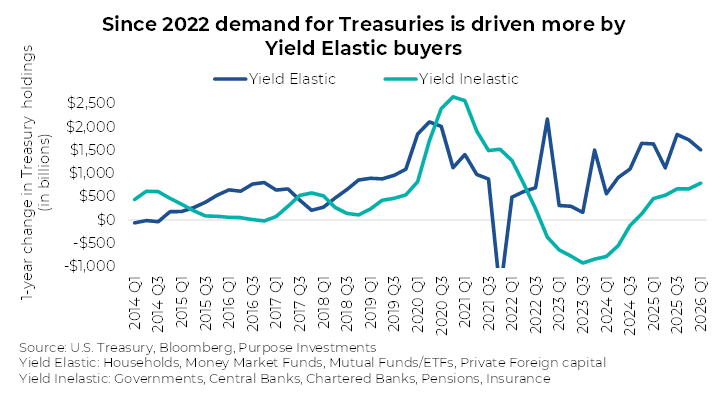
Bond investors have become more yield sensitive and higher yields attract more buyers. Conversely, lower yields cause investors to go elsewhere. This is one of the factors that has kept bond yields in the same range for the past 4+ years. This may change but with yields at the upper end of the range we are already seeing more bond buying via ETFs.
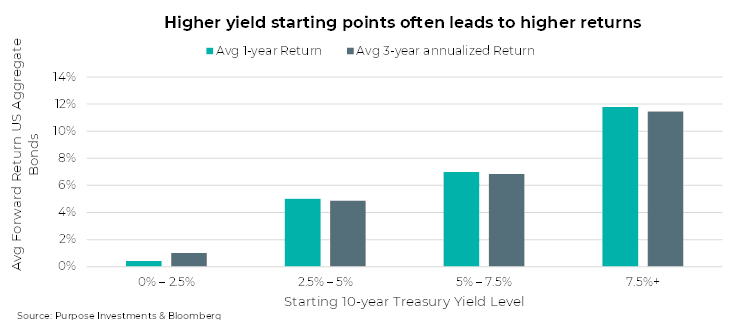
One final positive of these higher yields, it does raise the return expectation for bonds. The simple truth is over the past 50 years, the best indicator of forward bond market returns is the yield at the starting point. Bucketing into various ranges of 10-year Treasury yields, the higher yield starting points led to higher average forward returns over the next 1 and 3-year time periods. It might not be fun getting to the higher yield starting points, but the returns should be more pleasant.
Final Thoughts
Inflation, deficits, healthy economic growth, competition for capital and hiking central banks have all combined to push yields higher. Feels good to be underweight bonds with mildly lower duration. However, with these higher yields the attractiveness of bonds has increased. Buying bonds when the 10-year yielded 4% was bad, at 5% certainly less bad or even good if economic growth cools and/or rate hikes instill more confidence that central banks are serious about combatting inflation.
Not saying yields can’t go higher, but with investing it is all about risk vs return and the ratio has improved as yields climbed higher.
— Craig Basinger at Purpose Investments.
Get the latest market insights in your inbox every week.
Sources: Charts are sourced to Bloomberg L.P., as of September 11, 2026.
The content of this document is for informational purposes only and is not being provided in the context of an offering of any securities described herein, nor is it a recommendation or solicitation to buy, hold or sell any security. The information is not investment advice, nor is it tailored to the needs or circumstances of any investor. Information contained in this document is not, and under no circumstances is it to be construed as, an offering memorandum, prospectus, advertisement or public offering of securities. No securities commission or similar regulatory authority has reviewed this document, and any representation to the contrary is an offence. Information contained in this document is believed to be accurate and reliable; however, we cannot guarantee that it is complete or current at all times. The information provided is subject to change without notice.
Commissions, trailing commissions, management fees and expenses all may be associated with investment funds. Please read the prospectus before investing. If the securities are purchased or sold on a stock exchange, you may pay more or receive less than the current net asset value. Investment funds are not guaranteed; their values change frequently, and past performance may not be repeated.
Certain statements in this document are forward-looking. Forward-looking statements (“FLS”) are statements that are predictive in nature, depend on or refer to future events or conditions, or that include words such as “may,” “will,” “should,” “could,” “expect,” “anticipate,” “intend,” “plan,” “believe,” “estimate,” or other similar expressions. Statements that look forward in time or include anything other than historical information are subject to risks and uncertainties, and actual results, actions, or events could differ materially from those set forth in the FLS. FLS are not guarantees of future performance and are, by their nature, based on numerous assumptions. Although the FLS contained in this document are based upon what Purpose Investments and the portfolio manager believe to be reasonable assumptions, Purpose Investments and the portfolio manager cannot assure that actual results will be consistent with these FLS. The reader is cautioned to consider the FLS carefully and not to place undue reliance on them. Unless required by applicable law, it is not undertaken, and is specifically disclaimed, that there is any intention or obligation to update or revise FLS, whether as a result of new information, future events, or otherwise.


