As we enter the ninth straight day of missiles being lobbed between Iran and the U.S. since the MOU, tension rose notably this past weekend with the U.S. military death toll rising once again, and subsequently news of potential mediation efforts this morning seems to have calmed markets a bit. While the oil market is certainly pricing in rising supply risk in the short term as tanker traffic slows versus a couple weeks ago, the outcome of the current phase of the conflict remains up in the air as the U.S. seems to be focusing its campaign on reducing Iran's ability to launch attacks at marine traffic. I'm not convinced this is possible without some version of a ground invasion, although if the tanker companies view the probability of getting attacked as low enough — i.e., the U.S. military is somewhat successful in suppressing IRGC aggressions coupled with U.S. naval escorts — and the premiums getting paid to deliver those barrels are high enough, there will be companies willing to transit given the upside. Despite the majority of commentary around the Middle East conflict revolving around oil price, and rightfully so given its immense impact as the engine of the global economy, one area that we continue to like that is an outsized beneficiary of the current conflict is European gas, which is closing in on its March highs versus Brent oil in the $90s, still shy of the $120 peak.
TL;DR: We continue to like Tenaz Energy and initiated a position in CF Industries as a second-derivative European gas play on the renewed conflict.
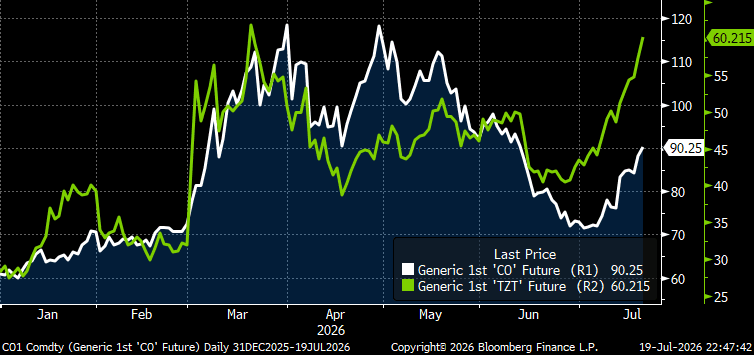
As a recap, as of June 2025, about 20% of global LNG trade moved through the Strait of Hormuz in 2024¹, primarily from Qatar, per the U.S. Energy Information Administration. That is the slice of world LNG that sits behind this one chokepoint and the flow that gets disrupted whenever Hormuz is unsafe, whether or not any plant is hit. In the opening acts of the war, Iranian strikes knocked out about 17% of Qatar's LNG export capacity², damaging two of its 14 LNG trains and one of its two gas-to-liquids facilities. The missiles hit Ras Laffan on March 18 and 19, and QatarEnergy then declared force majeure on several long-term supply contracts affecting buyers in South Korea, China, Italy, and Belgium. Force majeure lets a seller suspend delivery obligations when an extraordinary event stops it from performing, so buyers lose their contracted Qatari cargoes and must replace them on the spot market.
After the June truce, Qatar prepared to bring most output back quickly and had been pushing to revive most LNG production within two months (the 12 of the 14 trains that were not damaged). On July 7, the Al Rekayyat, a laden Qatari LNG carrier, was struck by a missile or drone strike in the waters of Oman as it exited Hormuz in the early hours. Qatar then paused its push to rapidly revive production after the tanker attack raised fears that transit was still too risky, with the CEO deciding to keep Ras Laffan at minimum output and cut the number of vessels docking in the coming days. Recall that a modern LNG tanker can cost upwards of twice as much as a crude carrier, given its complexity and requirement to keep gas in a liquid state.
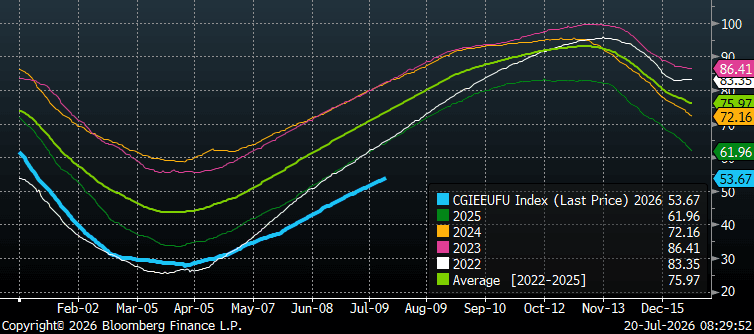
This matters because the EU is a heavy gas importer, and gas is a requirement to be able to heat homes in the winter. The injection season for the EU's gas storage is the only window Europe has to rebuild, and it normally shifts into high gear in May when seasonal demand falls, then tails off in September and October. If tanks are low on November 1, there is no way to catch up midwinter, so the whole cushion for a cold spell or a late-season supply shock is set by how much gets injected over these summer months. In Europe, it's important to remember that they have more of a wet cold, where it feels a lot colder, than a dry cold, where "putting on a sweater" can make it more manageable. The problem this year is that Europe started the summer very low and is filling slowly. As of July 18, we are at 53% full, about 20%+ below the five-year seasonal norm of 75%³. Normally winter gas trades above summer gas, which pays a trader to buy and inject in summer, then sell in winter. This means that the EU will have to chase to fill up storage now in order to meet the regulatory minimum of 80% full by November 1, or risk facing a disastrous winter season, and thus European gas prices will remain elevated for extended periods of time. Tenaz Energy, our long-time favorite, continues to execute, with one of its key JV operators announcing significantly larger-than-expected production volume at a new location, and Peters & Co, arguably the top sell-side broker in energy, just launched on the name at a $72 price target, of which the input assumptions to their model look light to me.
A second-derivative beneficiary of the Strait of Hormuz is nitrogen fertilizers, as the Strait supplies a third of globally traded urea and a quarter of ammonia, both of which are nitrogen-derived. The Haber-Bosch process involved in producing ammonia and other nitrogen-derived fertilizers is highly intensive in its use of natural gas as both a feedstock and a fuel source. What this means is that an ammonia plant based in North America, where there is cheap, abundant natural gas, is highly cost-advantaged versus the same plant in other parts of the world, especially Europe, which once based its energy security strategy on cheap Russian gas (the U.S. is not exactly a great trading partner to Europe as of late either). This trade certainly is not a secret, and many nitrogen fertilizer names have already moved YTD, but the entry point for many of the names looks interesting at this point in the conflict, given that the natural gas price arbitrage between European gas and North American gas is back at highs while the valuation of the equities has come off from the peak. As the conflict drags on and other countries start raising their own oil production to replace "lost" barrels, we believe North American gas prices will likely remain capped as associated gas production from oil continues to increase and the gas-to-oil ratio rises in shale basins.
We have recently initiated a position in CF Industries, the largest North American nitrogen producer, whose core thesis rests on a structural cost advantage from cheap U.S. natural gas feedstock, which lets it produce ammonia, urea, and UAN at margins that most global peers running on higher-priced gas cannot match. This cost edge is paired with world-class export logistics, including the flagship Donaldsonville complex in Louisiana, which sits on the Mississippi River with deep-water docking, barge, rail, truck, and pipeline access, so CF can ship product to global buyers as well as to ten company-owned terminals in the U.S. Corn Belt, swinging output between products to chase the best margin. On top of this, CF exports a large share of its production overseas, and its low-carbon blue-ammonia push, plus Europe's incoming carbon border tax (CBAM), gives U.S. supply a growing pricing advantage into export markets.
— Ritu Ghai is Senior Director, Product Optimization at Purpose Investments.
Sources: EIA (June 24, 2025)¹; QatarEnergy CEO (March 19, 2026)²; GIE AGSI+ (July 7, 2026)³.
The content of this document is for informational purposes only and is not being provided in the context of an offering of any securities described herein, nor is it a recommendation or solicitation to buy, hold or sell any security. The information is not investment advice, nor is it tailored to the needs or circumstances of any investor. Information contained in this document is not, and under no circumstances is it to be construed as, an offering memorandum, prospectus, advertisement or public offering of securities. No securities commission or similar regulatory authority has reviewed this document, and any representation to the contrary is an offence. Information contained in this document is believed to be accurate and reliable, however, we cannot guarantee that it is complete or current at all times. The information provided is subject to change without notice.
Commissions, trailing commissions, management fees and expenses all may be associated with investment funds. Please read the prospectus before investing. If the securities are purchased or sold on a stock exchange, you may pay more or receive less than the current net asset value. Investment funds are not guaranteed, their values change frequently and past performance may not be repeated.
Certain statements in this document are forward-looking. Forward-looking statements ("FLS") are statements that are predictive in nature, depend on or refer to future events or conditions, or that include words such as "may,” "will,” "should,” "could,” "expect,” "anticipate," intend,” "plan,” "believe,” "estimate" or other similar expressions. Statements that look forward in time or include anything other than historical information are subject to risks and uncertainties, and actual results, actions or events could differ materially from those set forth in the FLS. FLS are not guarantees of future performance and are by their nature based on numerous assumptions. Although the FLS contained in this document are based upon what Purpose Investments and the portfolio manager believe to be reasonable assumptions, Purpose Investments and the portfolio manager cannot assure that actual results will be consistent with these FLS. The reader is cautioned to consider the FLS carefully and not to place undue reliance on the FLS. Unless required by applicable law, it is not undertaken, and specifically disclaimed, that there is any intention or obligation to update or revise FLS, whether as a result of new information, future events or otherwise.