Andrej Karpathy has a line I keep coming back to. For decades, software had two kinds of users: humans, who click through screens, and programs, which call APIs. In his "Software Is Changing (Again)" talk he argues there is now a third. Agents are a new category of consumer of digital information, "computers, but humanlike." That reframes a question every investment firm is quietly wrestling with: when you want to put AI to work inside a real trading operation, what do you actually plug it into?
The industry is mid-debate on the how: MCP, raw APIs, or command-line tools. We chose the CLI. Partly bias, happily admitted: I am a quant by training, and the command line is where I come from. Mostly practical: LLMs are exceptionally well trained on the terminal, it is where today's best agents already live, and there is no extra server to run or spec to maintain, which is more than MCP can say. A human can drive it, a script can drive it, and now an agent can drive it too. Karpathy's three consumers, one surface. And every PM has the muscle memory anyway; the Bloomberg terminal is the world's most expensive command line. The CLI was simply the shortest path to getting AI into the trade process.
But an interface is only as good as what sits behind it. The real lift was never the wiring; it was the plumbing. A working investment operation has to do a handful of unglamorous things in sequence: see the book, stage an order, route the order, and reconcile the connective tissue underneath it, custodian files, prime-broker reconciliation, ETF creation and redemption baskets. Most firms run these across a patchwork of vendor systems that were never meant to talk to each other, and stitching them into one chain used to be a multi-year program.
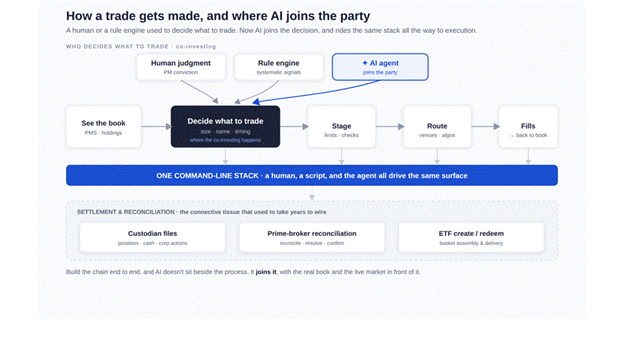
Figure 1 — How a trade gets made, and where AI joins the party (illustrative)
At Purpose we treated that as the actual investment, and we built it end to end: from pulling the book, to staging an order, to routing it, on one integrated stack exposed through a single command-line spine. Modern APIs made it dramatically faster to build than the same thing would have been a few years ago. The payoff is subtle but it is the whole game: when every piece of the chain speaks the same language, an agent can stand at any point in it, with the real book and the real market in front of it, not a sandbox.
Where the Rubber Meets the Road
Plumbing is necessary, not interesting. The interesting part is what you can do once it is in place. So let me make it concrete with a live strategy: Big Banc Split Corp., our equal-weight portfolio of Canada's Big-Six banks, enhanced with an active covered-call writing program on up to 30% of the portfolio to enhance income and reduce volatility. And it is listed: the Class A shares trade on the TSX under BNK, with a targeted 8% annual distribution on their original issue price.
Quick primer, because covered calls sound more exotic than they are. You own a stock, say one of the big banks paying roughly a 3% dividend. Each month you sell someone the right to buy that share from you at a set higher price, the strike, and they pay you a premium today. If the stock stays below the strike, you keep the premium as income stacked on top of the dividend. If it runs above, you still keep the premium but you cap your gain at the strike. In plain terms, you convert a steady dividend payer into an income engine, trading away some of the upside tail for cash in hand now.
Run across six banks, that strategy is systematic and high precision. The one real decision each month is how aggressive to be: which strike, or in options language, which delta. Sell a closer strike and you harvest more premium but cap upside sooner; sell a further one and you keep more upside for less income. A pure rules engine handles that decision well, and that is the floor we already stand on.
Here is what changes when you put an agent on the same desk.
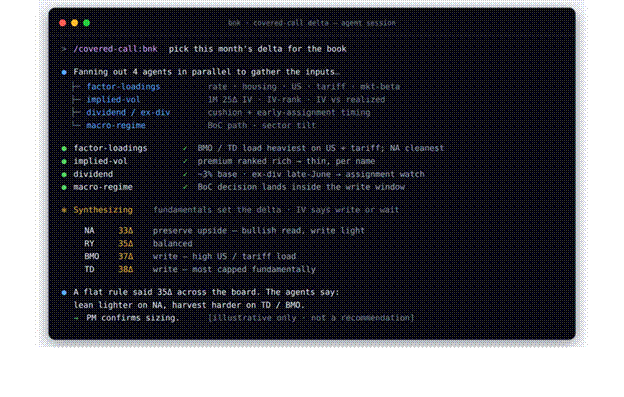
Figure 2 — The agent session: fan out, synthesize, recommend. Illustrative only; not a recommendation or current portfolio positioning.
It does not overrule the rule. It enriches it, fast. With the whole stack speaking one language, the agent has all the real market data and the real context, and in the time it used to take an analyst to pull a single chart it now reads the common factors that move all six banks together (the rate path, the housing and mortgage-renewal cycle, US exposure, trade and tariff risk, capital-markets beta), maps how heavily each bank loads on each one, pulls the live implied volatility and tells you whether option premium is rich or thin relative to that name's own recent range and to what the stock is actually realizing, and lays the delta decision out with the facts attached. What used to be an afternoon of work becomes a single, well-posed question with the evidence already in the room.
That moves the call from "the rule says 35-delta" to "the rule says 35, and the fundamental and volatility context says lean lighter on the bank you have most upside conviction in, and harvest harder where the premium is genuinely rich." Systematic-fundamental, not just systematic. Same precision on the floor, a higher ceiling on the judgment.
This is the framing we hold to internally and it matters: AI is scale, not edge. It systematizes the analyst layer, widens the coverage, and compresses the research latency to near zero. Conviction and sizing stay with the portfolio manager. We are still co-investing. We have just handed the rule a research analyst who has read everything and never sleeps. The rule sets the floor; the agent raises the ceiling.
We are genuinely excited about where this goes. The plumbing is built, the agent is on the desk, and the value-add compounds from here. At Purpose we are not waiting for the agentic era to arrive. We are already trading in it.
— Jason Chen is Portfolio Manager, Systematic Investing at Purpose Investments.
Sources: YCombinator, Purpose Investments
The content of this document is for informational purposes only and is not being provided in the context of an offering of any securities described herein, nor is it a recommendation or solicitation to buy, hold or sell any security. The information is not investment advice, nor is it tailored to the needs or circumstances of any investor. Information contained in this document is not, and under no circumstances is it to be construed as, an offering memorandum, prospectus, advertisement or public offering of securities. No securities commission or similar regulatory authority has reviewed this document, and any representation to the contrary is an offence. Information contained in this document is believed to be accurate and reliable; however, we cannot guarantee that it is complete or current at all times. The information provided is subject to change without notice.
Commissions, trailing commissions, management fees and expenses all may be associated with investment funds. Please read the prospectus before investing. If the securities are purchased or sold on a stock exchange, you may pay more or receive less than the current net asset value. Investment funds are not guaranteed; their values change frequently, and past performance may not be repeated.
Certain statements in this document are forward-looking. Forward-looking statements (“FLS”) are statements that are predictive in nature, depend on or refer to future events or conditions, or that include words such as “may,” “will,” “should,” “could,” “expect,” “anticipate,” “intend,” “plan,” “believe,” “estimate,” or other similar expressions. Statements that look forward in time or include anything other than historical information are subject to risks and uncertainties, and actual results, actions, or events could differ materially from those set forth in the FLS. FLS are not guarantees of future performance and are, by their nature, based on numerous assumptions. Although the FLS contained in this document are based upon what Purpose Investments and the portfolio manager believe to be reasonable assumptions, Purpose Investments and the portfolio manager cannot assure that actual results will be consistent with these FLS. The reader is cautioned to consider the FLS carefully and not to place undue reliance on them. Unless required by applicable law, it is not undertaken, and is specifically disclaimed, that there is any intention or obligation to update or revise FLS, whether as a result of new information, future events, or otherwise.