
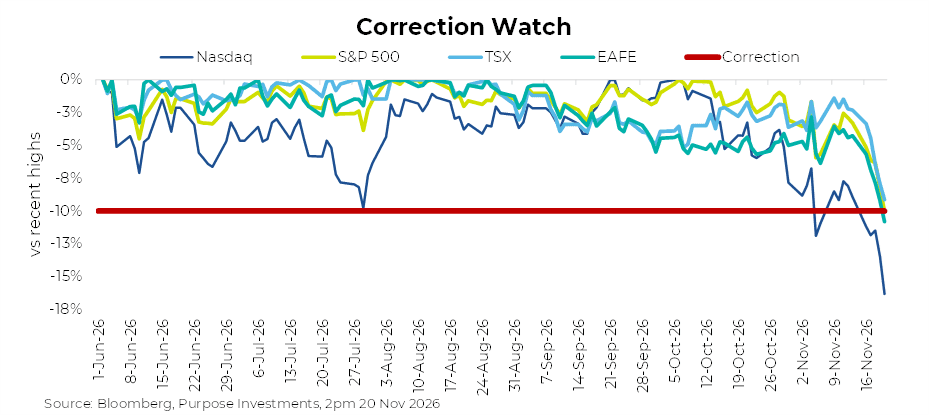
Sometimes it is hard to come up with a topic for the Market Ethos that resonates with our readers, but not so of late. The S&P, TSX and International developed indices are sitting around the -10% line from their recent highs. While NASDAQ, often an over achiever, is down over 15%. Obviously, the epicenter of the weakness is the AI trade. Weakness started in October, which was partially offset by a rotation into more defensive sectors such as health care or consumer staples. This trend accelerated following the midterm elections, then partially recovered before re-accelerating to the downside. Last week, this weakness became broader based. And at the epicenter, not even strong Nvidia earnings or the Anthropic IPO were enough to stem the selling pressure. Fortunately, offsetting this weakness are some familiar diversifiers, namely bonds and the U.S. dollar. Both have been moving higher since market weakness began in early October.
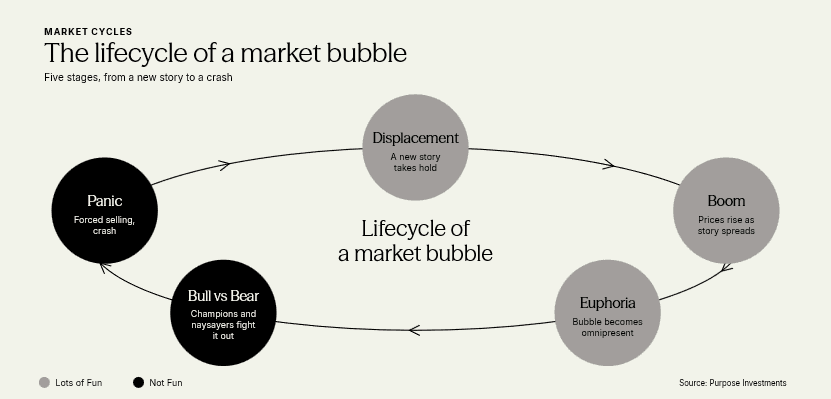
Going forward the only question that matters: what phase is this AI bubble in? We are certainly past the ‘Euphoria’ phase as this sure doesn’t feel like that. Then there’s the ‘bull vs bear’ phase that often lasts a while and sees multiple big moves in the market, up and down. Or are we entering the ‘panic’ phase, as investors increasingly head for the exit?
Most past bubbles (dot-com, marijuana, housing, fracking, 3D printing, cloud, etc.) go through a phase when it is questioned or challenged in the markets. Not the technology or disruption in how things are changing, but in how much has been priced in and the path forward. They all pop for different reasons. Sometimes it’s rates, sometimes it’s the economy, sometimes it has gone too far and become too big, or results start to miss elevated expectations, or the mob moves on to something shinier. We are unconvinced it is one of these and believe we are in the bull and bear fight phase.
The size of this bubble naturally scares us. That was one of the reasons we built out AI exposure measurement tool. It attempts to measure how much AI exposure an index or portfolio contains. For instance, the S&P 500 is about 45-50% exposed to AI while the TSX is much lower at 10-15%. FYI: the TSX is flirting with a correction not due to AI but more due to gold. This AI measurement also measures a portfolio, enabling us to know our AI exposure in multi-asset portfolios was low vs most other balanced funds and models put through the tool. Many advisors took us up on the offer to measure their AI exposure (which we continue to offer today). Will say though, this correction has likely made the portfolio’s AI exposure painfully clear.
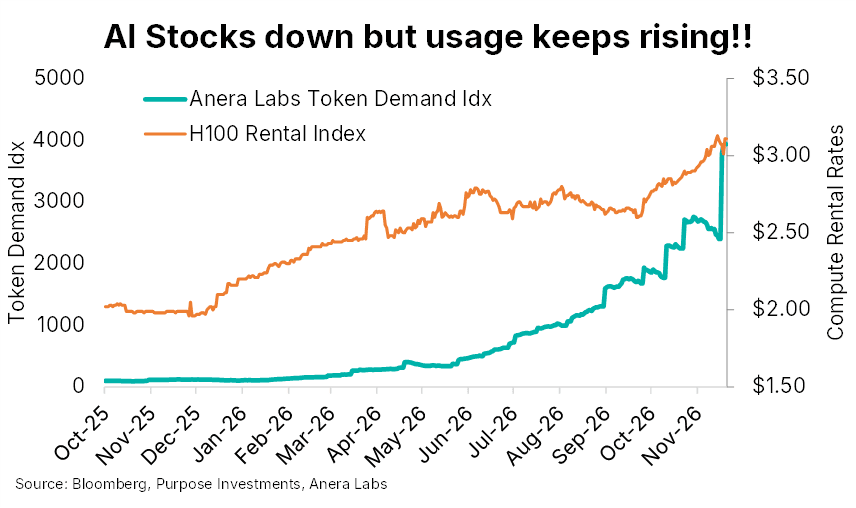
That being said, this does look to be more the ‘bull vs bear’ phase and not the start of ‘panic’. Economy is healthy, yields are up (but not too much), company results remain very strong. We are now seeing a balance between those saying, ‘it’s all over’ and those saying to buy the dip. Perhaps more important, demand growth remains really strong along with adoption. Morgan Stanley research team tracks the percentage of companies quantifying AI adoption benefits, which has steadily risen and continues to do so in 2026. Or look at token demand, the measurement of usage for AI. That recent spike appears to be partially due to some providers switching platforms that are included in this index. Nonetheless, the demand is real and it’s rising. The rental computing cost is also rising.
It is getting more interesting out there. But the challenge is twofold. This bubble is so big that even if you agree this is more a checkback phase, its size could make that really bad. The other factor is the momentum. More and more of this market has become momentum driven, whether it’s retail trading, algos, hedge funds, gamma traders or other participants. Which likely means that mean reversion or valuation motivated investors are just not as plentiful. So, anything can keep going from rational to irrational to extreme to crazy. Truthfully, we all participated in that during the inflating phase of this bubble, just not that many folks complained about it.
We developed a correction monitor to help gauge a correction and when it might be getting oversold. The big caveat is if this is the start of a bear, which usually has a recession nearby, all bets are off. But we don’t think that is the case at this point. So, is this correction oversold enough to warrant some more attention or capital? The correction monitor looks at a large number of indicators for markets being oversold. We outlined them with their current reading below:
|
Correction Model |
Measurement |
Signal |
|
VIX / RSI |
Volatility index (VIX) over 30 and Relatives
Strength (RSI) below 30: yep |
|
|
Investor Sentiment |
AAII survey has bears outnumber bulls by 20: 33
Bulls, 42 Bears |
|
|
Spreads |
Credit spreads have spiked higher: up a bit |
|
|
Correlations |
Equity / Bond correlations turn negative: yep |
|
|
Market Breadth |
Low % trading above 50-day moving average: currently
50% |
|
|
Skew / Put Call |
Skew measures market tail risk, Put / Call measures
demand for insurance: mixed |
|
|
Currency |
Performance of risk-off currencies vs risk-on: yep |
|
|
Sectors |
Strong outperformance of defensive sectors: yep |
|
|
Valuations |
Cheap enough to start attracting value investors:
yep |
|
|
Source: Purpose Investments |
| |
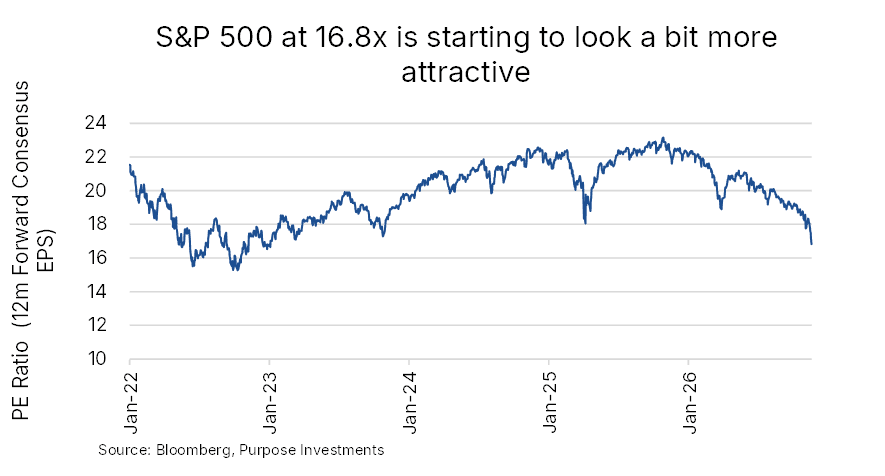
Wouldn’t call this a slam dunk, but more signals suggesting this correction is getting longer in the tooth. If in the camp this cycle isn’t done just yet, or have some opportunistic capital, it’s certainly getting more interesting. Now valuations have never signaled market bottoms but S&P at 17x is noteworthy. Obviously, the valuation of Nvidia at 8.9x and still carrying a 5.7% weight is a contributor to this fallen PE for the S&P 500.
Final Thoughts
We did a small move earlier this month, with the words ‘earlier’ clearly meaning too early. On brand for us. Bottoms for market corrections are unknown, until they have formed. As my co-manager said in our Friday morning daily huddle, all we really know is the bottom was not last week. Very true words. But this is getting interesting, oversold indicators piling up and bears getting all the media attention, interesting.
— Craig Basinger at Purpose Investments.
Get the latest market insights in your inbox every week.
Sources: Charts and data are sourced to Bloomberg L.P. as of November 20, 2026, unless specified otherwise.
The content of this document is for informational purposes only and is not being provided in the context of an offering of any securities described herein, nor is it a recommendation or solicitation to buy, hold or sell any security. The information is not investment advice, nor is it tailored to the needs or circumstances of any investor. Information contained in this document is not, and under no circumstances is it to be construed as, an offering memorandum, prospectus, advertisement or public offering of securities. No securities commission or similar regulatory authority has reviewed this document, and any representation to the contrary is an offence. Information contained in this document is believed to be accurate and reliable; however, we cannot guarantee that it is complete or current at all times. The information provided is subject to change without notice.
Commissions, trailing commissions, management fees and expenses all may be associated with investment funds. Please read the prospectus before investing. If the securities are purchased or sold on a stock exchange, you may pay more or receive less than the current net asset value. Investment funds are not guaranteed; their values change frequently, and past performance may not be repeated.
Certain statements in this document are forward-looking. Forward-looking statements (“FLS”) are statements that are predictive in nature, depend on or refer to future events or conditions, or that include words such as “may,” “will,” “should,” “could,” “expect,” “anticipate,” “intend,” “plan,” “believe,” “estimate,” or other similar expressions. Statements that look forward in time or include anything other than historical information are subject to risks and uncertainties, and actual results, actions, or events could differ materially from those set forth in the FLS. FLS are not guarantees of future performance and are, by their nature, based on numerous assumptions. Although the FLS contained in this document are based upon what Purpose Investments and the portfolio manager believe to be reasonable assumptions, Purpose Investments and the portfolio manager cannot assure that actual results will be consistent with these FLS. The reader is cautioned to consider the FLS carefully and not to place undue reliance on them. Unless required by applicable law, it is not undertaken, and is specifically disclaimed, that there is any intention or obligation to update or revise FLS, whether as a result of new information, future events, or otherwise.


