
Well, that was one wild week. Going into the U.S. midterm elections expectations were all over the map. Democrats would make gains for sure, but would Trump contest the results? Would he resume attacks on Iran afterwards? Would Republicans pile on policies in a rushed, haphazard manner? It appears the size of the blue wave defused all of these risks, and markets reacted positively for a day. Then the blue wave turned markets red, or did it?
Yes, the popular narrative is concern over any potential legislation that slows data center build outs. With the AI bubble broadly represented in many equity markets and the infrastructure buildout being one of the biggest economic growth drivers, slowing sure doesn’t sound good. We are not buying this narrative. Both parties are involved in data center buildouts in different jurisdictions. And keep in mind, they can be built in many different locations. Yes, the concentration of data center builds in Texas is a bit too concentrated but if they slow, other states would start to look appealing or perhaps even provinces.
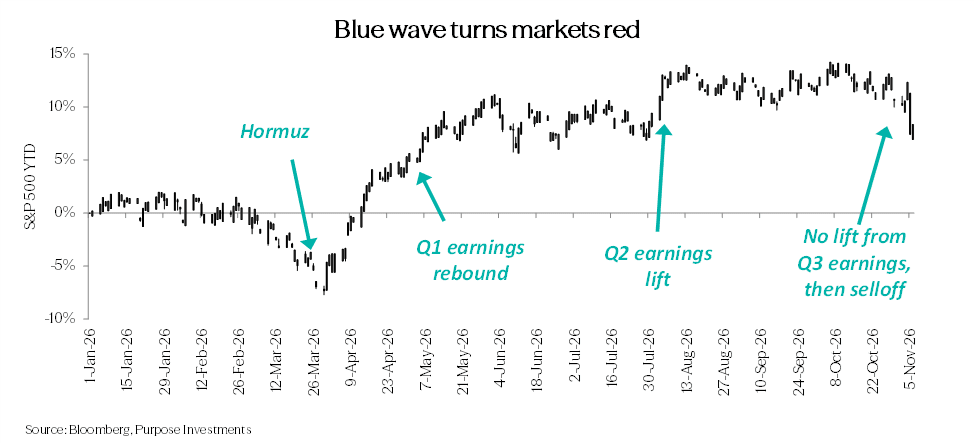
This market was fragile before the election results. The AI enthusiasm in the market peaked in June and had been struggling since. Q3 earnings season did not help with some major AI companies failing to exceed elevated expectations. The election was just a cup of kerosene thrown on a smoldering fire. This led to a rapid deleveraging trade last Thursday.
It is no secret there is a lot of leverage in this market, whether straight up margin accounts, hedge fund leveraged bets or innovative products that allow investors to more easily apply leverage. A popular trade, and when we say popular, we mean crowded, has been long AI and short defensives such as health care or consumer staples. Some of this trade was likely unwinding over the past month, as AI stocks oscillated a bit and defensives flew higher. Well, that unwind went into ludicrous speed last week. Markets also appear to have tripped into CTA sell zones, that fed more selling and deleveraging.
When systematic selling floods the market, prices overreact. Thursday pushed the S&P 500 down about 6% from its high from October 6. More interesting is the tech dominated Nasdaq being off 12% from its high. With the economy in very good shape, this has us in the camp of this is likely a V-shaped correction and not anything more nefarious. The tougher question is whether it’s a small v or a BIG V. We don’t know the answer to this one, as it will only be known well after the fact. But this kind of exogenous shock, the election results, and systematic selling certainly looks like an opportunity.
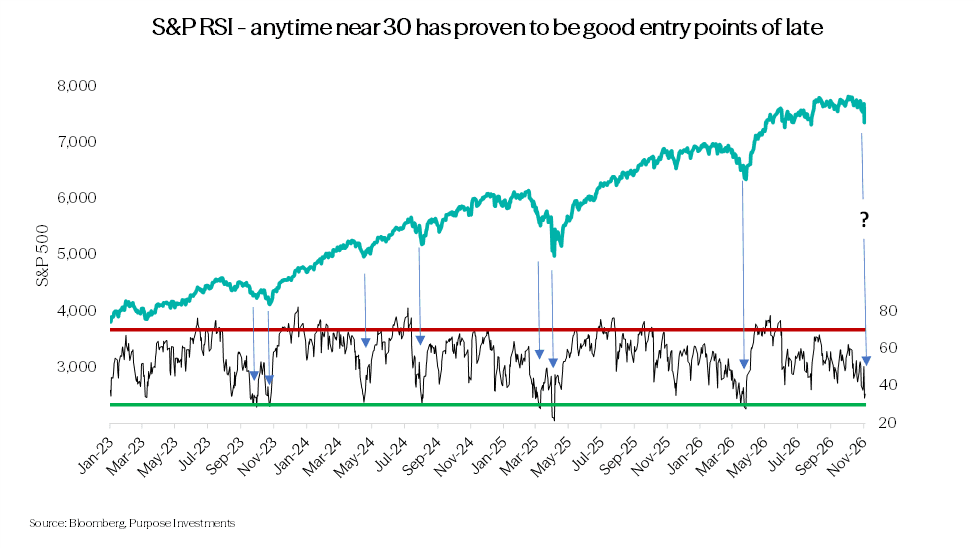
First off, from a technical perspective things already look oversold. During the past few years, most times the S&P 500 RSI touched or neared 30, they proved to be good entry points.
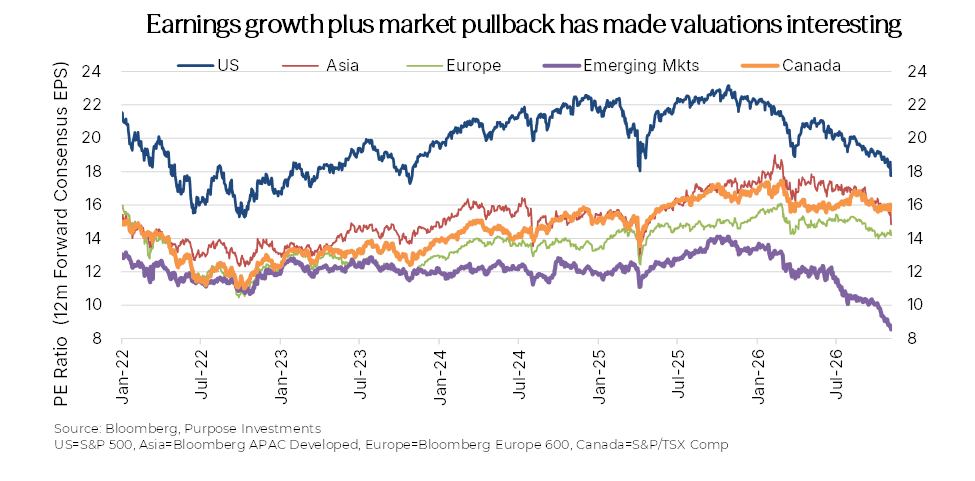
And we would add valuations have become rather compelling. We typically don’t compare one index to another from a valuation perspective mainly because different index compositions often have different valuation dynamics. But emerging market valuations look really cheap. And the S&P 500 at 18 or 19x is also compelling as these levels have marked valuation troughs a number of times over the past few years.
Final Thoughts
Obviously, this could become a bigger V but the pullback, systematic selling pressure and valuations certainly are encouraging. One benefit is our starting point. Thanks to the tool we developed to measure portfolio AI exposure, we are keenly aware that our portfolios have less AI exposure compared to the broader market and many peers. This does make being opportunistic during periods of weakness much easier given our starting point. And if you are unsure or would like a deeper look at your portfolio’s AI exposure, just reach out to any member of the team and we can provide a similar analytical report. It has become a rather popular service we provide.
Finally, I’m an economist which typically has our team putting more emphasis on the economy and earnings relative to politics as it pertains to markets and portfolio construction. Political shifts do matter, even a bit more so in the era of Trump, but it has been our experience the market more often overreacts to politics. We think that is happening today.
— Craig Basinger at Purpose Investments.
Get the latest market insights in your inbox every week.
Sources: Charts are sourced to Bloomberg L.P. as of 6 November 2026, unless specified otherwise.
The content of this document is for informational purposes only and is not being provided in the context of an offering of any securities described herein, nor is it a recommendation or solicitation to buy, hold or sell any security. The information is not investment advice, nor is it tailored to the needs or circumstances of any investor. Information contained in this document is not, and under no circumstances is it to be construed as, an offering memorandum, prospectus, advertisement or public offering of securities. No securities commission or similar regulatory authority has reviewed this document, and any representation to the contrary is an offence. Information contained in this document is believed to be accurate and reliable; however, we cannot guarantee that it is complete or current at all times. The information provided is subject to change without notice.
Commissions, trailing commissions, management fees and expenses all may be associated with investment funds. Please read the prospectus before investing. If the securities are purchased or sold on a stock exchange, you may pay more or receive less than the current net asset value. Investment funds are not guaranteed; their values change frequently, and past performance may not be repeated.
Certain statements in this document are forward-looking. Forward-looking statements (“FLS”) are statements that are predictive in nature, depend on or refer to future events or conditions, or that include words such as “may,” “will,” “should,” “could,” “expect,” “anticipate,” “intend,” “plan,” “believe,” “estimate,” or other similar expressions. Statements that look forward in time or include anything other than historical information are subject to risks and uncertainties, and actual results, actions, or events could differ materially from those set forth in the FLS. FLS are not guarantees of future performance and are, by their nature, based on numerous assumptions. Although the FLS contained in this document are based upon what Purpose Investments and the portfolio manager believe to be reasonable assumptions, Purpose Investments and the portfolio manager cannot assure that actual results will be consistent with these FLS. The reader is cautioned to consider the FLS carefully and not to place undue reliance on them. Unless required by applicable law, it is not undertaken, and is specifically disclaimed, that there is any intention or obligation to update or revise FLS, whether as a result of new information, future events, or otherwise.


