
Last week, we took a break from talking about yields and look what happened, they just kept going higher with the U.S. 10-year Treasury yield peaking above 5.2%. Up 50 bps in a month, and this yield was below 4% as recently as February. One would think a run-up in yields like this would elicit equity market weakness, but not so (or yet) with the S&P sitting near its highs.
If runaway inflation, soft bond auctions, central bank faith, or fiscal concerns were the biggest factor in these higher yields, you would likely see equity market weakness. And while these are all likely contributors, this move higher in yields appears largely driven by an economy that is getting hot (aka growing quick). GDP is the standard measure of economic activity, but the official reporting data suffers from a long delay, being reported about 3 weeks after the quarter ended. To help the timeliness the Atlanta Fed created GDPNow, which updates the data as various pieces are reported throughout the quarter. It gives a timelier indication of economic activity.
GDPNow is flying high and you can see in the following charts the big contributors. Consumer spending has been moving higher, mainly on services. Fixed Investment (orange) is pretty big and that is all non-residential business investment as residential is a minor negative. Non-residential is where data center spend sits. And then there is inventories, which are a positive contribution.
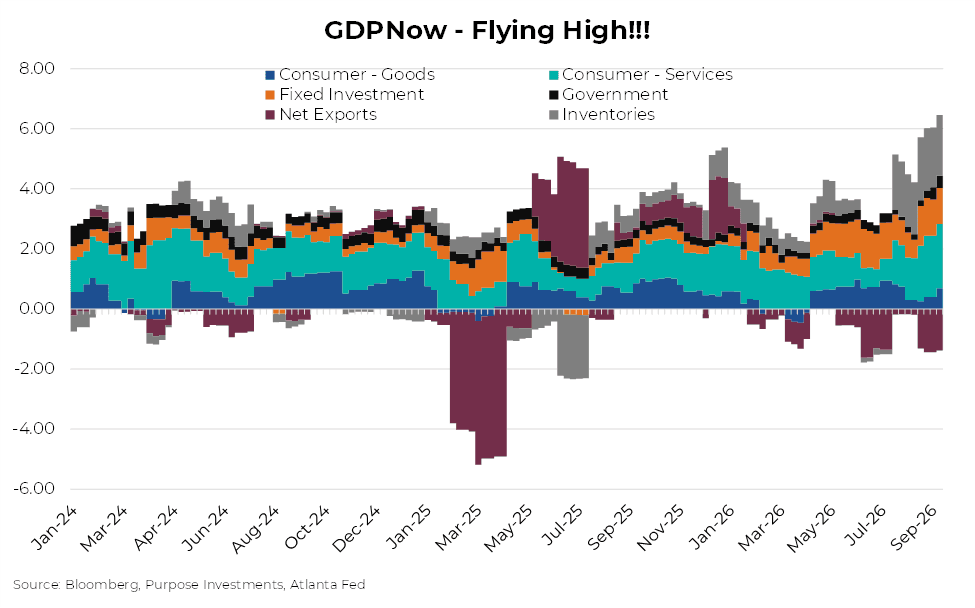
What are inventories in GDP data? GDP (Gross Domestic Product) is a measure of a country’s production but many of the input data feeds are based on final sales. So, if a country produces more than it sells, inventories rise and are added to GDP. This can be good news as companies are producing more as they expecting rising demand. Or it could be bad if inventories are accumulating as demand is softening and production hasn’t adjusted. With strong demand, it is likely the former. Now back to Ethos.
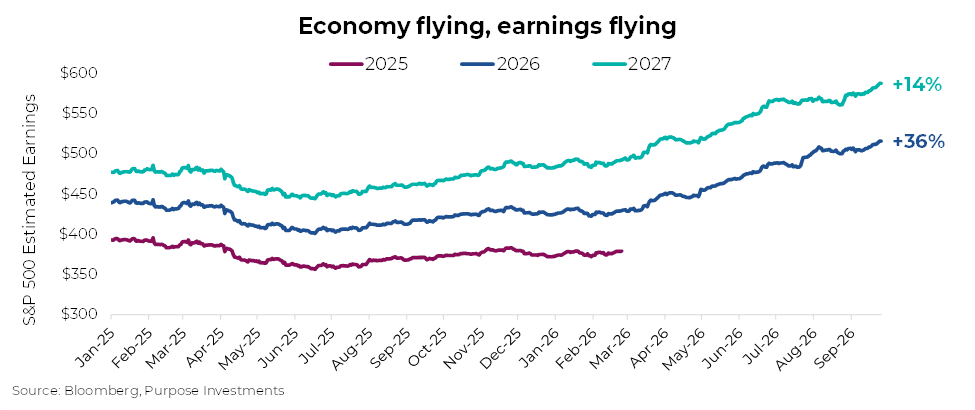
Bond yields higher on strong economic data is not a bad thing. Because that stronger economic activity is certainly helping earnings growth. A big factor in the equity markets resilience to higher yields, higher oil prices, higher geopolitical uncertainty has been the rising earnings. With two earnings seasons complete and two to go for 2026, earnings look to be rising an astonishing +36%. That kind of earnings growth buys the market a lot of resilience. And with Q3 earnings season starting in a few weeks, we believe another good one is likely given steady trends to last quarter.
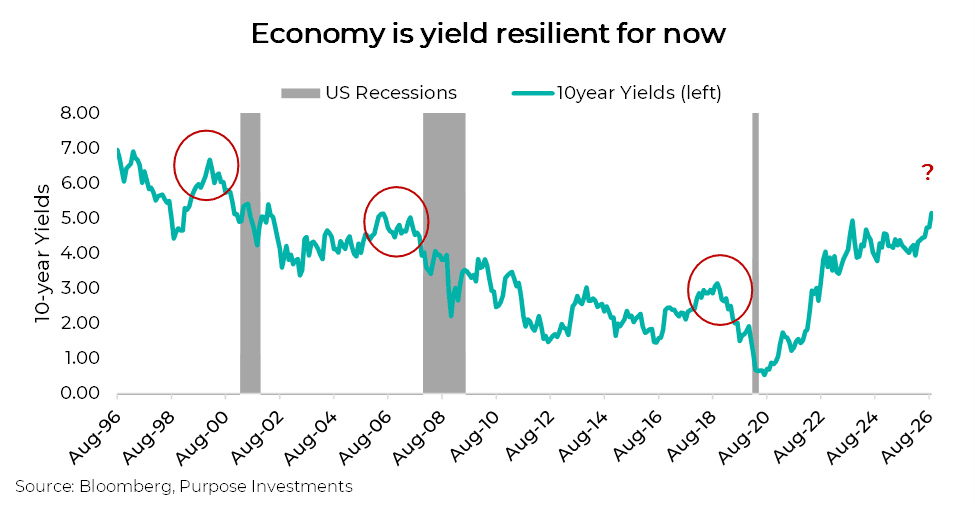
Make no mistake, these higher yields are having an impact. This is roughly where yields topped out in 2007 before the housing deceleration led to the great financial crisis of 2008. Higher yields are having an impact on the more interest sensitive parts of the economy, namely housing. But since manufacturing and the AI buildout is a big driver of economic activity, this spending is not as interest rate sensitive. While not an apples-to-apples comparison, the economy during the dotcom buildout was also not very interest rate sensitive and continued despite much higher yields. Yields are a drag, but the economy continues to prove resilient thanks to its composition.
On the downside, these higher yields have resulted in a rising bond/equity correlation. This has made diversification harder to come by for portfolio with those two core building blocks. And while there is a clear hate-on for bonds these days due to rising yields (lower price), let’s not forget the foundation of bond/equity diversification. It goes something like this: when the economy is slowing down, earnings growth falls and optimism around equities falls as recession risk rises. At the same time yields fall as slowing economy typically results in less inflation pressure so bond prices move up, providing diversification to the suffering equities. Today is the opposite, economic growth is accelerating, rising inflation expectations and rising earnings growth. This is good for equities and not good for bond prices. Hate them if you want but they are kind of doing what they are supposed to.
While bond / equity correlations are elevated, making diversification a bit harder to find, we have some good news. The correlation between individual stocks is historically low, also known as high dispersion. Sometimes the equity market, in this case S&P 500, moves as one. Other times there is a wide dispersion of performance among index members. That is the case today, which does make finding diversification within the index much easier to find.
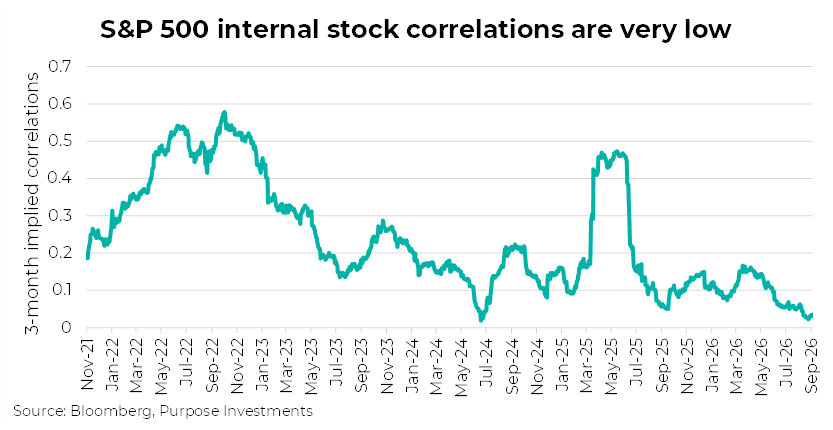
We are not naïve, we are well aware that if the market goes for a tumble, this internal stock correlation will spike as everything goes down. Nonetheless, there is diversification among equities. The S&P 500 is top heavy and highly concentrated; it is divergence among those names that is helping lower correlations within the index.
Final Thoughts
Yields are up and markets don’t seem to be bothered, mainly because this yield move is being driven by the good news story of stronger economic growth. This will have its limits of course, if yields go too far the negatives will overwhelm the good news. There is probably a line in the sand for yields, so far, we haven’t crossed it. And for the economy, it is getting hot in herre.
— Craig Basinger at Purpose Investments.
Get the latest market insights in your inbox every week.
Sources: Charts are sourced to Bloomberg L.P., as of September 25.
The content of this document is for informational purposes only and is not being provided in the context of an offering of any securities described herein, nor is it a recommendation or solicitation to buy, hold or sell any security. The information is not investment advice, nor is it tailored to the needs or circumstances of any investor. Information contained in this document is not, and under no circumstances is it to be construed as, an offering memorandum, prospectus, advertisement or public offering of securities. No securities commission or similar regulatory authority has reviewed this document, and any representation to the contrary is an offence. Information contained in this document is believed to be accurate and reliable; however, we cannot guarantee that it is complete or current at all times. The information provided is subject to change without notice.
Commissions, trailing commissions, management fees and expenses all may be associated with investment funds. Please read the prospectus before investing. If the securities are purchased or sold on a stock exchange, you may pay more or receive less than the current net asset value. Investment funds are not guaranteed; their values change frequently, and past performance may not be repeated.
Certain statements in this document are forward-looking. Forward-looking statements (“FLS”) are statements that are predictive in nature, depend on or refer to future events or conditions, or that include words such as “may,” “will,” “should,” “could,” “expect,” “anticipate,” “intend,” “plan,” “believe,” “estimate,” or other similar expressions. Statements that look forward in time or include anything other than historical information are subject to risks and uncertainties, and actual results, actions, or events could differ materially from those set forth in the FLS. FLS are not guarantees of future performance and are, by their nature, based on numerous assumptions. Although the FLS contained in this document are based upon what Purpose Investments and the portfolio manager believe to be reasonable assumptions, Purpose Investments and the portfolio manager cannot assure that actual results will be consistent with these FLS. The reader is cautioned to consider the FLS carefully and not to place undue reliance on them. Unless required by applicable law, it is not undertaken, and is specifically disclaimed, that there is any intention or obligation to update or revise FLS, whether as a result of new information, future events, or otherwise.


