
Income is one of the most sought-after features in portfolios today. In our portfolio reviews with advisors, one common question comes up: “How do we add more income?” It’s an understandable focus, especially when a large portion of their client base is seeking income in retirement.
Rising popularity - Over the past few years, covered call strategies, particularly within sector ETFs in Canada, have seen a steady rise in popularity. What was not long ago more of a niche strategy has become a fairly common allocation across portfolios for enhancing income. The chart below encapsulates some of this growth; both product launches and assets under management have picked up meaningfully, with more than half of the launches in the space occurring in the post-Covid era.
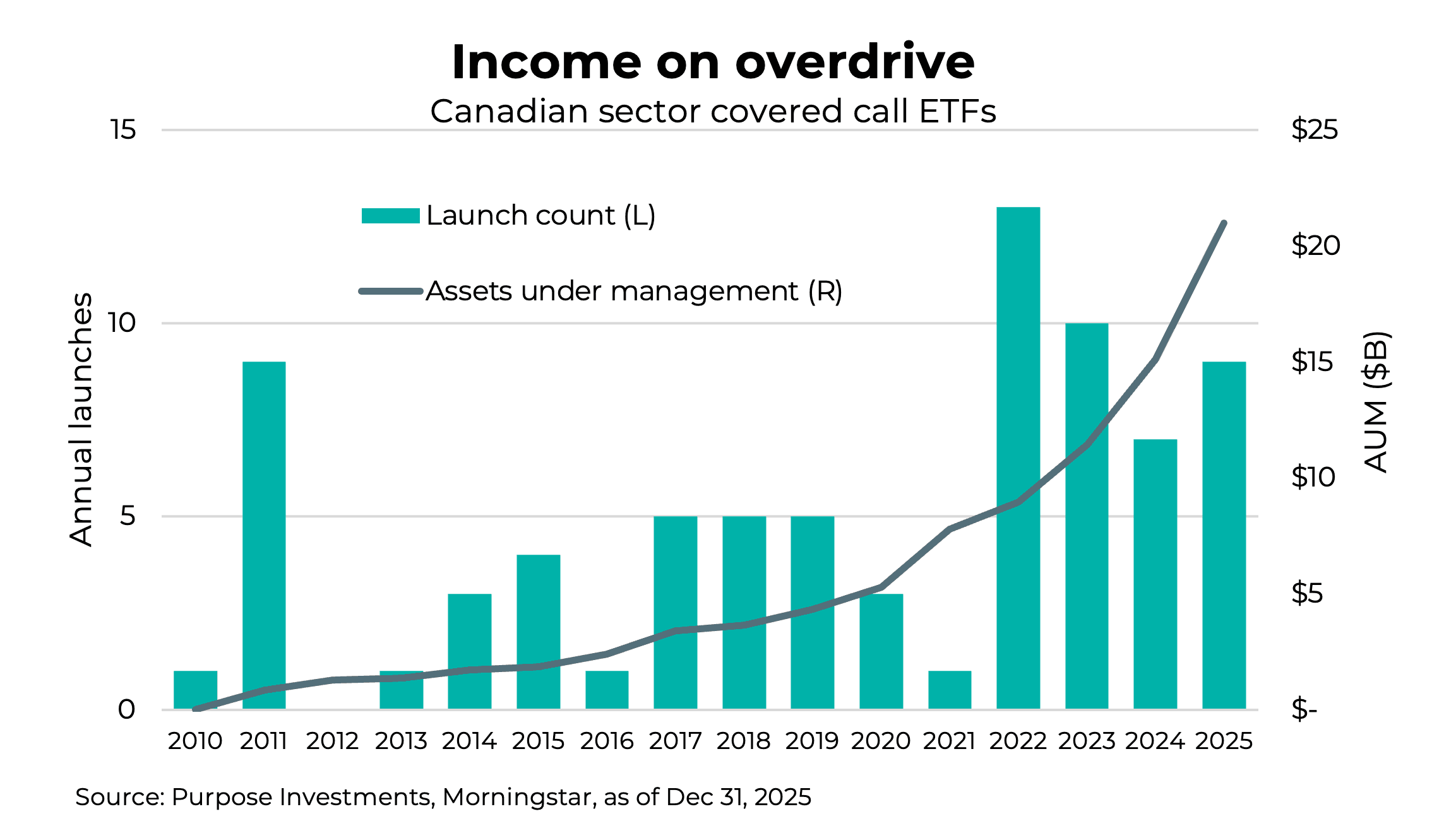
While covered call strategies also exist across broad indices and, more recently, single stocks, what we tend to see the most of in portfolio reviews are sector-based implementations such as banks, energy, and utilities paired with that option income overlay. As you can see, that segment of the market has grown considerably on an absolute basis.
But even if you extend that to relative terms, in Canada, the sector covered call space is roughly half the size of multi-asset ETFs, a similar size to alternative ETFs, and double the size of real asset ETFs. In total, it accounts for about 7.5% of the Canadian and U.S. Equity ETF category in Canada. At this point, it’s no longer a niche allocation, but a serious consideration for many investors in their portfolios.
That growth is not any sort of accident or coincidence. Higher interest rates have certainly increased competition amongst income solutions for portfolios. But much of the desire for income is due to investor demand. A large portion of capital in Canada sits with retirees or near-retirees, where naturally the focus shifts toward generating consistent cash flow. A steady yield can feel more reliable, even if the underlying is still exposed to equity markets.
At a high level, covered call strategies generate income by selling call options on the underlying holdings. In short, you are giving up some portion of the upside in exchange for receiving option premiums, which is flipped into income.
That’s the part we're not sure every investor understands when they make an allocation. These strategies tend to work best in a sideways market, or one that is gradually moving higher, where you can still enjoy that income and the foregone upside is less noticeable. Can anyone still remember a range-bound market? It’s been a bit since we’ve had one. Things can start to look different during strong bull markets, when that trade-off starts to become more glaring.
Performance - Not every sector in Canada has a covered call counterpart, but looking across the ones that do, the pattern is consistent. Over longer periods, in this case 10 years, the pure equity exposure has generally outperformed the covered call version. In some sectors, the gap is modest, while in others, it’s much more meaningful, but outperformance is outperformance.
That outcome isn’t meant to suggest that the strategy is flawed; it’s simply a reflection of how it’s built. The upside is being exchanged for income, which is perhaps not a one-to-one exchange, given the long-term total return relative performance.
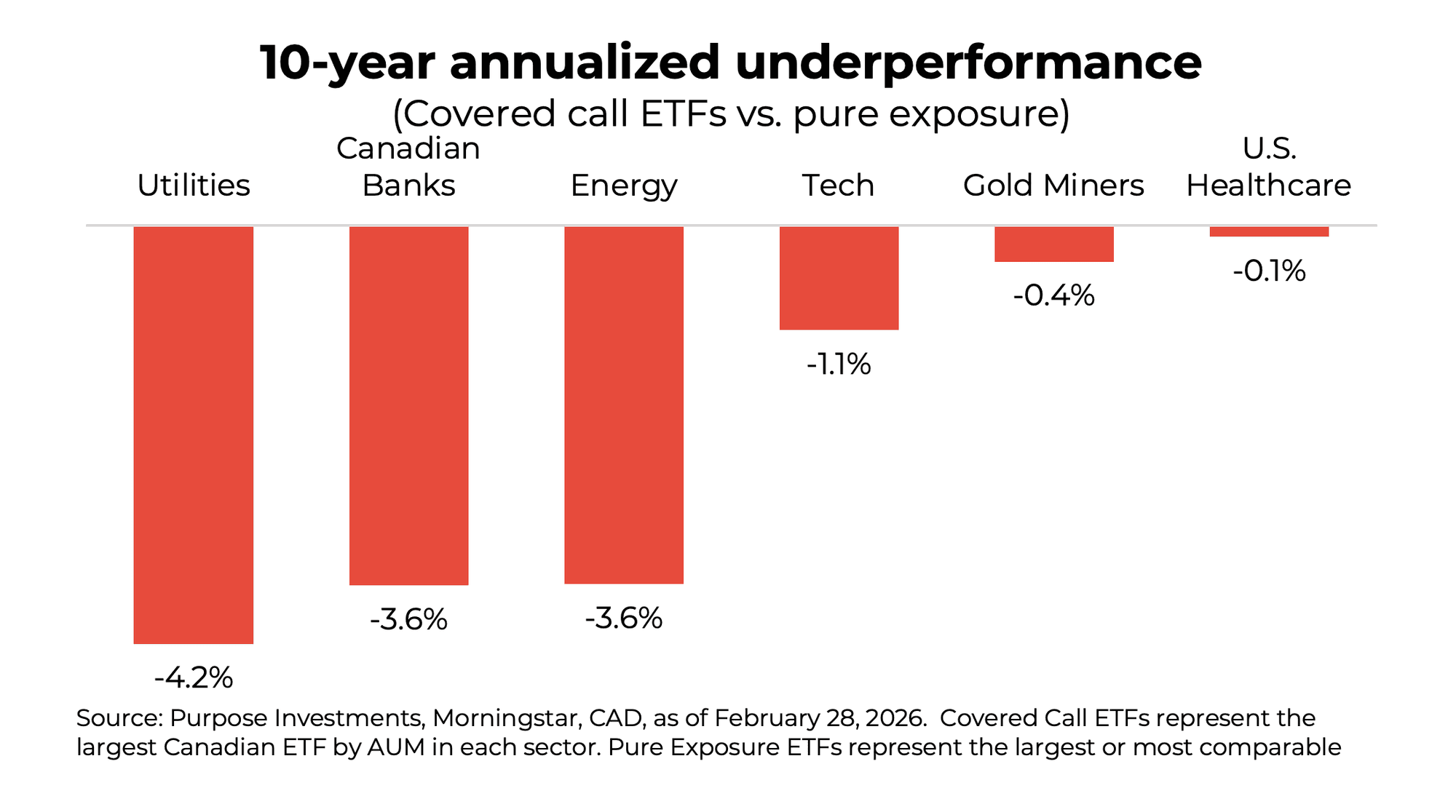
There are a couple of important considerations when interpreting this underperformance. First, it’s certainly endpoint-biased. As I said, the strategies will lag in a strong bull market, and the last 10 years could definitely be considered just that. Whether the next decade will look the same or not is up to the investor, but the environment in which the comparison is shown does matter.
Second, the covered call ETFs were chosen by selecting the largest Canadian ETF by assets under management in each sector, while the pure exposure ETFs represent the largest or most comparable ETF within the relevant category. In cases where the largest ETF was not a clean comparison, we moved down the spectrum to a more appropriate match, with a focus on maintaining a 10-year track record and avoiding currency differences.
The peers are not meant to be exact one-to-one matches at the security level. The more important takeaway is that if you had a positive view on a given sector, owning a plain vanilla version of that exposure would have generally resulted in stronger total returns over the last 10 years.
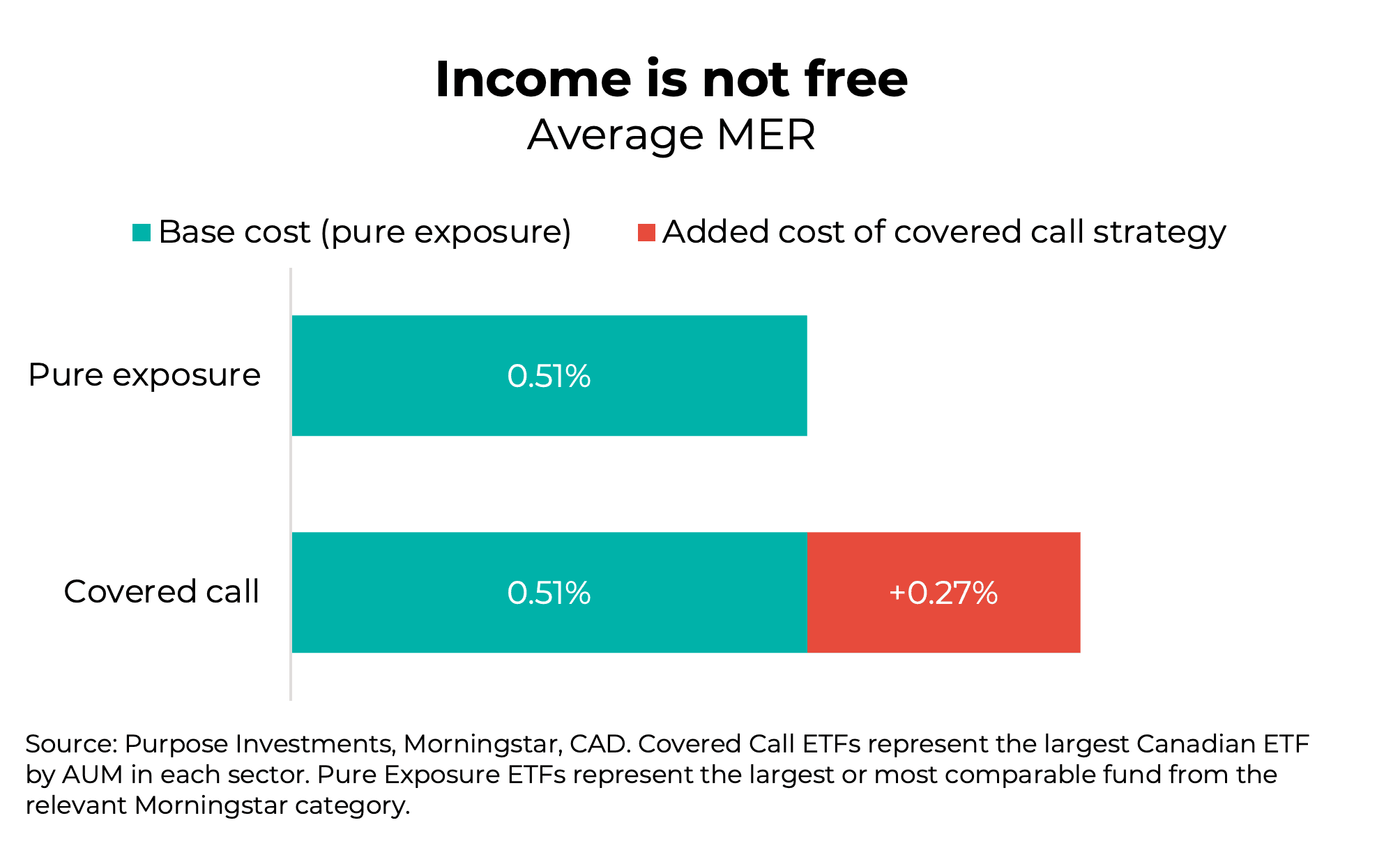
Don’t forget that there’s a cost component to this decision as well. Covered call ETFs tend to have higher fees than their pure exposure equivalents. As shown below, the covered call overlay is not free.
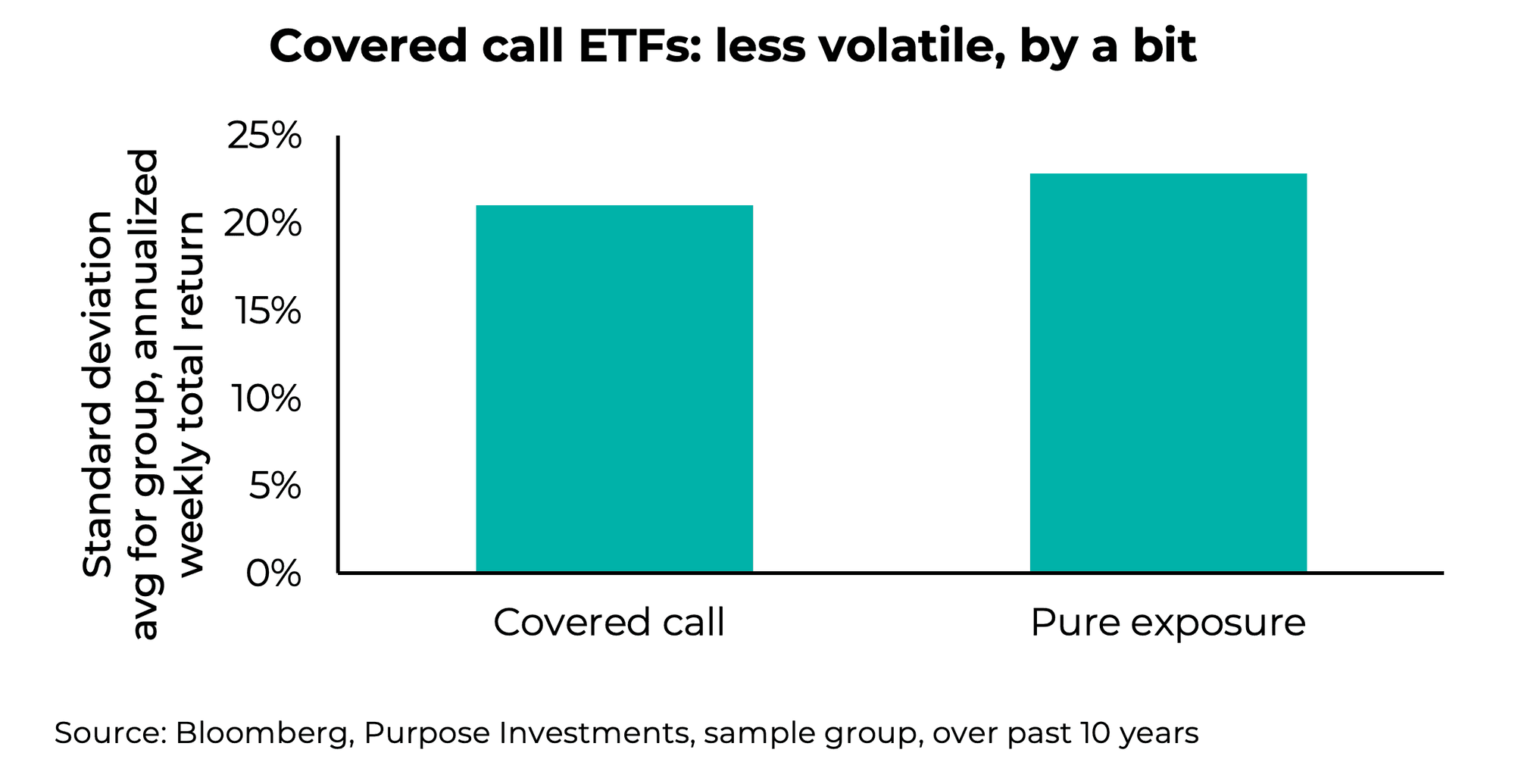
Risk – It’s generally true that the covered call overlay strategies do tend to have lower volatility. In our narrow sample set, the standard deviation of weekly total returns for the covered call strategies was about 8% less than the raw equity sector equivalent strategy. BUT, the largest reductions in risk or volatility were in the Energy, Banks and Utilities pairings.
Why the all caps, you may be wondering? Well, these are also the same pairings where the relative underperformance was the highest. Lower performance often mathematically translates into being less volatile.
Options or derivatives, by their nature, alter the performance characteristics of the asset they’re based on. You can magnify or suppress the return, alter the return/income ratio, or limit or increase upside or downside. Now, some are incorporating a leverage component. But in all these combinations and permutations, there isn’t a free lunch.
Put all of that together, and that’s where the illusion element comes into play. The portfolio is clipping income, sure, but when you step back and look at longer-term outcomes, that income has generally come alongside lesser total returns. If investors are aware of that and comfortable with it, that’s a different story, but we believe most aren’t.
In Canada, arguably more so than other countries, investors really love yield and never want to touch the principal. This certainly feeds the yield hunger in the marketplace. The fact is, you can simply sell a percentage of any liquid investment annually to create any yield that you like.
Final Thoughts
None of this is to say covered call strategies don’t have a place in portfolios. They do offer a hands-free solution to enhance yield, which is often tax-friendly. For investors who require or desire yield from all parts of their portfolio, these strategies can help improve diversification by including some exposure to non-yielding parts of the market.
The key is being clear on what role they play and what you’re giving up in return. They can complement an equity portfolio, but replacing a larger portion of equity exposure with them will change how the portfolio behaves over time. Everything is a trade-off; make sure you know what you’re giving up for what you’re getting.
— Brett Gustafson is an Associate Portfolio Manager at Purpose Investments
— Craig Basinger is Chief Market Strategist at Purpose Investments
Sources: Charts are sourced to Bloomberg L.P.
The content of this document is for informational purposes only, and is not being provided in the context of an offering of any securities described herein, nor is it a recommendation or solicitation to buy, hold, or sell any security. The information is not investment advice, nor is it tailored to the needs or circumstances of any investor. Information contained in this document is not, and under no circumstances is it to be construed as, an offering memorandum, prospectus, advertisement or public offering of securities. No securities commission or similar regulatory authority has reviewed this document and any representation to the contrary is an offence. Information contained in this document is believed to be accurate and reliable, however, we cannot guarantee that it is complete or current at all times. The information provided is subject to change without notice.
Commissions, trailing commissions, management fees, and expenses all may be associated with investment funds. Please read the prospectus before investing. If the securities are purchased or sold on a stock exchange, you may pay more or receive less than the current net asset value. Investment funds are not guaranteed, their values change frequently and past performance may not be repeated. Certain statements in this document are forward-looking. Forward-looking statements ("FLS") are statements that are predictive in nature, depend on or refer to future events or conditions, or that include words such as "may," "will," "should," "could," "expect," "anticipate," intend," "plan," "believe," "estimate" or other similar expressions. Statements that look forward in time or include anything other than historical information are subject to risks and uncertainties, and actual results, actions or events could differ materially from those set forth in the FLS. FLS are not guarantees of future performance and are by their nature based on numerous assumptions. Although the FLS contained in this document are based upon what Purpose Investments and the portfolio manager believe to be reasonable assumptions, Purpose Investments and the portfolio manager cannot assure that actual results will be consistent with these FLS. The reader is cautioned to consider the FLS carefully and not to place undue reliance on the FLS. Unless required by applicable law, it is not undertaken, and specifically disclaimed, that there is any intention or obligation to update or revise FLS, whether as a result of new information, future events or otherwise.