
One leftover mining card, a second card, and two questions an investor can test at home: what can private AI do for a firm today, and when it runs out of road, what exactly runs out?
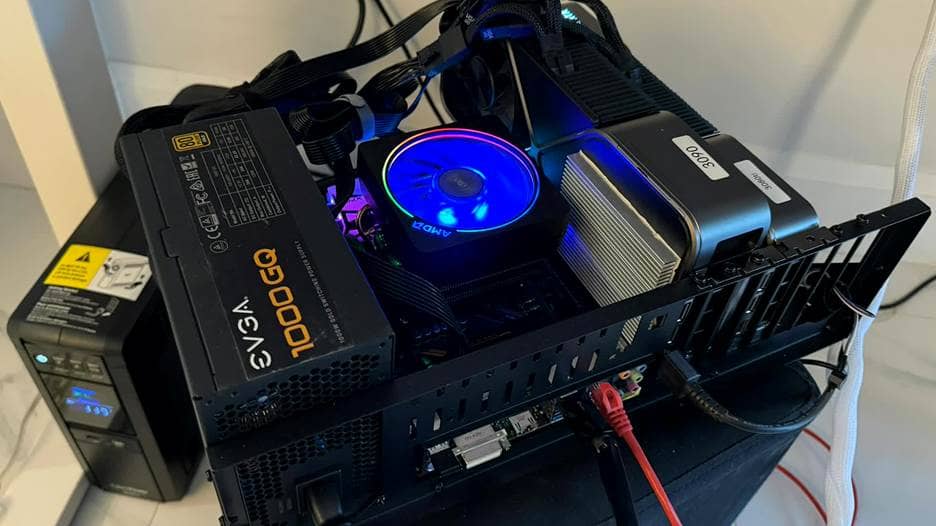
Somewhere in most households that went through the 2021 crypto boom there is a graphics card in a drawer: the part of a gaming PC that draws the pictures, which turned out to be good at mining Ethereum too. Mine is a 2020 RTX 3090 that mined until the network stopped needing it in 2022. A few weekends ago, I put it back to work as a local AI server, a computer at home that runs AI models on its own, with a second card added to test whether two cards share the work the way they did in a mining rig.
The reason was professional. I follow the AI trade from the equity side, and most of what I know about the buildout arrives second-hand: spending plans, factory allocations, price series. A machine I own is a way to test two questions directly. What can private AI, the kind you download and run on your own hardware, do for a firm today? And when it runs out of road, what exactly runs out? The week sharpened both: OpenAI shipped GPT-6 Astra on September 3 with its most advanced cyber capabilities limited at launch, and nine days later Anthropic's Dario Amodei asked the industry to "pace the frontier," with Sam Altman and Elon Musk agreeing. If the best models become more gated, what a firm can run itself is a live question.
This is the third piece in a series, following pieces on having an agent joining the desk and context mattering more than the model. This one is about the hardware underneath both.
What Private AI Can Do
The old card runs a mid-sized downloadable model that writes faster than I can read and can hold about 300 pages in view at once; it reads a PDF, writes code and looks things up. For summarizing a filing or drafting code it gets most of the way to what a frontier subscription gives, and the document never leaves the building.
More useful than any one model is the menu: a careful one for code, a fast one for bulk reading, one that holds long documents, a small one that answers instantly, all reachable at one address on the home network, the way one printer serves every laptop in the house. Beyond those, the small models that others have trained further on financial text are instructive: in published benchmarks, models a fraction of GPT-4's size match it at reading sentiment and sorting headlines, while trailing on hard reasoning. An analyst does not need a model that knows physiology; it needs one that knows filings, footnotes and the house style, and the value is a small model made sharp on those tasks, on your premises. That is my next experiment, and my sense is that many firms may want a version of it beside a frontier subscription for the hardest questions.
For an investor the point is structural. The models themselves are becoming a commodity from below, free to download and good enough for most of the work; what stays scarce is the memory and hardware underneath them and the private context and judgment above them. The rule wrote itself within a week: local for anything private or bulk, frontier for judgment. AI is scale, not edge, and the judgment stays with the person.
The second card taught the first hardware lesson. A mining rig scaled sideways: ten cards did ten times the work, because each card could work alone. A language model writes one word at a time and needs the whole model for every word, so two cards take turns rather than sharing; a second card adds room, not speed. This workload wants one large pool of fast memory, which is the one thing a consumer cannot buy.
Where it Stops, Three Times
A computer keeps things in three places: the graphics card's own memory, the machine's main memory, and the drive. On a home machine the road ends at each of them in turn. Not at the processor. At memory.
The card's memory first. A model is, underneath, a very long list of numbers it learned in training, called parameters, and the whole list has to sit in the card's memory while it runs. The model on my card has 27 billion of them: 54 GB at full precision, more than twice the 24 GB the card has; rounded to a quarter of the precision, which costs surprisingly little quality, about 14 GB, and it fits, with the room left over as working memory for whatever it is reading. A frontier model has a trillion or more, half a terabyte at the same rounding before it reads a page: about twenty of these cards, or a rack of AI accelerators with high-bandwidth memory (HBM), memory chips stacked right against the processor, which no consumer product ships. The gap to the frontier is memory, and the kind of memory.
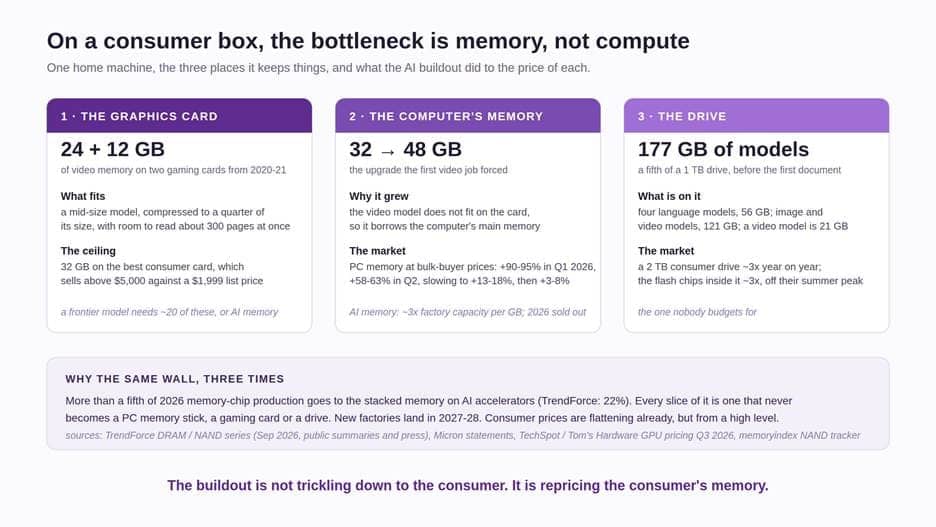
The machine's main memory second. The video model does not fit on the card, so it borrows the computer's main memory; the first video job overflowed the 32 GB the machine had and spilled onto the drive, and it now has 48 GB. The upgrade met the market: PC memory costs more than twice what it did a year ago at the prices bulk buyers pay, and the reason sits in the factories. Micron has said the stacked memory an AI accelerator uses takes about three times the factory capacity of ordinary PC memory for the same gigabytes, and sells at a multiple, so more than a fifth of this year's memory-chip production goes to AI accelerators instead of PCs. Micron's entire 2026 supply of it was spoken for by December; new factories land in 2027 and 2028.
The drive third, the one nobody budgets for. Models are enormous files, 177 GB on this machine before the first document is saved, and a 2 TB consumer drive costs about three times what it did a year ago because the flash chips inside every drive roughly tripled in price. The "AI PC" needs three kinds of memory the buildout has been pricing up, not down.
What It Says About The Trade
The popular story is trickle-down: the cloud giants buy the chips, the technology matures, cheaper hardware reaches the rest of us. Next to the machine, the flow runs the other way. The buildout is not trickling down to the consumer. It is repricing the consumer's memory: gaming cards 20 to 150 percent above list, memory doubled, drives tripled.
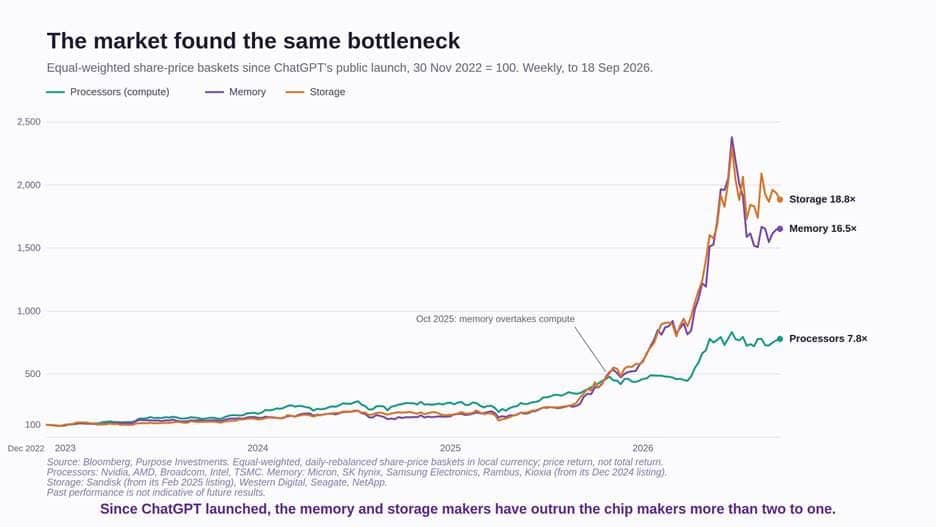
The market found the same bottleneck. Craig Basinger, our Chief Market Strategist, ran the three groups as share-price baskets since ChatGPT's public launch (Figure 2). For two and a half years the memory and storage makers trailed the processor names that carry the AI headlines; last autumn, as memory prices began to climb, both baskets broke away, memory passing the processors for good in late October, and this spring both went vertical, memory nearly tripling in a quarter. By mid-September storage was up about nineteen-fold, memory sixteen-fold, processors eight-fold. Two things matter more than the multiples. The scarcity I measured at a desk is already in the price. And all three baskets peaked in the same June week; memory has given back a third since, the same months the quarterly rise in bulk-buyer prices slowed from about 60 percent to the teens.
Memory is not the only bottleneck. At the data-centre campus it is power: projects waiting for a grid connection add up to hundreds of gigawatts, and gas turbines are sold out into 2029 and 2030. At the chip it is the assembly of processor and memory into one package and, this month by most accounts, the stacked memory itself: a chip Nvidia announced with cheaper graphics-card memory to sidestep the shortage has reportedly come back with the stacked kind after all. Which one binds depends on where you stand; memory is the one that runs all the way from the accelerator to my desk.
For the AI complex, I read that as a floor of sorts, under a specific thing. With the stacked memory sold through the year and no new capacity before 2027, that is, to me, a floor under demand for the accelerator and the memory bolted to it, not under memory as a whole, and Figure 2 says the market has paid for a good deal of it already; if the labs mean what they said on September 12, the race that fills those factories slows with them. The consumer end is already flattening, and the memory makers still earn much of their revenue there: the 2018 pattern, the year before memory prices roughly halved. While consumer memory stays scarce, private AI stays a privacy-and-bulk tool and the frontier stays a subscription. A structure, not a forecast.
The frontier is a subscription away. The floor under the frontier, it turns out, is memory.
P.S. The Box Did More Than Benchmarks
Craig Basinger, our Chief Market Strategist, generously lent his likeness to a stress test of the video model: a short that opens as 1960s Mad Men and ends as a Michael Bay action sequence, two ad men walking out of an explosion without spilling a drop of whisky. An afternoon, one 24 GB card, and unmistakably AI slop, which I mean as a compliment to the card. What it does well is not yet what it does usefully. Craig approves. The memory budget does not.

The short itself, the four-shot cut the P.S. describes: 18 seconds, AI-generated label burned in.
This article is for information purposes only and does not constitute investment advice, a recommendation, or an offer or solicitation to buy or sell any security. It reflects the author's personal views and describes a personal project on personally owned hardware; it does not describe the current investment process of any Purpose fund, and investment decisions for all Purpose funds are made by their portfolio managers. Third-party companies, products and data sources are mentioned for illustration only; no endorsement is implied and the author has received no compensation from any company named. Price and supply figures are as of September 2026 from publicly available industry sources and may change. Certain statements are forward-looking; actual results may differ. The video and still image referenced are AI-generated and shared with the consent of the individuals depicted.