
Part 2: From Daily Habit to Operating System
In Part 1, we made the case that while 63% of advisors are "using AI," most are stuck at the chat box. We walked through the first two stages of practice maturity: ad-hoc adoption (the Dabbler) and proving value (the Regular). Maybe you've picked a core assistant, written your two rules, and started a couple of measured pilots. If so, congratulations, you are already ahead of many.
Now for the part where it gets interesting. Stages three and four are where AI stops being a personal productivity trick and starts being how the practice runs. This is also where the gap between practices starts to compound. If you recall from Part 1, adoption at larger practices is currently higher. That gap isn't about intelligence or budgets anymore; it is about whether anyone in the practice has done the unglamorous work of mapping workflows. That is the subject of this piece.
Stage Three: The Integrator
The thinking shift from stage two to stage three is subtle but important. A Dabbler asks, "Can AI write this email?" An Integrator asks, "What are steps between 'Booked Client Meeting’ and 'CRM updated, recap sent, tasks assigned'. Then decides which of those steps still need a human?" The analysis changes from the task to the workflow.
A blueprint you can apply for this is a five-stage process:
1. Prioritize → 2. Map → 3. Match → 4. Pilot → 5. Scale
It is not complicated. It is just work. Here's an example, using the workflow that eats more advisor time than most others: client meeting prep and follow-up.
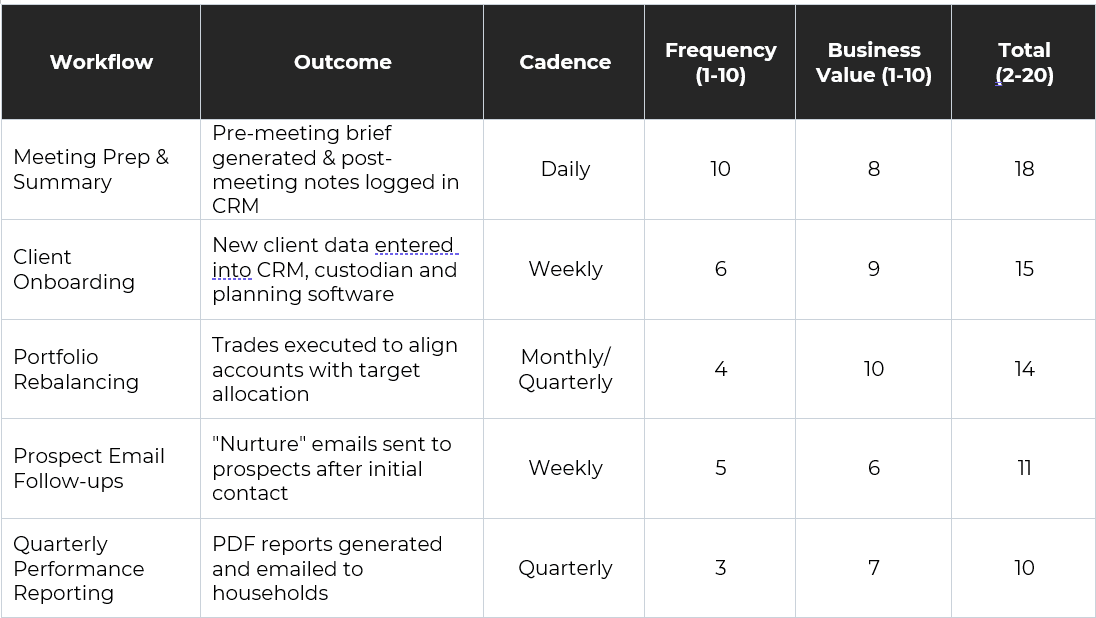
- Prioritize. Inventory the recurring operations of your practice and score each on two dimensions, 1–10: frequency and business value. Meeting prep and summary happens daily and touches every client, call it a 10 on frequency, 8 on value = 18 out of 20. Client onboarding: weekly, high value, 15. Quarterly performance reporting: 3 on frequency, 7 on value, 10. Rank the list, start at the top. It’s important to resist the temptation to start with whatever annoyed you most recently.
Fig 1: Practice Workflow Scoring Grid
Tasks and Data for Illustrative Purposes Only
- Map. Break the winning workflow into its actual subtasks, and record the following: the deliverable, the data it needs, who owns it, and an honest hours per week it consumes. The example exercise here is broken into seven steps, define the meeting goal and agenda, build a client snapshot, pull portfolio and plan highlights, prep materials and talking points, run the internal huddle, capture decisions and action items, send the recap and update the CRM. The estimate totals roughly 17 hours per week for a team.
- Match. Assign an AI capability to each step. Most steps in the meeting workflow map to your core AI platform, the meeting itself maps to an AI notetaker. The internal huddle maps to nothing, because some things stay human. Note the steps where current technology has no good answer, and remember that list likely shrinks every quarter, which is why you revisit it.
- Pilot. Share the plan with the team, agree on ownership, and this is key as almost everyone skips: build system prompts for each step. A system prompt is just a reusable, tested instruction: objective, inputs, guardrails, output format. For meeting prep: "Turn the inputs below into a meeting objective and time boxed agenda. Inputs: meeting type, duration, attendees, client segment, last meeting highlights from CRM, open items, what's changed. Guardrails: no PII, don't invent numbers or holdings, no product pitches. Format: goal in one sentence, 5–7 agenda bullets with time boxes, key questions for the client, prep checklist." Refine that until the output is right, then everyone on the team uses that same prompt. This is how a personal trick can become an institutional capability.
- Scale. Measure before and after, per step. In our example, the estimated 17-hour meeting workflow dropped to about ~9 hours with AI in the loop — a 44% saving, with the biggest wins in capturing decisions/action items and sending recaps (down 50–60%). Then take the playbook to the next workflow on your ranked list.
Fig 2: The Money Chart: One workflow, 44% of the time back
Hours per week on meeting prep and summary; by step, estimates only.
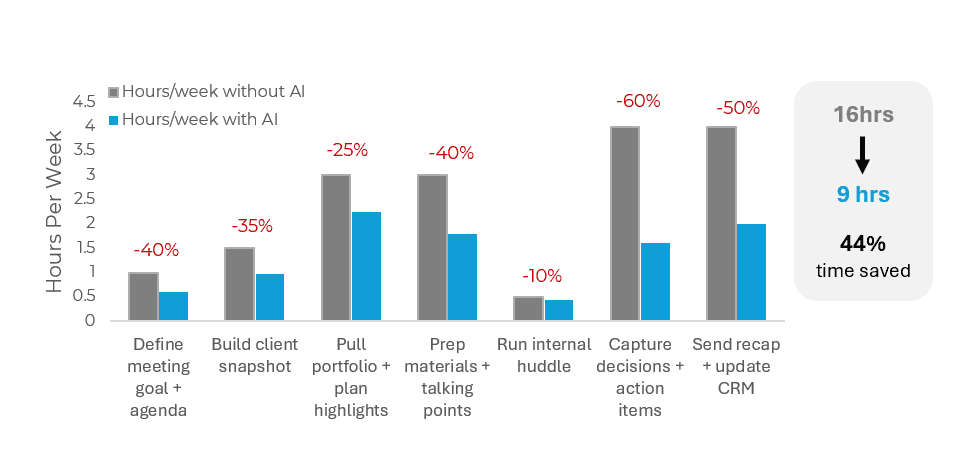
Run that estimated saving forward: 7-ish hours a week is roughly 350 hours a year, so call it nine working weeks you get back from one workflow. What's that worth? If you spend it on prospecting or deeper planning conversations, quite a lot. If you spend it on more meetings about meetings, likely nothing. AI can give you the hours back, it has no opinion on what you do with them.
Stage Four: The Transformer
Strategic transformation is where the practice starts making structural decisions around AI: hiring for AI skill sets (or making it part of the criteria in your next hire), prioritizing outcomes over activity in how you measure the team, and carefully, with compliance's blessing — introducing autonomous systems for tasks. Few practices are here today. That's fine. The point of a maturity model is to know where the road goes.
The strategic logic for why you'd bother comes down to one of our favourite economic frameworks: commoditization and complements. Technology relentlessly commoditizes whatever it does well. The price of routine, repetitive, codifiable work typically heads toward zero. But the complements to that work, meaning the things that must still be done by a person, become more valuable, not less. The figure below shows that when China joined the WTO in 2001, the price of TVs fell ~98% and software ~73%, while the price of the human stuff: hospitals, tuition, childcare — inflated 100–240%. The Same economy with opposite fates, sorted by one variable: could it be automated and shipped?
Fig 3: What Technology Commoditizes Gets Cheap; The Complements Get Dear
Inflation adjusted price changes since 2000; hypothetical advisor services with AI assistance
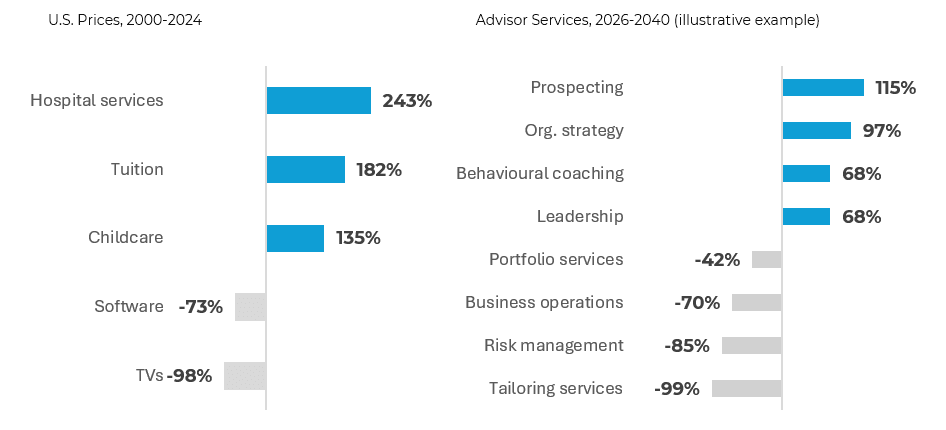
Apply this to an advisory practice and the strategy writes itself. What AI does best: routine, repetitive, data driven, codifiable tasks. Things like meeting notes, document summaries, first drafts, scenarios. What advisors do best: judgment, trust, behavioural coaching, prioritization, talking a client off the ledge in a drawdown, reading the room in a family meeting.
Embrace AI for the first list. Deliberately upskill yourself and your team in the second. As the MIT Sloan research puts it, the work AI is least likely to replace depends on "uniquely human capacities, such as empathy, judgement, ethics and hope." Nobody has yet built a chatbot clients want to cry in front of.
The Power-Users Honest Risk Register
Three cautions from the field, all of which get more important as you automate more:
- Skill atrophy is real. If members of your team never write a meeting summary, they may never learn to hear what matters in a meeting. Rotate the humans through the loop deliberately. AI should compress the work, not remove the learning.
- The jagged frontier doesn't flatten just because you're advanced. AI still stumbles on qualitative judgment. Things like assessing a management team, weighing a client's unspoken anxieties. The more polished the output, the more discipline it takes to keep editing it. The rule to "never distribute AI content directly" survives every maturity stage.
- Govern the fleet. By stage three you'll have some prompts, tools and integrations scattered across the team. Someone needs to own the inventory, the approvals and the data flows.
Your Stage Three-to-Four Checklist
- Map one workflow this month. Pick your highest frequency-times-value candidate, break it into subtasks, and put honest hours against each. The potential hours of savings is half the motivation.
- Build and share system prompts. One tested prompt per step, owned by the team, refined quarterly. Institutional memory beats individual heroics.
- Measure like you mean it. Hours before, hours after, per step. If a pilot doesn't save time, kill it without sentiment. Adoption should follow the evidence, not enthusiasm.
- Reinvest the hours purposely. Decide in advance where recovered time goes: prospecting, deeper planning, more client contact etc. and hold yourself to it.
Closing Thoughts
This technology has been doubling every five-ish months₁. Your practice's workflows change at the speed you choose. Advisors who win this cycle won't be the ones with the hottest AI takes in the quarterly commentary. They will likely be the ones who turned nine weeks of admin into nine weeks of client conversations and spent the saved time building the parts of the business AI can't touch. It can be a meticulous grind on the first go around, but the payoff and reward for getting it right are exceptional. And if you want some help framing it or thinking through the process we’d love to talk with you. And don't worry, if you do reach out, a human will answer.
— Spencer Morgan and Brett Gustafson at Purpose Investments.
₁ Task duration at which models succeed 50% of the time, by release date, METR.org, 2026
Date of Publication: September 3, 2026
The content of this document is intended for advisors for informational purposes only, and is not being provided in the context of an offering of any securities described herein, nor is it a recommendation or solicitation to buy, hold or sell any security. The information is not investment advice, nor is it tailored to the needs or circumstances of any investor. Information contained in this document is not, and under no circumstances is it to be construed as, an offering memorandum, prospectus, advertisement or public offering of securities. No securities commission or similar regulatory authority has reviewed this document and any representation to the contrary is an offence. Information contained in this document is believed to be accurate and reliable, however, we cannot guarantee that it is complete or current at all times. The information provided is subject to change without notice.
Certain statements on this site may be forward-looking. Forward-looking statements (“FLS”) are statements that are predictive in nature, depend on or refer to future events or conditions, or that include words such as “may,” “will,” “should,” “could,” “expect,” “anticipate,” intend,” “plan,” “believe,” “estimate” or other similar expressions. Statements that look forward in time or include anything other than historical information are subject to risks and uncertainties, and actual results, actions or events could differ materially from those set forth in the FLS. FLS are not guarantees of future performance and are by their nature based on numerous assumptions. Although the FLS contained in this document are based upon what Purpose believes to be reasonable assumptions, Purpose cannot assure that actual results will be consistent with these FLS. The reader is cautioned to consider the FLS carefully and not to place undue reliance on the FLS. Unless required by applicable law, it is not undertaken, and specifically disclaimed, that there is any intention or obligation to update or revise FLS, whether as a result of new information, future events or otherwise.