
April was the month that the stock market reinforced one key principle: we are still underbuilt.
You want proof? Look at the semiconductor index. From the March 30, 2026 low, the PHLX Semiconductor Index (SOXX) index has now climbed 72 % in 42 days.
Jet fuel was added to the fire with the revelation of two key things over earnings period: 1) capex numbers were still too low; 2) hardware has all the pricing power.
There’s a very interesting thing going on in the supply chain here, but you need to zoom out before zooming in to understand what is driving this supply and demand imbalance.
Invest in the companies cashing the cheques, not the ones writing them.
In this month’s What The Tech, I’m going to walk through the AI value chain in the following manner:
- Jevons paradox prevails: Each evolution of AI (generative –> reasoning -> agentic) sees token costs declining ~100x while usage increases 10,000x, driving more demand for more compute and more dollars spent.
- Knife fight for compute: Token consumption explosion and service outages are results of massive demand for AI, driving companies to fight for scarce capacity.
- Consensus has been wrong for 18 months: This usage eruption is leading to capex spiking across the board, way outpacing prior estimates as the goalposts continue to shift.
- Gimme that capex: This is driving pricing power for semiconductor and infrastructure companies. Stocks are up on a stick, but earnings revisions are outpacing stock price performance.
- How’s this for ROAI?: Demand is further validated by AI Startup revenue run rate ramp, and from growing backlog from hyperscalers. However, a large portion of backlog from hyperscalers is the AI startups, creating some concentration/circularity risk.
- Every constraint leads to a glut: What I’m looking at for indicators for trying to figure out when the music stops.
Jevons Paradox Prevails
A while ago, you couldn’t go on Twitter without seeing hundreds of tweets about Jevons paradox. I think If you say Jevons Paradox 10 times in front of a mirror, you summon Jensen Huang, who appears in a cloud of smoke. Summed up, this fancy economic term just means that making something cheaper and more efficient can cause people to use much more of it, increasing total demand.
The 100x vs. 10,000x idea. When you hear about the unit of consumption, you may hear people refer to tokens. Think of 1,000 tokens as equal to about 750 words. All the AI/ML PhDs that get paid $10M signing bonuses (or start companies with zero revenue and get tossed a $10B valuation), are working in AI labs to make better and faster models. As these models get better, older ones get cheaper. This has led to a massive decrease in the cost per token (usually measured by the million and split into input and output) for these frontier models. At the same time, usage has gone parabolic. We’re seeing token consumption go through the roof as certain companies are even rewarding employees on leaderboards just for burning through tokens (a.k.a. “tokenmaxxing”).
But at the heart of this is a massive spike is use cases and productivity. AI is no longer just writing a poem for the anniversary you forgot about; it is now orchestrating multi-step agentic workflows, calling tools, building apps, failing, iterating, and running 24x7 through recursive loops. Not all tokens are created equal, and we might be moving more towards a paradigm of driving total cost of operations down, but for now, this is the prevailing dynamic. The end result is more tokens = more demand for compute = we need more semis + infra.
Knife Fight for Compute
This is where it gets interesting and the powerful nerds start fighting each other.

I remember listening to a Dwarkesh Patel podcast episode a while ago, where he had Anthropic CEO Dario Amodei on. In the episode, Dario blasts Sam Altman for being irresponsible in the buildout, saying that OpenAI spent way too much in terms of commitments to build out datacenters. Then we got a ton of these images across our X feeds:
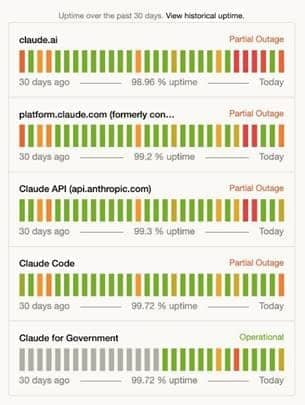
Anthropic’s Claude started to get so overwhelmed with demand that they had outages. Talk about success-fail. There were so many people using their products they couldn’t keep up with demand. There were even Twitter/X sub-threads on details that revealed how Anthropic was shadow-throttling users so that their datacenters wouldn’t melt. Point for Sam Altman. OpenAI CFO Sarah Friar has previously linked OpenAI’s revenue run rate directly with how many GW they can deploy. X GW deployed = Y revenue.
There is a war going on right now for compute. In April 2026 alone, here are some headlines that Claude pulled from my inbox:
- IREN energized phase 1 of its 1.4 GW Sweetwater site.
- MARA acquired a 505 MW gas plant in Ohio for $1.5B.
- DLR delivered $423M of bookings, a near-record quarter.
- Anthropic Buys 100% of xAI Colossus output.
- Anthropic locked in 5 GW of compute from Google.
- Amazon disclosed an OpenAI commitment to consume roughly 2 GW of Trainium capacity beginning in 2027.
- GLXY energized its first data center hall for CoreWeave.
- EQIX pre-sold a record bookings quarter.
- OpenAI's stacked compute commitments now total roughly $1 trillion
So, we can see that Anthropic is trying to now fight back by rapidly adding more and more compute. Why? Say it with me…demand outstripping supply.
All of that leads to this…
Consensus Has Been Wrong for 18 Months
Now let’s get to the meat of earnings. Hyperscaler numbers. The TLDR is: numbers go up. The hyperscaler CFOs showed that they have no regard for sell-side analysts sleep schedules, and all reported on the same day on April 29. When three of the big guys pushed numbers up, they cited increased component costs. If alarm bells are starting to go off in your head… good.
Here is my favourite visualization of the entire buildout and just how wrong the market has been:
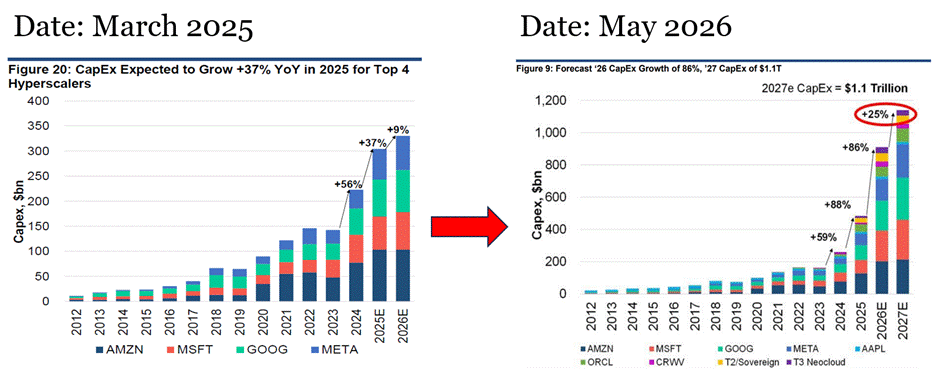
Look at how wrong consensus was in early 2025. In March of 2025, the Street thought 2026 capex was going to be less than $350B. Now? That number is around $900B. The Street was off by an order of magnitude. Where did that incremental $550B get spent? Over half a trillion incrementally being spent on semiconductors and the supporting infrastructure around it.
An important question to answer is just how wrong is consensus for 2027? Will the goalposts move again?
Gimme That Capex
In April, semiconductors stocks were up on stick. The bar was high, but semi companies came equipped with jetpacks.
The market missed $550B in spend that was mostly directed towards semis +infra. The stock market “prices in” what it expects. Think back to that chart above. This has caused some buck wild price action:
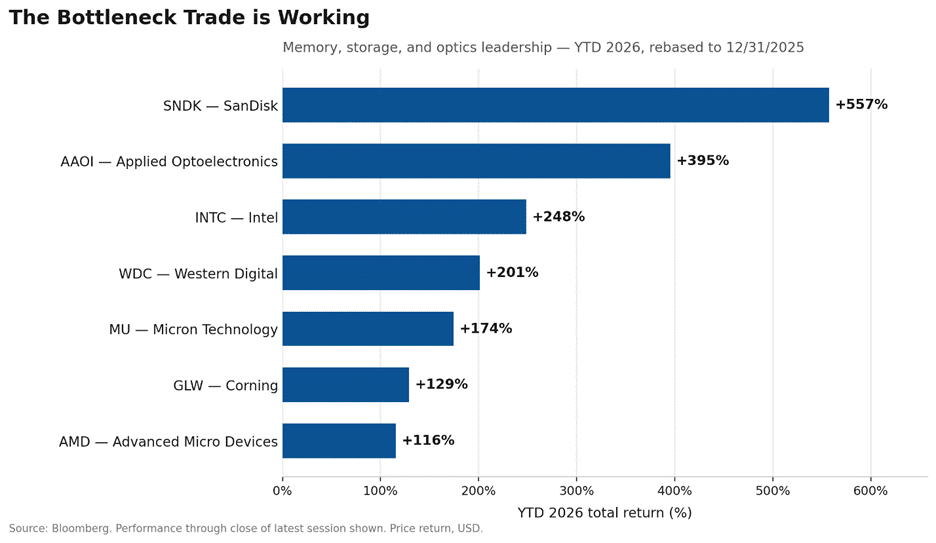
AMD up 116% out here looking like a laggard…
But I want to dissect one specific company to take a deeper look at what’s really going on here. Let’s look at Sandisk, the top dog.
Sandisk makes flash memory storage solutions that play a critical role in AI data storage. Previously, this was a very cyclical/commoditized industry, but demand in this area has exploded, and the company is now signing long-term contracts at higher prices, so it is not as exposed to cyclicality as before (I’ll get to that in a second). This is what I’ve been calling a “golden screw”, a term I’ve borrowed from Evercore ISI’s Mark Lipacis. Golden screws are critical components in the buildout with huge demand/supply imbalances.
The stock is up 557% YTD, but Forward EPS estimates are up 575% YTD. The end result is the 12M forward P/E is down 13.5% on a YTD basis. The stock is cheaper than where it started the year. Calling this stock expensive relative to fundamentals is incorrect. Questioning the forward-looking fundamentals would be the correct bear case.
Let’s look at why this is happening. Here is a hilarious snippet from an earnings note (emphasis my own):
“SNDK delivered a strong beat-and-raise, with Mar-qtr revs/EPS of $5.95B/23.41 beating street estimates by $1.2B and $8.79, respectively, on structurally higher pricing and continued customer/product mix. Total revs grew +251% y/y, led by outsized strength in Data Center (+645% y/y), which represented 25% of total revs (vs. 14% LQ). Notably, bit growth was roughly flat y/y (driven by inventory staging ahead of a BiCS8 ramp in FQ4), while ASPs were up >200% y/y, driving overall gross margins to 78.4% (vs. street at 67.4%). For June-qtr, SNDK guided revs of ~$8B at midpoint and EPS of $30.00-33.00, well ahead of consensus estimates of $6.62B/$23.38, implying gross margins of ~80% at midpoint.” – Amit Daryanni, Evercore
Three elements: 1) whooping the street’s numbers; 2) ASPs skyrocketing resulting in; 3) margin profile on steroids. The hardware guys have software margins. Pricing Power.
For next quarter, SNDK guided EPS midpoint of $31.50, vs $23.38 consensus. The sell side is supposed to have somewhat an idea of what these companies are going to print. Being that far off is a big deal. But you can’t really blame them when Sandisk’s data center revenue went from $197M a year ago, to $1.47B this quarter, and is on its way to this:
“Sandisk announced a New Business Model (“NBM”) arrangement signed with 5 customers that represent more than 33% of the company’s total bits in 2027 that include $42B NAND bit obligations, $11B financial/cash guarantees, $400M pre-payments (to date), and both fixed and variable pricing that ensure demand visibility (contract duration 1-5yrs), pricing protection, and durable returns to Sandisk” – CJ Muse, Cantor
Absolutely wild.
Tons of mispriced assets out there, just need to find them ahead of consensus.
How’s This for ROAI?
We are witnessing a historically impressive growth rate at scale. Anthropic. Take a look at this trajectory:
Anthropic is at a rumoured revenue run rate of $44B as of May 2026, up from *checks notes* $1B in December 2024 and $30B in April 2026. Did they seriously just tack on $14B ARR in a month? The $30B in April is confirmed and impressive on its own, but if that $44B number is legit…wow. Now, there are nuances around some of the whole gross vs. net revenue, but directionally, this is probably the most impressive growth I’ve ever seen.
All of this is mostly a result of flipping on the consumption revenue switch. Anthropic famously targeted enterprises while ceding the consumer market to OpenAI, which is looking like the right call. As users blew through their credit limits, they were charged additional consumption fees on top. And the secret sauce here…employers didn’t care, they actually encouraged it. Jensen jumped on a video saying that he would be disappointed if a $500k/year engineer doesn’t use $250k in AI credits. Uber CTO says they blew out their annual AI budget allocation in March. Everyone is full send on it. Because it shows immediate and measurable ROI. You don’t need a $95k/yr analyst working for you with a $5k/yr software subscription anymore. You can spend $10k on AI credits for the same (if not better) productivity and save 90% of your budget. Anthropic gobbles up all that revenue (which you’ll note is higher than that software subscription).
The final thing that I want to mention before I wrap up is backlog. If we try to square off all the spending for the hyperscalers, we have to look at how they will recoup this on the other side. For this, we look at cloud bookings:
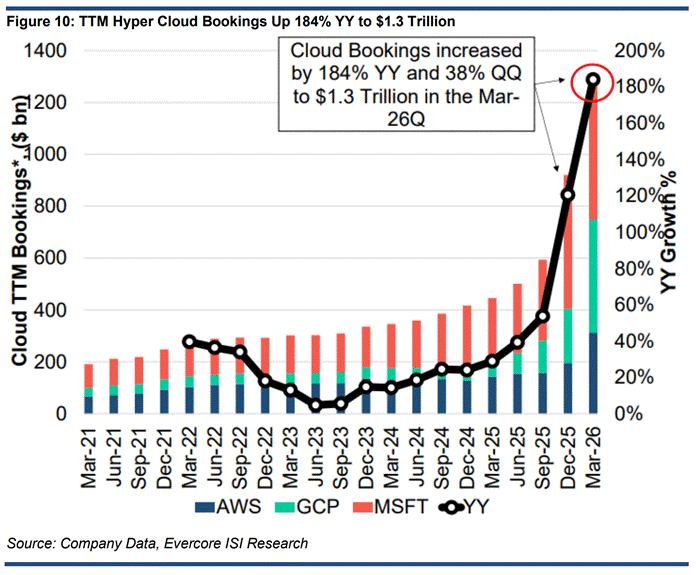
Backlog is starting to inflect massively at the major cloud companies when we look at the bookings growth line in black there. However, we also need to look at this one layer further:
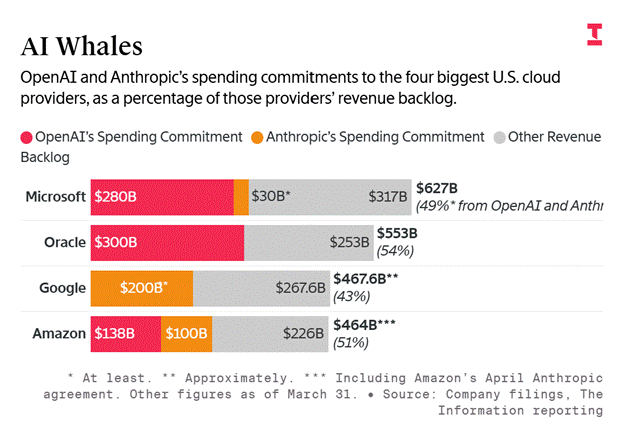
If we look at the ramp in these bookings’ numbers, a huge portion (around 50%) of that comes from the two frontier labs. This introduces a boatload of customer concentration risk. Which begs the question – could these frontier labs bring down the whole thing if they overextend?
Wrapping Up
In my view, the message here really comes down to one thing: stay, stay, stay — stay long semis, stay long infrastructure, and stay away from software. Long scarcity, short abundance. As long as demand is chronically outpacing supply, we will continue to need more power, cooling, networking, memory, optical, and accelerators.
We also need to figure out when the party stops. This will not last forever. The reason that this area is on fire right now is because it has all the earnings growth in the market. Cash flow is changing hands from hyperscalers to semi and infrastructure companies. This tide will ebb and flow.
This is why we need to keep a close eye on the supply chain. I have built a model that I currently incorporate into my portfolio construction that has deep channel checks on things like shifting margin profiles (aka pricing power), grid interconnect times, combined-cycle gas turbine lead times, GPU spot rental pricing, book-to-bill for cooling systems, fab capex guides and foundry node roadmaps, etc. While this may evolve over time, monitoring this buildout helps give confidence to hold high conviction positions, but also gives quick indicators on when certain components move from golden screws to gluts. That is when it is time to sell, not when valuations run away. Valuations may run away temporarily, only to reset as expectations gap up next earnings cycle. Focus on earnings.
I believe we will still go through the technological wave cycle we have seen before: 1) semis; 2) infrastructure; 3) applications. Right now, the absolute dollars are still flowing to 1 + 2, but eventually this will shift to 3. While we can feel the tide building and the wave starting to form with Anthropic, we just don’t know the shape of it quite yet. Applications are next up, but unfortunately, you can’t buy these leading generational companies in the public markets yet.
I’ll end on this: “I've seen gluts not followed by shortages, but I've never seen a shortage not followed by a glut.” – Nassim Taleb
This wave will last longer than people think, but it may also crash faster than most expect.
Strong convictions. Loosely held.
- Nick Mersch, CFA
The content of this document is for informational purposes only and is not being provided in the context of an offering of any securities described herein, nor is it a recommendation or solicitation to buy, hold or sell any security. The information is not investment advice, nor is it tailored to the needs or circumstances of any investor. Information contained in this document is not, and under no circumstances is it to be construed as, an offering memorandum, prospectus, advertisement or public offering of securities. No securities commission or similar regulatory authority has reviewed this document, and any representation to the contrary is an offence. Information contained in this document is believed to be accurate and reliable; however, we cannot guarantee that it is complete or current at all times. The information provided is subject to change without notice.Commissions, trailing commissions, management fees and expenses all may be associated with investment funds. Please read the prospectus before investing. If the securities are purchased or sold on a stock exchange, you may pay more or receive less than the current net asset value. Investment funds are not guaranteed, their values change frequently, and past performance may not be repeated. Certain statements in this document are forward-looking. Forward-looking statements (“FLS”) are statements that are predictive in nature, depend on or refer to future events or conditions, or that include words such as “may,” “will,” “should,” “could,” “expect,” “anticipate,” intend,” “plan,” “believe,” “estimate” or other similar expressions. Statements that look forward in time or include anything other than historical information are subject to risks and uncertainties, and actual results, actions or events could differ materially from those set forth in the FLS. FLS are not guarantees of future performance and are, by their nature, based on numerous assumptions. Although the FLS contained in this document are based upon what Purpose Investments and the portfolio manager believe to be reasonable assumptions, Purpose Investments and the portfolio manager cannot assure that actual results will be consistent with these FLS. The reader is cautioned to consider the FLS carefully and not to place undue reliance on the FLS. Unless required by applicable law, it is not undertaken, and specifically disclaimed, that there is any intention or obligation to update or revise FLS, whether as a result of new information, future events or otherwise.