
These days, market moves are very abrupt and dramatic. Sometimes they’re are an overreaction, sometimes they aren’t. Whether it’s a policy headline, a sentiment swing, a bad economic number, or a positioning unwind, many moments have to be evaluated, especially with pressure from clients. They see it all in real time, and it creates an impression that something must be done.
However, the core of a portfolio is built on much slower forces such as valuations, long-term risks, or multi-year macro shifts. Those positionings do not change because of one volatile Tuesday in the markets. You, of course, have your identity as a portfolio manager, but in essence, there are two types of portfolio managers: long-term investors who ignore the noise, and tactical traders reacting to every dislocation. That framing has historically made sense, but we believe the two types need not be independent.
You do have the ability to have a clear structural identity for your portfolio, but still explore new opportunities. In fact, you probably should. The point is to be clear about whether this trade is a short-term adjustment or a long-term shift in philosophy. We’ll walk through how we think about tactical adjustments inside a longer-term framework.
Portfolio Layers: Structural Vs. Tactical Positioning
To keep it simple, let's consider a portfolio as having two main layers: a fast one and a slow one. Structural positioning is the slow layer. This is the positioning that aligns with your overall macroeconomic outlook for the portfolio. It determines how much risk you’re willing to accept in each bucket. It sets regional positioning, how much you’re going to put in fixed income or diversifiers, and the overall style tilts of the portfolio.
This reflects deeper forces like valuation regimes, certain risks like concentration, and perhaps how correlations have been interacting. These are not elements that change from week to week. And nor should they; if your structural view is shifting that often, you may not have one. In essence, this layer defines the portfolio and will have the greatest impact on the outcomes.
Tactical positioning is the fastest layer. It exists to add exposure when risk and reward shift meaningfully. The point of this layer is not to alter the belief of the portfolio, but to exploit dislocations in the market where you believe there might be an overreaction.
These trades don’t come around every day. There are events that cause extreme decoupling quite often, but the job of the portfolio manager is to determine whether or not this is an overreaction worth pursuing or if the reaction is justified and will take many years to recover. Looking back over the last few years, we have historically had one or two ‘tactical’ trades in our portfolios every year. To give you an idea, the image below shows what those trades looked like:
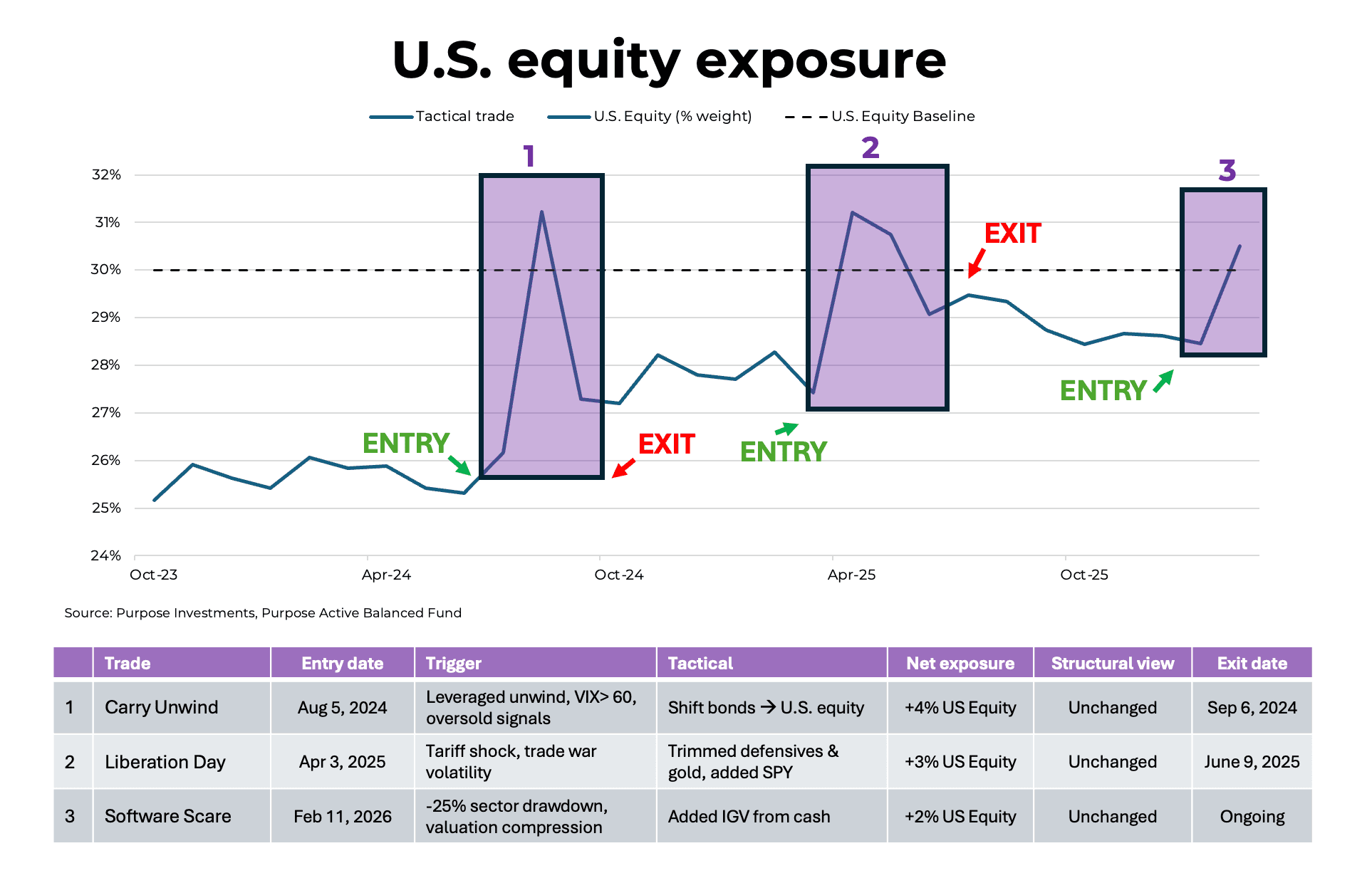
While these trades resulted in a move in U.S. equities above our baseline, they didn't change our structural long-term underweight. We returned to our underweight position within a short period of time. These trades were our own expression of what we believed to be short-term overreactions in the market. The sizing of the trades matters as well, showing anywhere from 2-4% of the portfolio to maintain the original identity. If the opportunity plays out, we reassess; if it doesn’t, the structure of the portfolio remains intact.
The Hidden Risks of Portfolio Drift
There are a few ways that tactical trades can go wrong. In the moment, they don’t feel very dramatic, but over time, they can be. ‘Going wrong’ is also not about the growth of capital; you can still make money, but this is more about a couple of different types of portfolio drift.
The first way is simply the accumulation of several tactical trades. Most tactical moves are smaller in nature: a trim here, an add there, or a rotation. Individually, each decision is rational. Often, they feel prudent, staring you in the face. But over time, if portfolio discipline is lacking, those small adjustments compound.
Exit discipline is very important. Otherwise, what started as a series of short-term expressions can shift the overall tone of the structural layer. No one declared that shift in view, but the portfolio represents the new view anyway.
The second risk? Success. It’s a good problem to have, but let’s say the tactical trade works out, it works well, and the position grows beyond its original size. As it becomes one of the stronger contributors to performance, trimming feels counterintuitive. Why reduce something that’s clearly working in the portfolio?
Investors carry many biases, but there’s perhaps no one larger than greed. Having the discipline to remember the intentional sizing of the position is key. It is important to set target prices for exiting the short-term position and holding yourself accountable if that target price is reached.
If you leave tactical trades unchecked, small shifts can become core positions, changing the risk profile of the portfolio without a deliberate decision. That is why setting targets and selling when they’re hit isn’t optional; it's how you make sure short-term remains short-term. The danger isn’t volatility, it’s drift. If a trade works out, take the win.
How to Set Effective Guardrails
Tactical trades are meant to add flexibility, not freedom. To set the portfolio up for the most success, there needs to be structure. Without structure, the portfolio can change, but with too much, you may never muster the courage to pull the trigger. The balance is having clear rules set before the volatility shows up.
For our portfolios, the tactical risk management starts with sizing. Position sizes are actively monitored, and positions are reviewed over time in light of the original investment thesis. Sector and regional exposures are also considered as part of the portfolio construction process. While a trade may be attractive on a standalone basis, its impact is evaluated within the context of the portfolio as a whole.
Next, the focus is on a written rationale. This moves the trade away from a feeling and more towards a clear reason for why the move is being made and what could go wrong. This sets up an efficient structure for reviewing historical trades. You also get the added benefit of learning more about the space along the way.
Most investors are disciplined about downside risk; fewer are disciplined about upside management. Before putting on a tactical trade, discuss revisit levels around trimming, exiting, adding, and honour those levels. When you initiate the trade, that's when you’re likely to be the most level-headed about it, not after it has already moved. The goal is to remove future second-guessing before emotion creeps in.
Before deploying a tactical trade, take a step back and run through a few basic checks:
- What specific inefficiency are we trying to capture?
- Is this truly a short-term dislocation, or are we reacting to noise?
- How does this look amongst the existing positioning of the portfolio?
- Is the sizing appropriate for a short-term tilt?
- Determine levels for exiting, to the downside and upside.
- Are we adding to the risk of the portfolio or reallocating from previous risk levels?
Tactical trades are not about perfection; they’ll be wrong from time to time. These questions will not eliminate mistakes, just reduce the ability for short-term adjustments to shift into long-term ones.
Final Thoughts
Markets will always tempt you to do something, especially ones that move as quickly as these. Tactical flexibility adds flair to a portfolio, but it will always be the structural base that will drive most of the outcomes. Used properly, tactical trades should enhance the structure, not compete with it.
— Brett Gustafson is an Associate Portfolio Manager at Purpose Investments
— Spencer Morgan is Director, Portfolio Strategy at Purpose Investments
Sources: Charts are sourced to Bloomberg L.P.
The content of this document is for informational purposes only, and is not being provided in the context of an offering of any securities described herein, nor is it a recommendation or solicitation to buy, hold, or sell any security. The information is not investment advice, nor is it tailored to the needs or circumstances of any investor. Information contained in this document is not, and under no circumstances is it to be construed as, an offering memorandum, prospectus, advertisement or public offering of securities. No securities commission or similar regulatory authority has reviewed this document and any representation to the contrary is an offence. Information contained in this document is believed to be accurate and reliable, however, we cannot guarantee that it is complete or current at all times. The information provided is subject to change without notice.
Commissions, trailing commissions, management fees, and expenses all may be associated with investment funds. Please read the prospectus before investing. If the securities are purchased or sold on a stock exchange, you may pay more or receive less than the current net asset value. Investment funds are not guaranteed, their values change frequently and past performance may not be repeated. Certain statements in this document are forward-looking. Forward-looking statements ("FLS") are statements that are predictive in nature, depend on or refer to future events or conditions, or that include words such as "may," "will," "should," "could," "expect," "anticipate," intend," "plan," "believe," "estimate" or other similar expressions. Statements that look forward in time or include anything other than historical information are subject to risks and uncertainties, and actual results, actions or events could differ materially from those set forth in the FLS. FLS are not guarantees of future performance and are by their nature based on numerous assumptions. Although the FLS contained in this document are based upon what Purpose Investments and the portfolio manager believe to be reasonable assumptions, Purpose Investments and the portfolio manager cannot assure that actual results will be consistent with these FLS. The reader is cautioned to consider the FLS carefully and not to place undue reliance on the FLS. Unless required by applicable law, it is not undertaken, and specifically disclaimed, that there is any intention or obligation to update or revise FLS, whether as a result of new information, future events or otherwise.