
Every model's knowledge freezes at a training cutoff. Research runs on what it can reach after that: the right information, accurately, and fast.
Something quietly remarkable happened this month, and most people missed it. OpenAI shipped GPT-5.6 Sol. Anthropic's Claude Fable 5 sits at the top of the leaderboards next to it. And Moonshot released Kimi K3, a 2.8-trillion-parameter open-weight model that lands within a point of both. Three frontier models, three weeks, and every one of them is available in a browser tab on a consumer subscription. Enterprise deployments and API usage scale the bill, of course, but the entry point to frontier intelligence now costs less than a professional desk pays for a single data terminal in a day.
Comparing them is worthwhile. Any frontier model today can refactor a large codebase or hold a deep line of reasoning for an hour. We experiment with all of them, and the honest finding is that they are converging: on raw intelligence, the gap between the leaders is measured in weeks, not years.
What has kept my attention instead is a different axis entirely: information. However smart the model, its knowledge froze at a training cutoff; ask about anything after that date and it was not in the room. So every lab has quietly built a second product alongside the model, the information it can reach at answer time, and that is where the real differentiation lives. Grok is the cleanest example. It ships with the X feed built in, a feed otherwise closed to the outside world: scrapers are blocked, and API access starts around $42,000 a month at the enterprise tier. A consumer Grok subscription is, in effect, the model plus the Twitter firehose. Among everything LLMs do, information retrieval is a standalone layer, and it is priced into which door you walk through, not how smart the model is behind it. The leverage is not which model you picked. It is what you can feed it.
Shopify's Tobi Lütke put it better than I can: the core skill is "the art of providing all the context for the task to be plausibly solvable by the LLM." Andrej Karpathy sharpened it further, calling context engineering "the delicate art and science of filling the context window with just the right information for the next step." Prompt engineering was about phrasing. Context engineering is about logistics. The output is only as good as the context you feed in.
Retrieval Used to be a Job Description
Consider the most basic research task there is: a chart of M2 money supply from FRED. That was historically an analyst task. Find the series, check the vintage, download, chart, format, circulate. Today it is one sentence typed into a browser, and the chart comes back with the source linked, ready for the analyst to check. Retrieval, the unglamorous bottom layer of all research, is one of the things LLMs are simply best at.
But "retrieval" is not one thing. In practice it splits into three layers, and each layer has a different answer for which tool wins.
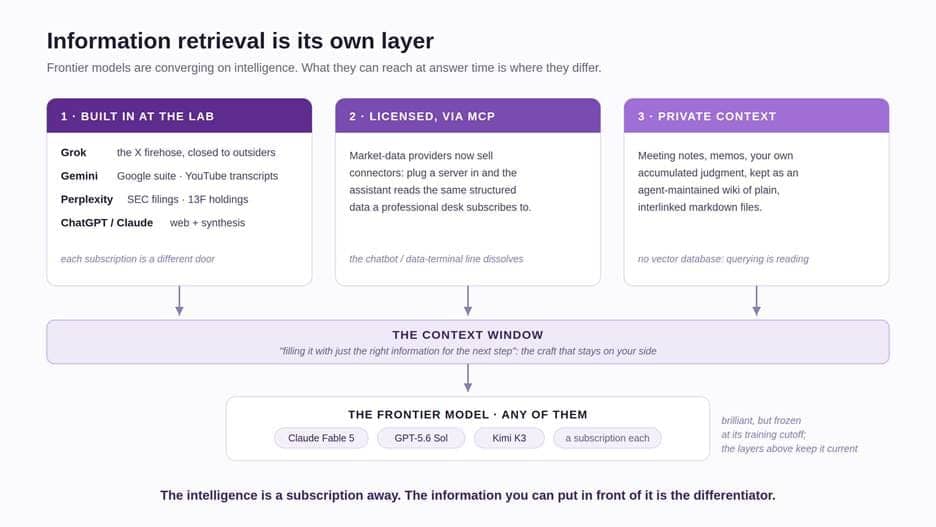
Figure 1: Three layers of information feed the context window; the model underneath is increasingly interchangeable. Illustrative.
Layer One: What the Model is Connected to
Each frontier assistant ships with different pipes into the world, and the pipes matter more than the benchmark scores.
Grok, again: because it sits on a feed nobody else can touch, it is genuinely strong on sentiment and breaking news. Most market-moving stories surface on X before they hit the wires, and Grok reads the room natively. When the question is "what is the crowd saying," nothing else comes close.
Gemini is quietly the freshness champion, and its integration with the Google suite is the underrated part. Give it a YouTube video or a podcast episode and the transcript is just there, no tooling, no copy-paste. An hour-long interview with a CEO becomes a five-minute structured read.
Perplexity took the citation-first path, and for regulatory documents it shows. SEC filings, 13F holdings, the paper trail of who owns what: it retrieves them with sources attached. You still verify against the source, that step never goes away, and cited answers do not always survive the check. But starting from a citation beats starting from a blank search box.
Claude and ChatGPT are the deep-work horses. When the retrieval is done and the task becomes synthesis, long documents, or code, that is where users may find they earn the subscription.
If you do not need to pick one and can subscribe to several, you can learn which door to knock on for which question.
Layer Two: The Data You Pay For
The second layer is licensed data reaching the model through MCP, the open standard for connecting assistants to external sources. Financial data providers now sell exactly this: plug their server in, and the model can pull the same structured data a professional desk subscribes to. Opinions on specific vendors aside, the direction is what matters: the boundary between "consumer chatbot" and "professional data terminal" is dissolving, one connector at a time.
And the terminal side is answering back. In February, Bloomberg opened the beta for ASKB, a conversational assistant built directly into the Terminal, running on Bloomberg's own data. It is Grok's mirror image: one is a model company that owns an exclusive feed, the other a data company that shipped a model. Both are closed systems, and that is the evaluation axis that matters now. The question is not which model sits underneath; it is what the tool is wired into, and whether anyone else can reach the same pipes.
The detail I keep coming back to is Bloomberg's design choice on accuracy. Their CTO has said ASKB is never allowed to answer from the model's own world knowledge: every answer is grounded in their data, validated step by step, with the source paragraphs surfaced next to it. For research work that is the whole game. Retrieval is only leverage if it is accurate, and a confident hallucination costs more than any subscription. ASKB is still in beta, but grounding-first is the bar the whole category should be judged against.
Layer Three: What Only You Know
The third layer is the most interesting one, because no subscription solves it: your own private context. Meeting notes, internal memos, the accumulated judgment of your own shop. The standard answer here is RAG, the retrieval pipeline that chunks documents into a vector database. I have experimented with it. The plumbing is heavy, and the retrieval is only as good as the chunking.
Then Karpathy published something better this spring, and it is almost embarrassingly simple. Instead of a retrieval pipeline, keep a wiki: plain, interlinked markdown files that the model itself maintains. When a new document arrives, the model reads it once and files the substance into the right pages. You pay the synthesis cost up front, and from then on querying is just reading. No embeddings, no vector database, no infrastructure. Files in folders. The simplest thing that could possibly work, and in my view it probably works much better.
There is something fitting here. The frontier of AI in 2026 is trillion-parameter models scored on leaderboards, and yet the highest-leverage move for a knowledge worker is closer to good filing. The models will keep leapfrogging each other; the craft that compounds is on our side of the context window: knowing what the machine needs to see, and building the quiet plumbing that puts it there.
The frontier is a subscription away. The context is still yours to engineer.
— Jason Chen at Purpose Investments.
This article is for information purposes only and does not constitute investment advice, a recommendation, or an offer or solicitation to buy or sell any security. It reflects the author's personal views on research tooling and how AI tools could be used for information retrieval; it does not describe the current investment process of any Purpose fund, and investment decisions for all Purpose funds are made by their portfolio managers. Third-party products and companies are mentioned for illustration only; no endorsement is implied and the author has received no compensation from any provider named. Certain statements are forward-looking; actual results may differ.