How we ended up long San Francisco and Silicon Valley offices
It was 9:30 p.m., minus 25C with the wind chill, and my three kids were bouncing off the walls of the living room. My fault. I'd taken them out for iced coffees earlier and hadn't thought it through — sugar and caffeine in a cup.
I had nothing left. I'd just finished a brutal day at work; the market had been so volatile it felt like it had physically beaten me up.
So there was really only one tough option: "I'm going for a walk outside. I can't take the living room Olympics anymore."
I put on my snow pants, covered my face, put on every piece of winter gear I own, and grabbed my personal alarm in case of coyotes. (I'm told coyotes are scared of those things.) In fairness, I bought it without ever testing that claim, and I'd rather keep it that way.
Ten minutes in, my phone rang. My headphones were in my pocket — I'd stopped wearing them on walks because they were starting to affect my hearing. So, I paused, scanned around for coyotes, dug out the phone, pulled off a glove, got the headphones in, answered, and had the glove back inside, all within 30 seconds.
"Hey Ragheb, I'm downtown San Francisco all the time — and the streets feel different lately. This new mayor is serious about bringing it back." That was a friend of mine, who lives just outside San Francisco and spends most of his week working downtown.
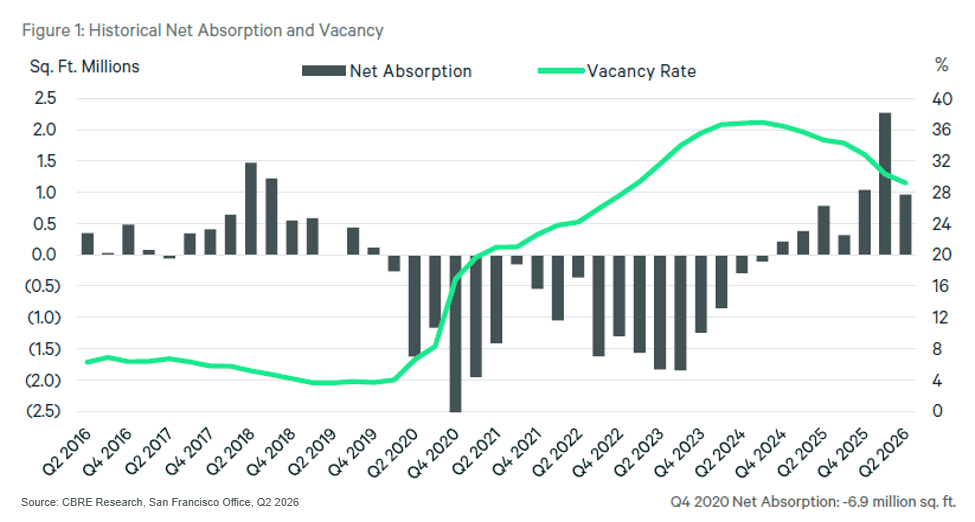
That sentence stayed with me until the next morning. Reviving downtown is big news. San Francisco was the hardest-hit major U.S. city on office space: city-wide vacancy stood around 36%. Was it time to make a U-turn and start buying offices? We'd made good money shorting office bonds in the Purpose Credit Opportunities Fund in 2021 and covering them around 2023. It was a great trade — but buying?
Then again, AI was the new thesis. OpenAI, Anthropic, all of them in San Fran and around. Don't they need space?
Hudson Pacific Properties (HPP) is the US-listed REIT with the greatest concentration in Silicon Valley and San Francisco office space, at 42.1% and 22.4% of Q2'26 net operating income (NOI), respectively. It's also exposed to LA's declining studio business — but so what? Studios sit in joint ventures, and HPP can walk away, losing whatever equity is left in them.
It was February 2025 when the idea felt complete. NOI, cap rate, future growth — all of it looked promising, and the company was undervalued. I fired off a report to Sandy Liang, my manager, and the fixed income team, proposing we buy HPP bonds.
We went back and forth with our process for several days before landing on it: start building a position. This is the kind of opportunity that shows up once in a few years — very good real estate that the market can't see the future demand for because it's still pricing the past. And the market was missing how easy the studio exposure was to solve: walk away, give up a small slice of equity, change some covenants, done.
In the first half of 2025 we bought the majority of our HPP 4.65% 04/01/29 holdings at prices between $73.50 and $80.75, with yields of 10.5% to 13.5%. Since then, on top of the coupon, we've made good money on price appreciation — the bonds trade around $94 as of publication date.1
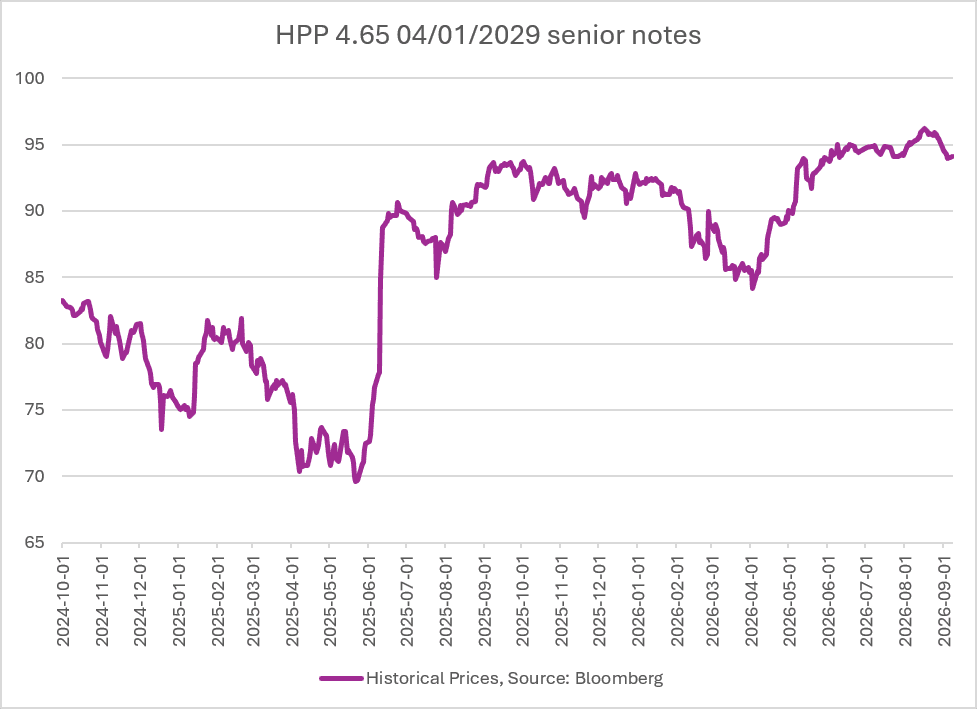
The thesis has been working, and HPP has become a focused bet on the AI-driven recovery in Silicon Valley and San Francisco office market, playing out quarter after quarter. In Q2 2026, the company posted its fourth consecutive quarterly office occupancy gain to reach 82.5% and, in that quarter alone, signed 1.3 million square feet of office leases — a record quarter — including multi years leases with the City and County of San Francisco.2 The city-wide picture matches: San Francisco office vacancy has fallen to 29.2% in Q2’26 (CBRE) from a peak of 36.9% in Q3’24 (CBRE), with AI tenants driving the recovery.
Today we estimate the cap rate implied through our bonds at about 13% 3, after removing NOI and debt contributions from the two studio joint ventures — Sunset Pier 94 Studios and BXHPP, HPP's joint venture with Blackstone. That leaves a wide margin of safety to our bonds because we estimate the appropriate cap rate value on HPP's office assets, excluding the Studio JVs, at roughly 7% at current benchmark rates.
Kidder Mathews puts San Francisco central business district office cap rates at 7.34% in 2026, down from a 7.46% peak in 2025. CBRE's H1 2026 survey is higher and wider at 8–9.5% for stabilized Class A. We believe both still lag: appraisals haven't caught up with how quickly vacancy has come down, and with so few transactions there is little to force the mark. As leasing tightens and volume returns, we'd expect San Francisco cap rates to compress and NOI to grow faster than currently marked, both supporting HPP's valuation. The recovery isn't spreading evenly — demand is concentrating in the best buildings, which is exactly where this portfolio sits.
All of that is more obvious now. None of it was obvious while we first put on the bond position but it is often the case the best investments feel uncomfortable upon entry because they go against consensus at the time.
The science is the part you can defend in a meeting: NOI, cap rate, the debt stack, the maturity wall, how much of the studio exposure is joint-ventured and what walking away actually costs. It's checkable. If you get it wrong, someone can point at the cell.
The art is deciding which number the market is discounting, and which one it should be. At the start of 2025, HPP bonds were priced on two fears: that vacancy would never recover, and that the studio business would sink the company. Both were the wrong things to watch. Leasing had already turned. The studio problem was non-recourse to the company; ultimately it was an equity investment even though its debt was on the balance sheet. That's clear now. It wasn't then, and no screen would have shown it to you. It came from a lot of work on the thesis, and from having been wrong before in ways that teach you where to look.
I still can't tell you whether that coyote alarm works. I might find out yet. Credit is the same — nothing is certain, you just work out the range of outcomes you can live with, and then you wait. My friend told me the city was serious about downtown. Eighteen months later, San Francisco office vacancy had fallen 7.7 percentage points, leasing had hit a record first half, and the AI companies were taking every good building they could find.
References:
https://kidder.com/trend-articles/san-francisco-cbd-office-cap-rates-hit-7-34/
https://www.cbre.com/insights/reports/us-cap-rate-survey-h1-2026
https://investors.hudsonpacificproperties.com/overview/default.aspx
- Source: Bloomberg
- As at August 5, 2026. Source: https://investors.hudsonpacificproperties.com/investor-resources/press-releases/press-release-details/2026/Hudson-Pacific-Properties-Reports-Second-Quarter-2026-Financial-Results/default.aspx
- Calculated as HPP's share of Adjusted NOI for Q2'26, annualized, divided by HPP's share of net debt at June 30, 2026, both excluding Sunset Pier 94 Studios and BXHPP.
Discussion of HPP is intended as an illustrative example only, not a recommendation to trade in any security, and is not representative of the fund's overall holdings or performance. Not all positions in the fund have performed similarly.
The content of this document is for informational purposes only, and is not being provided in the context of an offering of any securities described herein, nor is it a recommendation or solicitation to buy, hold or sell any security. The information is not investment advice, nor is it tailored to the needs or circumstances of any investor. Information contained in this document is not, and under no circumstances is it to be construed as, an offering memorandum, prospectus, advertisement or public offering of securities. No securities commission or similar regulatory authority has reviewed this document, and any representation to the contrary is an offence. Information contained in this document is believed to be accurate and reliable, however, we cannot guarantee that it is complete or current at all times. The information provided is subject to change without notice.
Commissions, trailing commissions, management fees and expenses all may be associated with investment funds. Please read the prospectus before investing. If the securities are purchased or sold on a stock exchange, you may pay more or receive less than the current net asset value. Investment funds are not guaranteed, their values change frequently and past performance may not be repeated.
Certain statements in this document are forward-looking. Forward-looking statements ("FLS") are statements that are predictive in nature, depend on or refer to future events or conditions, or that include words such as "may,” "will,” "should,” "could,” "expect,” "anticipate," intend,” "plan,” "believe,” "estimate" or other similar expressions. Statements that look forward in time or include anything other than historical information are subject to risks and uncertainties, and actual results, actions or events could differ materially from those set forth in the FLS. FLS are not guarantees of future performance and are by their nature based on numerous assumptions. Although the FLS contained in this document are based upon what Purpose Investments and the portfolio manager believe to be reasonable assumptions, Purpose Investments and the portfolio manager cannot assure that actual results will be consistent with these FLS. The reader is cautioned to consider the FLS carefully and not to place undue reliance on the FLS. Unless required by applicable law, it is not undertaken, and specifically disclaimed, that there is any intention or obligation to update or revise FLS, whether as a result of new information, future events or otherwise.
Date of Publication: September 8, 2026