
Apart from a volatile spat in March and April and a few smaller wobbles, 2025 has been a solid year. The most recurring theme from clients has been joy with a high level of nervousness. In our 2025 outlook, entitled “Three-Peat?”, we questioned if either the Kansas City Chiefs or the markets could achieve three victories in a row. We now know the Eagles prevailed last February, but it seems the markets pulled it off.
And while the headline noise remains challenging and does inject brief spats of volatility, it’s the underlying fundamental trends that really delivered. The economy remained decent – not great, but just good enough. Inflation remained somewhat contained, moving a bit higher in a few pockets, but generally holding at a mildly lower trend. This was good enough to keep bond yields rangebound, currently near the lower end of that range. Meanwhile, earnings delivered. The S&P 500 posted decent earnings growth, as did most other jurisdictions. This was in contrast to the previous few years, where S&P earnings growth was materially higher than most other major indices.
We could argue that a Santa Claus rally seems unlikely, considering it appears St. Nick came really early this year and already dropped presents into client accounts. But who knows, this could just push till the end. December often does see larger market moves, more up than down, in part due to investors’ unwillingness to realize gains late in the year, and lighter volumes tend to exacerbate market moves.
Canada's Banks: Value is Abroad
As mentioned in last week’s Market Ethos, Canadian banks are doing very well. In fact, they’re integral to the performance of the TSX. But reliance on banks isn’t just a Canadian market characteristic. While we are quick to point fingers at our neighbours down south and cry foul on the concentration issues of the big tech names, Canada and many other countries rely heavily on the health of their banks to drive equity market returns.
This past week, Canadian banks reported their year-end earnings. They were generally well received, with all but the Bank of Montreal positive month to date. A common theme was robust capital markets activity and wealth inflows offsetting some increase in provisions for credit losses. Net Interest Margin and a continued focus on expense management helped drive the earnings beats. Overall, the TSX Bank index is up 2.2% so far in December, with nearly all of the banks except BMO trading at all-time highs. Despite a challenged Canadian housing market and broader economic uncertainty, the banks have delivered.
While Canadian banks have posted a solid ~40% return so far this year, the true outperformance story belongs to European financials, which have led the pack on the back of a rising rate environment and restructuring efforts. European banks are up more than +90% YTD, followed by their U.K. counterparts, which are up over 60%. U.S. banks have still posted decent returns, but at “just” +23% YTD, the S&P 500 Bank index is trailing the pack. Regional bank volatility and commercial real estate concerns remain a drag for the group. What’s clear is that despite growth challenges around the globe, valuations DO MATTER and the market is rewarding regional cyclical recovery winners. The low valuation starting points for international banks presented significantly higher upside potential.

This is where it becomes somewhat concerning from a Canadian perspective. The Canadian banks currently trade at a blended forward valuation (P/E) that is now more than two standard deviations from their long-term historical average. They’re historically expensive, which is why the recent performance is even more remarkable. A common rationalization is that they’re simply keeping pace with global banks. A rising tide lifts all boats, so to speak. Fair.
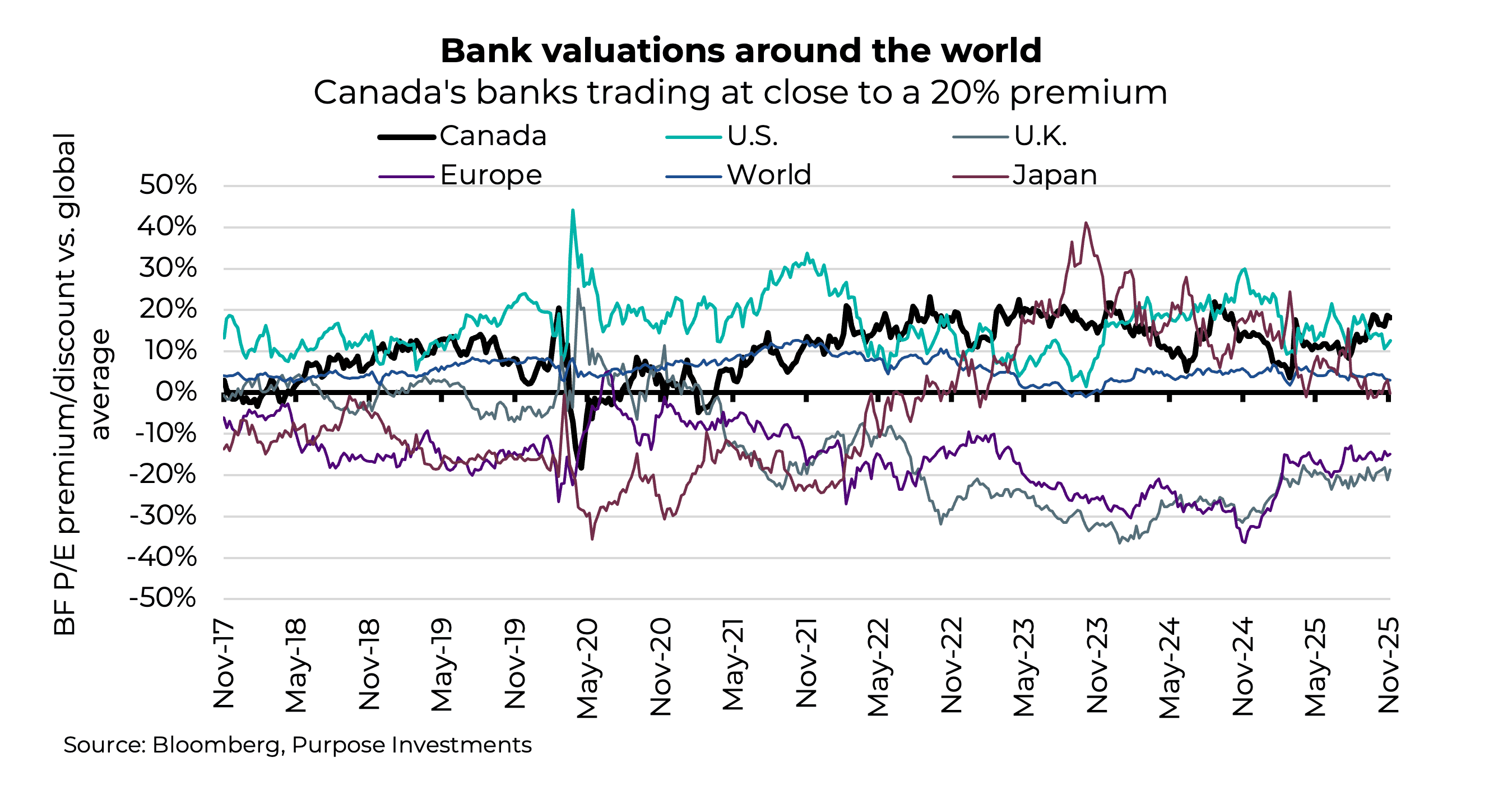
However, when you dig into it, Canadian bank valuations are currently trading near a 20% premium over the global bank peer average. In the chart below, we plot the historical bank valuations compared to the global average. Canada is typically at a premium, but at current levels, Canadian banks are trading richer than American peers. European and U.K. banks are still well below the global average, even after this year’s incredible performance. This leads us to think that there could still be further upside potential for international banks, but likely less for Canadian banks. Simply put, the risk/reward proposition for Canadian banks is less attractive on a relative valuation basis.
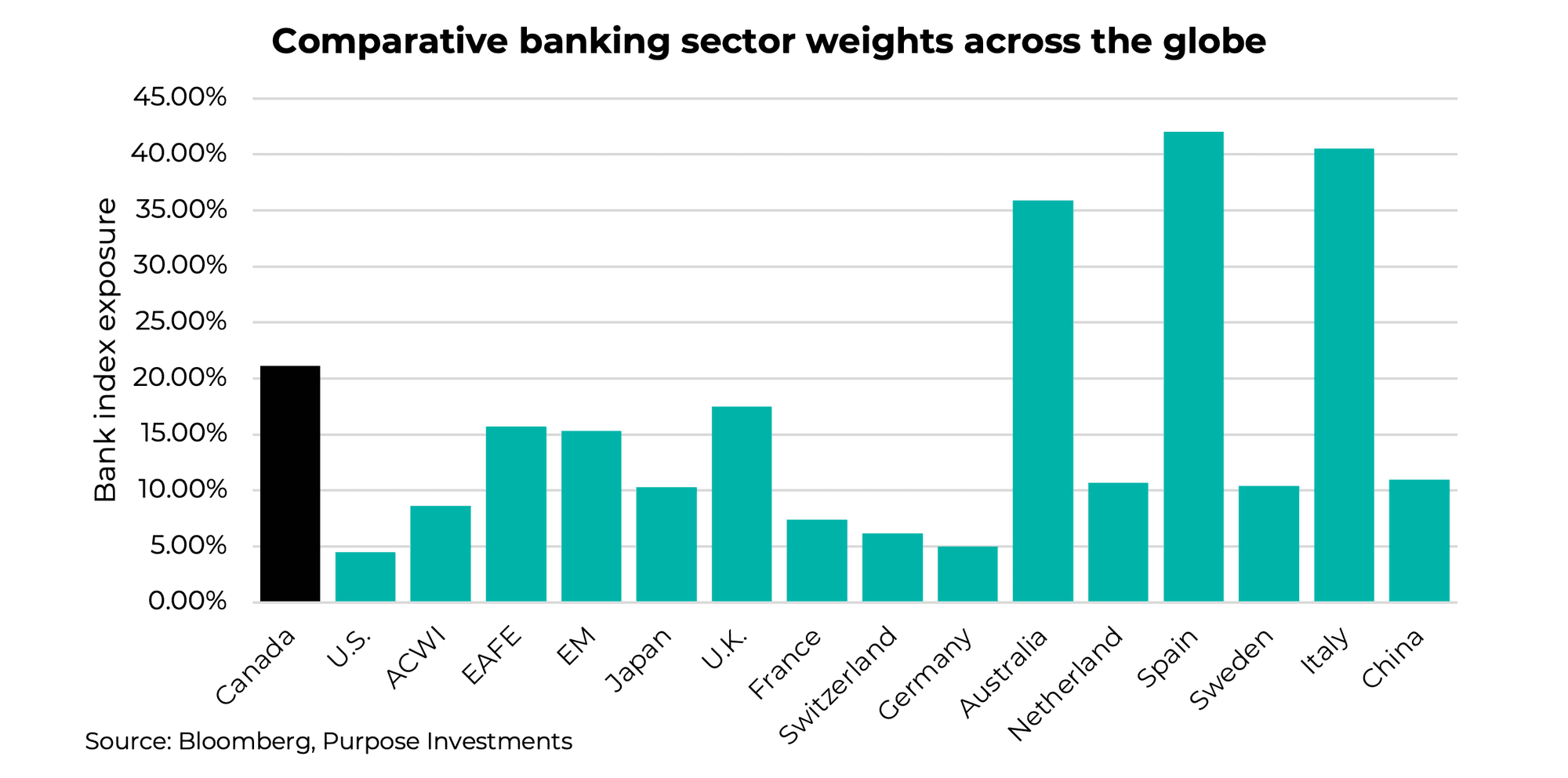
From a portfolio construction perspective, bank outlooks should play an important role in asset allocation decisions. The outsized 21% weight of banks in the S&P/TSX Composite means that equity performance is heavily correlated to the fate of the Big Six. Widening our lens, the chart below shows the bank exposure across major indices as well as some of the largest individual country exposures within the MSCI EAFE index. Banks are a lower weight in the All-Country World Index (ACWI) at 8.65%, and especially the S&P 500 (4.55%), but they play a big part in EAFE (15.7%) and Emerging Market (15.3%) indices. From a concentration risk standpoint, Canada is nowhere near Australia, Spain, and Italy, whose markets all have significant bank exposure.
From our perspective, it’s hard to deny the recent strength and stability of the Canadian banks. They’re a key part of most Canadian portfolios. Valuations are lofty, and yields are increasingly skinny. For instance, Royal Bank now yields just 2.9%, less than Canadian 10-year bonds and the lowest since 2007. While they typically trade at a premium to global peers, the spread is historically wider, which, in our opinion, presents a difficult setup for relative outperformance against global peers. We believe this only reinforces our conviction in maintaining a healthy international and emerging markets overweight. While not the sole reason, these could be two motivators to gain exposure to the cheaper global bank value thesis.
Japan: Land of the Rising Governance
One of the most humbling aspects of investing is when you are right, but it doesn’t work out, or vice versa. Two of the reasons we became more positive on Japan in June 2022 didn’t play out, but the position still benefited us. In other words, we were kind of wrong, but it still worked out.
The first, China’s reopening, didn’t actually work. Our thinking in June 2022 was that China, which left its economy shut much longer than the rest of the world with their Covid response, would come roaring back. But at that time, we didn’t want emerging market exposure, so we went with Japan due to its trade exposure. China didn’t come roaring back as confidence was hurt, and housing remained a problem.
The second was with the yen at $140; it was crazy cheap, making anything denominated in yen very cheap. That certainly made going there on vacation encouraging; the mighty loonie went a long way. Guess what? The yen weakened to over 160 by mid-2024 and is now sitting at around $155 (quoted yen per U.S. dollar, so a higher yen is a weaker yen). And yet the Nikkei has annualized about 22% since then in Canadian-dollar terms, so something must be working out.
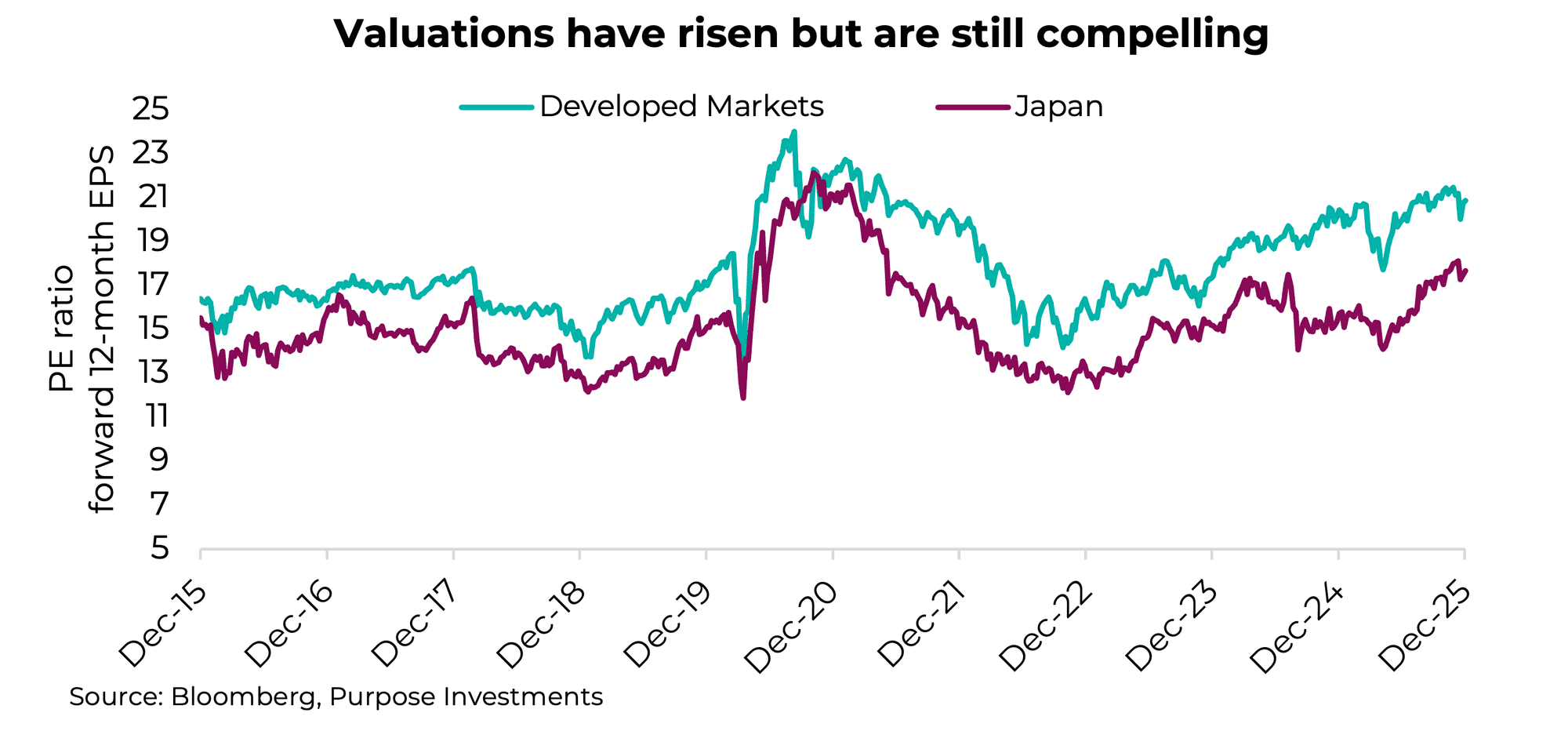
One aspect that has worked is valuations. Three years ago, Japan was trading at rather depressed levels of around 12.7x forward consensus estimated earnings. That was cheap on a historical basis and also cheaper than valuations across developed markets globally. Fast forward to today, and valuations have risen to about 17x. Not as cheap, but still rather compelling compared to developed markets. The other good news is that even with the strong price gains, this valuation is elevated, especially if you also consider strong earnings growth, which sits at just under 10% based on forward estimates for the next 12 months.
In our opinion, perhaps the most compelling rationale for being more positive on Japan is a gradual secular change for Japanese companies. For this, we need to take a little trip down history lane.
Japan enjoyed and then suffered from one of the greatest bubbles in history, which peaked at the end of 1989. This bubble had many drivers, with real estate at its core. Near the peak, it was estimated that the Imperial Palace was valued at more than all of Manhattan. Unfortunately, what prolonged the pain of the bust was the desire to avoid layoffs and keep companies alive. This led to many zombie companies that muddled along operationally but eroded shareholder value. Employment and stability were put above shareholders, prolonging the cleansing phase. This wasn’t the only reason, but it was a major contributing factor to the 34-year-long period before the Nikkei reached its peak.
Now for the good news: a number of years ago, this philosophy began to change, helped by some legislation requiring companies not to sit on as much cash and focus more on creating shareholder value. Evidence of this changing philosophy can be seen in the average “governance score” for Nikkei member companies. Bloomberg Governance scores focus on board composition, executive compensation, shareholder rights, and audits. From a shareholder’s perspective, a higher score out of 10 is better.
The trend has been gradual but certainly noteworthy. After many years with very low performance on governance, the overall score has been steadily rising. It’s not quite as shareholder-friendly as the S&P 500, but the gap is much smaller than it used to be. It’s hard to draw causation between governance and share prices, as there are many more factors at play. However, better governance is a positive, and this is likely a long-term secular trend that we could continue providing a tailwind for Japanese equities.

Japan does fit nicely into our more positive view of international equities, but it’s not without its uncertainties. Tariffs are obviously an ongoing risk variable, especially given that Japan sends a lot more goods to the U.S. each month than it imports. However, they trade much more globally, and don’t forget that the yen is still really cheap, which continues to provide an advantage.
With investing, things rarely work out as expected. Nonetheless, Japan continues to perform, and with a cheap yen, improving governance, and earnings growth, it still stacks up really nicely.
Market Cycle & Portfolio Positioning
Good news: with the U.S. government shutdown over, data compilers are catching up from their little break. So far, there hasn’t been anything noteworthy. When it comes to economic data, generally, nothing noteworthy is a good thing.
Still, the total market cycle indicators that are bullish ticked a little lower. Two signals flipped from last month: U.S. Energy Demand, which is based on U.S. manufacturing, while international earnings growth slowed a little. Forward estimates are still strong, and revisions remain positive, so not a huge deal. Of note, TSX earnings growth is now outpacing the S&P. Banks and gold are a powerful combo.
Overall, we believe things are still decently supportive.


No changes to positioning – that seems to be the trend this year. Markets have been great; nobody wants to trigger any more capital gains or upset the applecart. Hopefully, we’ll have a quiet December to put a cap on an awesome year.
Final Note
There’s no denying that such a great year has pushed valuations into a higher bracket than a year ago, which was already a bit expensive. We should also remember that valuations don’t mark tops or bottoms, but a higher valuation does increase market risks if there is a misstep.
Fortunately, at the moment, lots of market-friendly AI CapEx spending, decent economic data, and somewhat lower rates/yields are providing a pretty good foundation. Can’t wait to raise a glass to 2025 once we get through this final stretch.
— Craig Basinger, Derek Benedet and Brett Gustafson
Get the latest market insights in your inbox every week.
Sources: Charts are sourced to Bloomberg L. P.
The content of this document is for informational purposes only and is not being provided in the context of an offering of any securities described herein, nor is it a recommendation or solicitation to buy, hold or sell any security. The information is not investment advice, nor is it tailored to the needs or circumstances of any investor. Information contained in this document is not, and under no circumstances is it to be construed as, an offering memorandum, prospectus, advertisement or public offering of securities. No securities commission or similar regulatory authority has reviewed this document, and any representation to the contrary is an offence. Information contained in this document is believed to be accurate and reliable; however, we cannot guarantee that it is complete or current at all times. The information provided is subject to change without notice.
Commissions, trailing commissions, management fees and expenses all may be associated with investment funds. Please read the prospectus before investing. If the securities are purchased or sold on a stock exchange, you may pay more or receive less than the current net asset value. Investment funds are not guaranteed, their values change frequently, and past performance may not be repeated. Certain statements in this document are forward-looking. Forward-looking statements (“FLS”) are statements that are predictive in nature, depend on or refer to future events or conditions, or that include words such as “may,” “will,” “should,” “could,” “expect,” “anticipate,” intend,” “plan,” “believe,” “estimate” or other similar expressions. Statements that look forward in time or include anything other than historical information are subject to risks and uncertainties, and actual results, actions or events could differ materially from those set forth in the FLS. FLS are not guarantees of future performance and are, by their nature, based on numerous assumptions. Although the FLS contained in this document are based upon what Purpose Investments and the portfolio manager believe to be reasonable assumptions, Purpose Investments and the portfolio manager cannot assure that actual results will be consistent with these FLS. The reader is cautioned to consider the FLS carefully and not to place undue reliance on the FLS. Unless required by applicable law, it is not undertaken, and specifically disclaimed, that there is any intention or obligation to update or revise FLS, whether as a result of new information, future events or otherwise.


