
There is a wrecking ball bouncing from one industry to the next, and folks are calling it the AI Scare Trade. Wherever there’s any whiff of how AI could potentially disrupt an existing business model or service, stocks plunge lower. We discussed this last week in “Markets get Claude’d”, as Anthropic AI services’ new functionalities impacted the software space generally. This spread to legal and other services.
This past week, the AI wrecking ball visited wealth services, real estate firms, insurance brokers, rating agencies, and trucking. Some of the price moves are a bit eye-watering. S&P and Moody’s, both providers of financial services, including credit ratings, were down 25% and 20%, respectively, over the past couple of weeks. Raymond James, a wealth services company, dropped 10% when a financial planning AI tool was announced.
Perhaps the most outrageous price reaction may have been in the trucking industry. A Florida company, Algorhythm Holdings, announced its service has improved customers’ scale freight volumes by 300% to 400% without adding headcount. This knocked billions in market capitalization off truck transport shares. This company had $2 million in revenue as of September and just recently divested its previous core business of selling karaoke machines. The company’s ticker is RIME, more fitting when the name was Singing Machine Company.
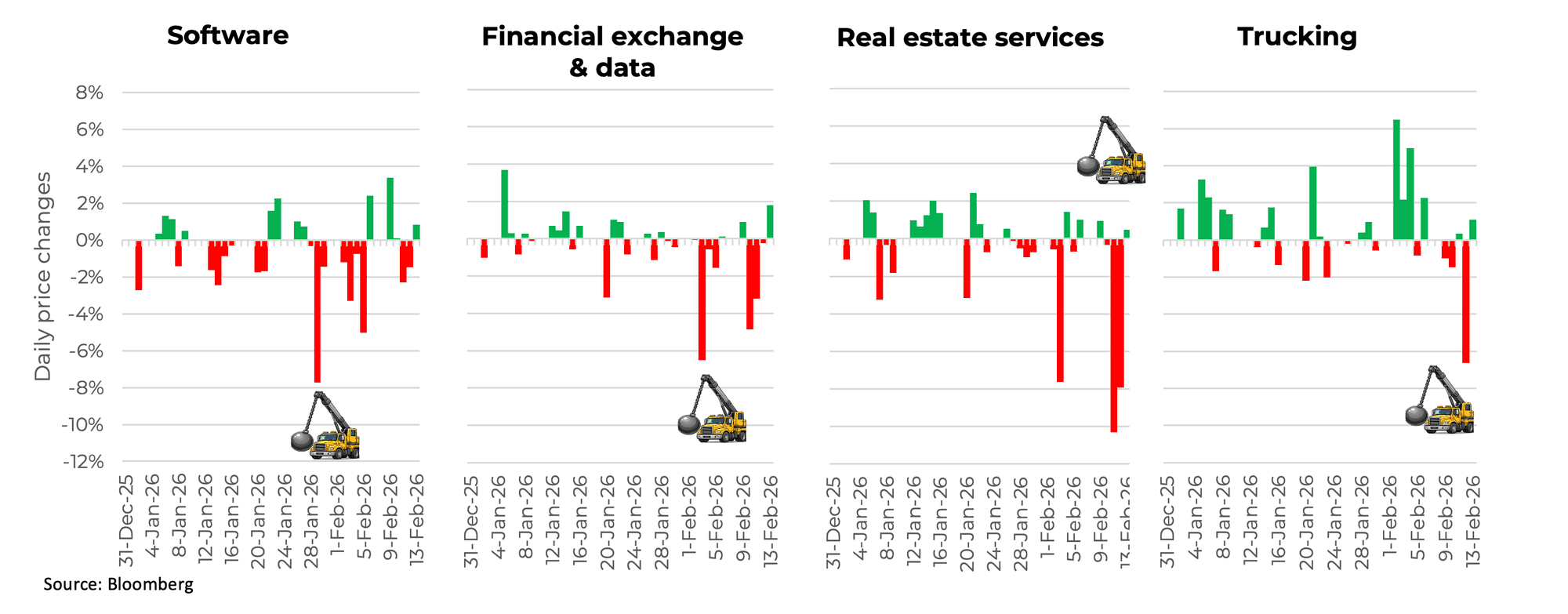
As the AI wrecking ball moves from one industry to the next on even the slightest whiff of disruption, does it present an opportunity, or is the market right to drop five, 10, even 20%? Markets do overreact in the short term and sometimes underreact in the really long term. It also appears these dramatic moves are driven in part by retail and likely some quant algorithms. It’s somewhat reminiscent of Roaring Kitty, but instead of hyping up questionable business models, it’s quickly deflating profitable businesses.
Leadership Rotation: Can The Market Have It Both Ways?
Lately, there have been rising concerns over the return on investment for the hyperscalers that are building out AI infrastructure. The capex levels are eye-watering and still rising, while the market is simply not sure they will make enough money to justify the dollars spent.
This is captured in the credit default swaps for Oracle, perhaps the hyperscaler with the most aggressive push into the space. In September, swaps sat at 40 bps, now 160 bps. BUT, if AI can disrupt all the above-mentioned industries in a material way, there’s clearly huge ROI potential.
As with everything, the truth usually sits somewhere in the middle. The hyperscalers will likely have a challenging time generating enough ROI, but they have strong balance sheets and are comfortable with the risk. Plus, the trend over the past year has been to spread that risk via more debt structures and circular finance arrangements. On the various industry sides, yes, there will be disruption, and business models will evolve – just probably not in the doomsday events being priced in off one headline here or there.
This has all created a higher level of divergence in the market. In fact, it’s a level of divergence, measuring performance dispersion among index members, that is most often seen during market selloffs. But the market aggregates are down just a bit. What has been saving the overall market from a weakening technology sector was originally the defensives in Q4 2025, including health care, consumer staples, utilities, and telcos. More recently, cyclicals from industrials, energy, and materials have been the saviours.
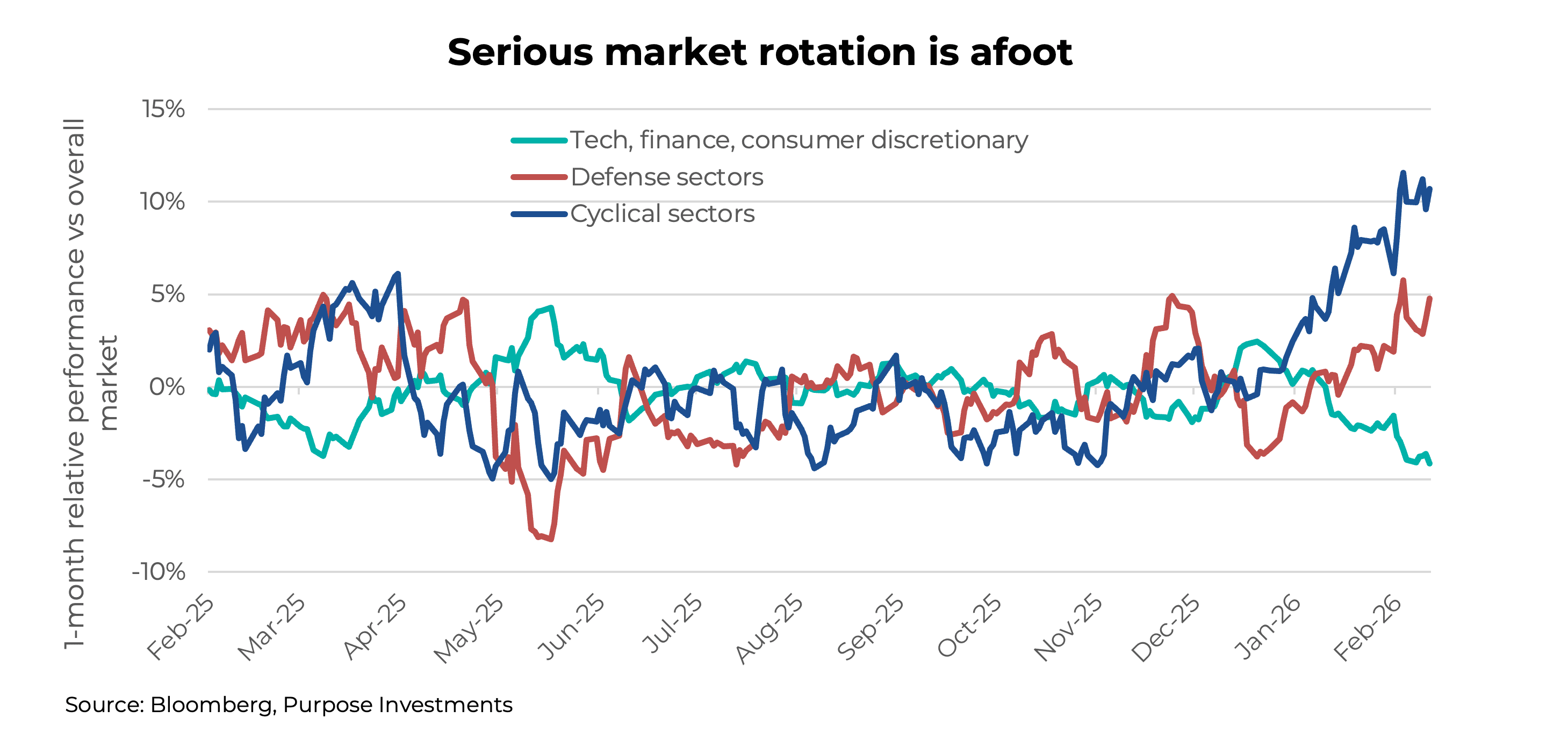
For all the fanfare, we should point out that the S&P 500 is currently (1:15 pm on February 13) down a paltry 1.7% from its all-time high set in late January, with the TSX down 2.0% from its all-time high set two days ago. At the headline index level, this is really just noise. But it does highlight the fragility of this market so far in 2026. Even in smaller companies that don’t influence the index much, these kinds of moves are not signs of a healthy market.
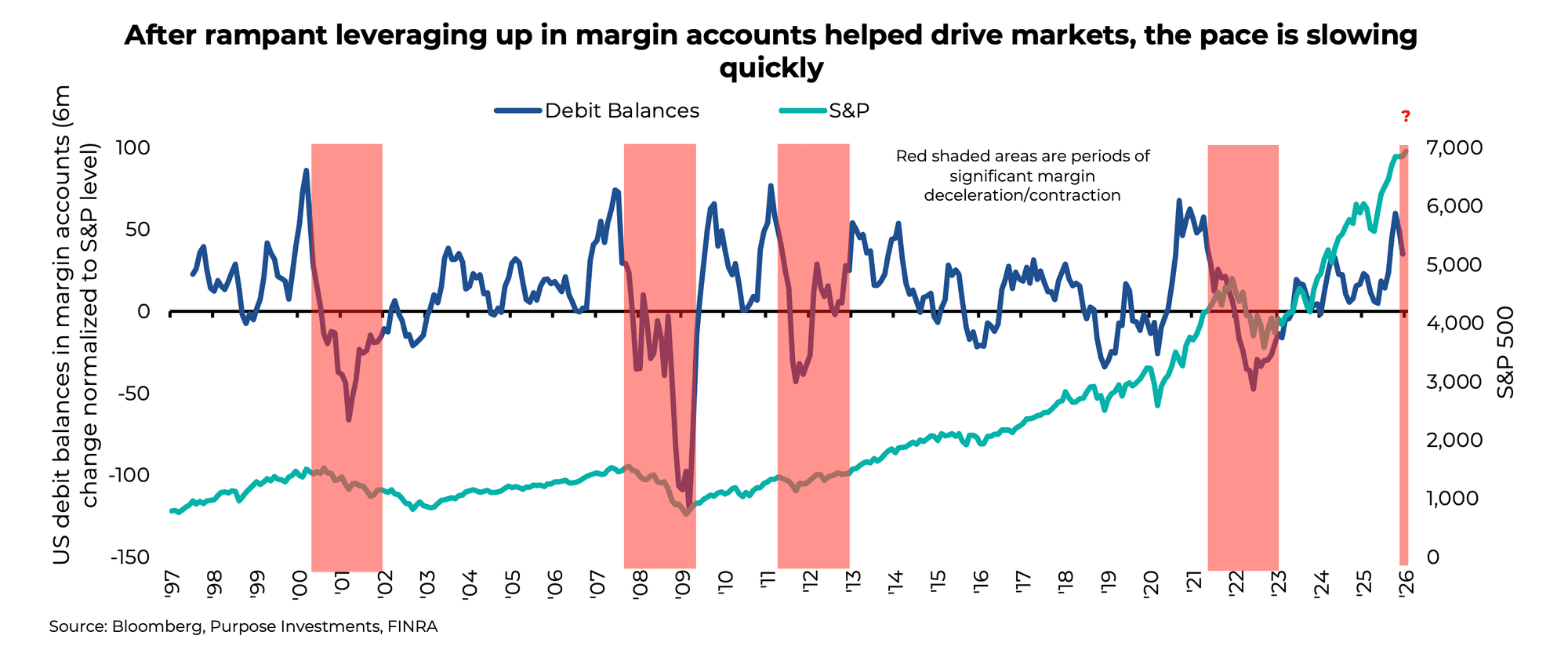
Another point of interest that supports maintaining a bit of a defensive tilt in 2026 is leverage. One factor that really helped equity markets post those strong returns in the second half of 2025 was increased leverage by investors. The chart below is the six-month change in debit balances, adjusted for the level of the S&P. This makes comparisons with years past a bit more apples-to-apples. Late last year, there was a pretty big increase in debit balances and stock ownership in margin accounts, as investors took on more leverage. The key is that when this reverses or loses upward momentum, a market reversal often follows as well. And based on the latest data point (December), the pace of margin growth has slowed.
Final Thoughts
A change in leadership, the AI wrecking ball hitting one industry after another, margin leverage starting to lose momentum, and a market that is less than a stone’s throw from all-time highs: could be good reasons not to chase this market. That being said, those price reactions in various industries are clearly knee-jerk at this point, and could present potential opportunities.
(The stocks mentioned are for informational purposes only and do not constitute a recommendation to buy or sell these securities.)
— Craig Basinger is the Chief Market Strategist at Purpose Investments


