
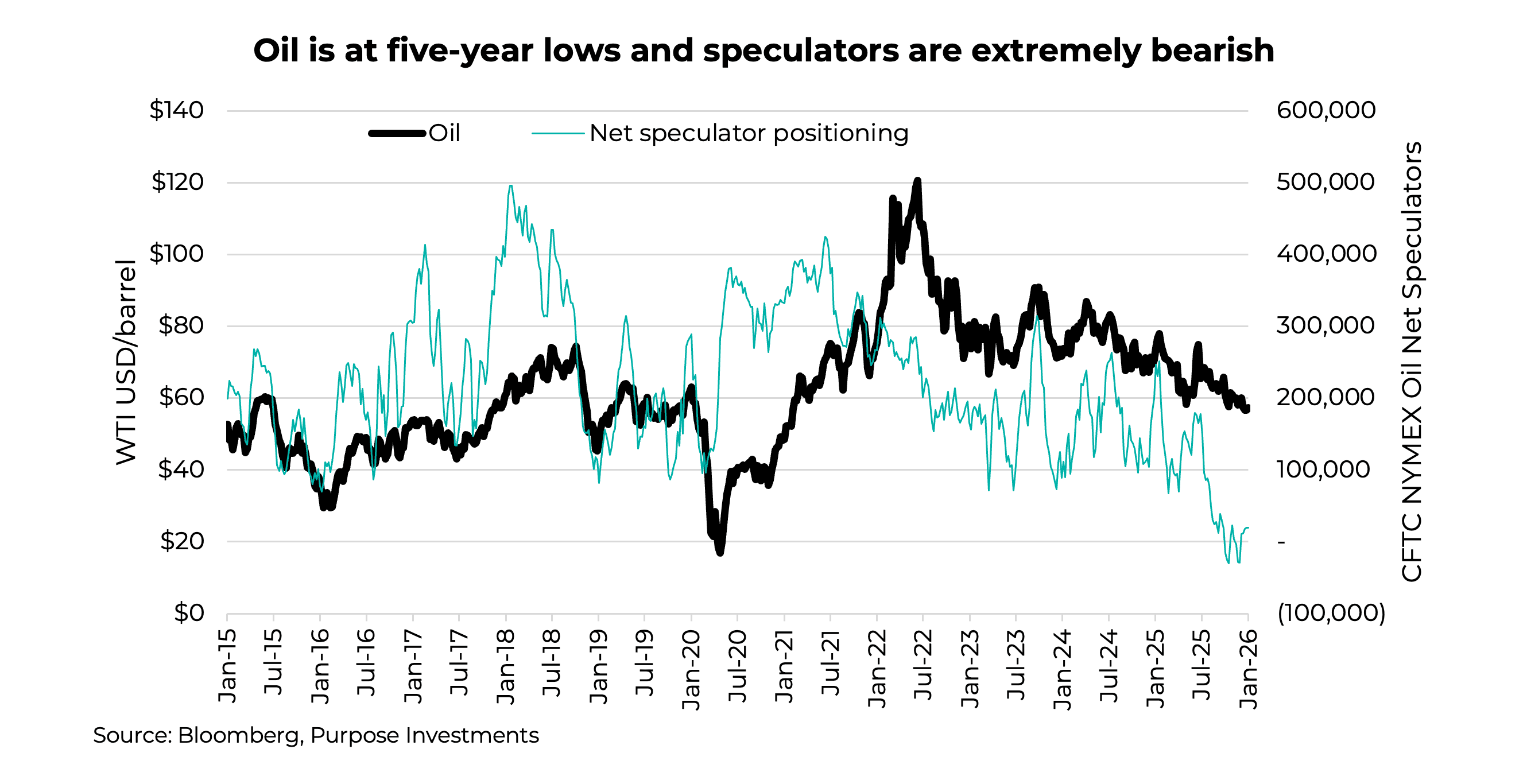
The price of oil is pretty much at a five-year low, in a world where everything costs much more than it used to. Thank God my car doesn’t run on gold. Before delving into the Canadian energy space and the developments in Venezuela, here’s a brief synopsis from our reading, research, and thinking on oil.
First, there’s too much oil in the world as we move into 2026, with both supply and demand sharing the blame. Supply has increased thanks largely to a few mega projects ramping up (e.g., the facilities in Guyana’s Stabroek Block); U.S. production holding up even with less drilling; and, obviously, OPEC removing previous production cuts.
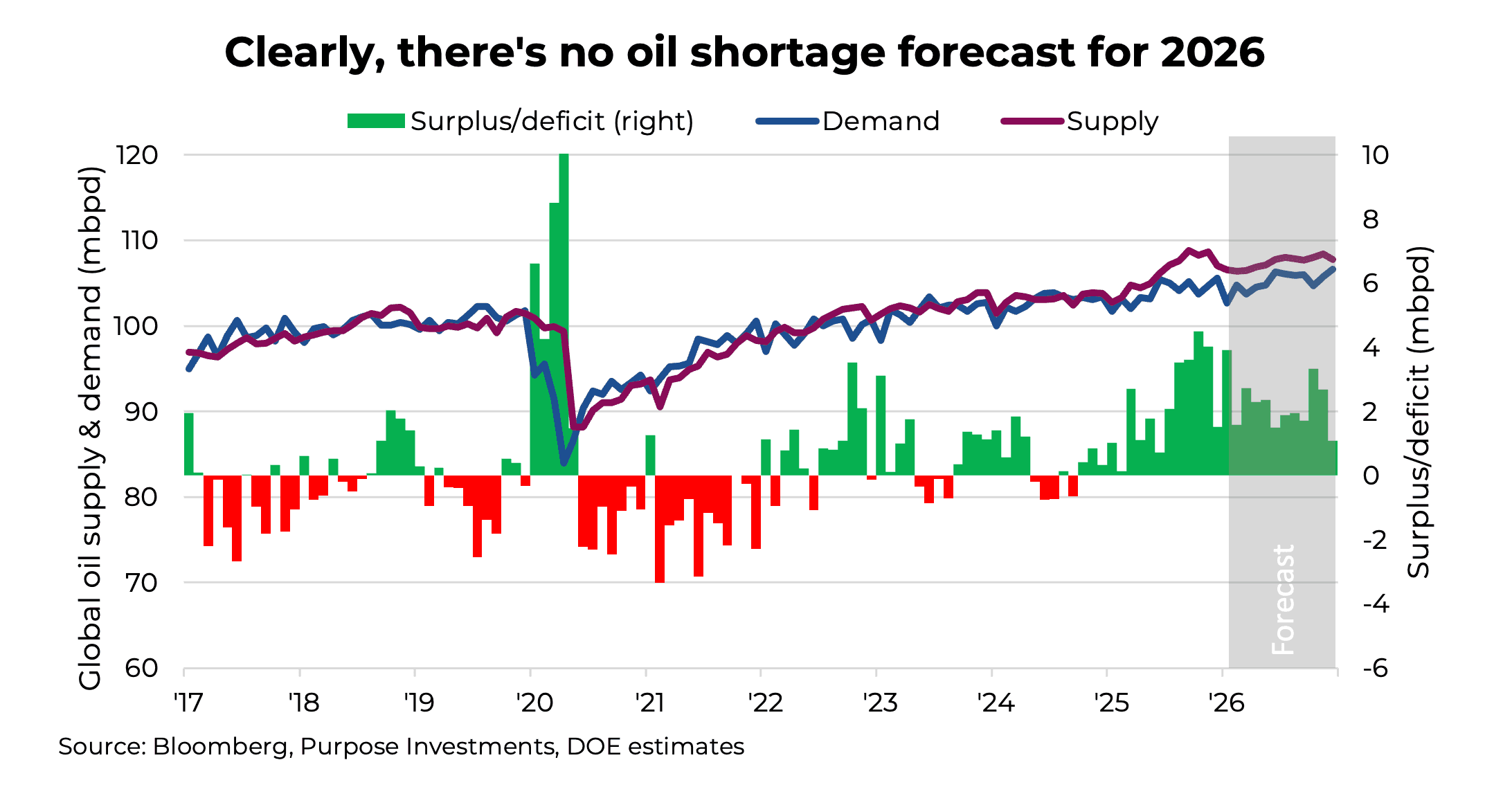
Meanwhile, demand growth has been rather flattish and is much more complex as the relationship between economic growth and oil demand has softened. The rising share of EVs and hybrids is having a gradual impact on gasoline demand, perhaps magnified somewhat by the hybrid work-from-home evolution that has simply reduced miles driven. China, historically a driver of oil demand, has seen flattish demand over the past few years. This is partly due to increased EVs, but their real estate crisis has likely been more impactful. Construction activity is a heavy user of oil.
On the positive side, other emerging markets are seeing rising demand, including notables such as India and Indonesia. Air travel is expanding, and while planes are more fuel-efficient, this is a positive demand. Petrochemicals as feedstocks are also becoming the most impactful demand factor.
Add this all up, plus a dozen factors not listed, and we have too much oil. The world knows this, the market knows this, the forward energy curve knows this, and hence oil is trading where it was five years ago. [Side note: the book I’m currently reading is When Everyone Knows That Everyone Knows…]
So What Happens Next?
We’re contrarian by nature, so when everyone is saying the same thing, we become interested. Currently, oil has a record number of speculative shorts or bearish bets. Often at extremes, this is a very good contrarian indicator. Near-term bounce potential aside, what about that surplus?
On the demand side, there are a few factors that may prove the broader consensus wrong. The EV/hybrid rising adoption trend will continue, but it may be moderating somewhat based on subsidy reductions and fewer announcements from auto manufacturers. And while work-from-home trends are sticky, the gradual trend is pointing toward more days in the office.
The bigger lift may come from developing economies. China’s real estate crisis is not over, but it’s starting to improve. And the economic momentum across the broader developing economies appears strong. This all may help firm up the demand side of the equation. We would add the caveat that if an economic slowdown manifests, which isn’t really in anyone’s forecast, all bets are off. That’s always a risk, though.
Supply is a bit more encouraging as well. There have been very few large projects started in the past number of years, and this may start to help on the supply side. Add to this the fact that U.S. production growth optimism is falling, and drilled uncompleted wells (DUCs) are at historical lows as the extended period of lowish oil prices has reduced drilling activity.
Based on the first chart, the surplus is already set to moderate somewhat in 2026 from the second half of 2025 (green bars are smaller). If a few of the above variations develop, perhaps the market is a little too bearish on oil.
The Situation in Venezuela
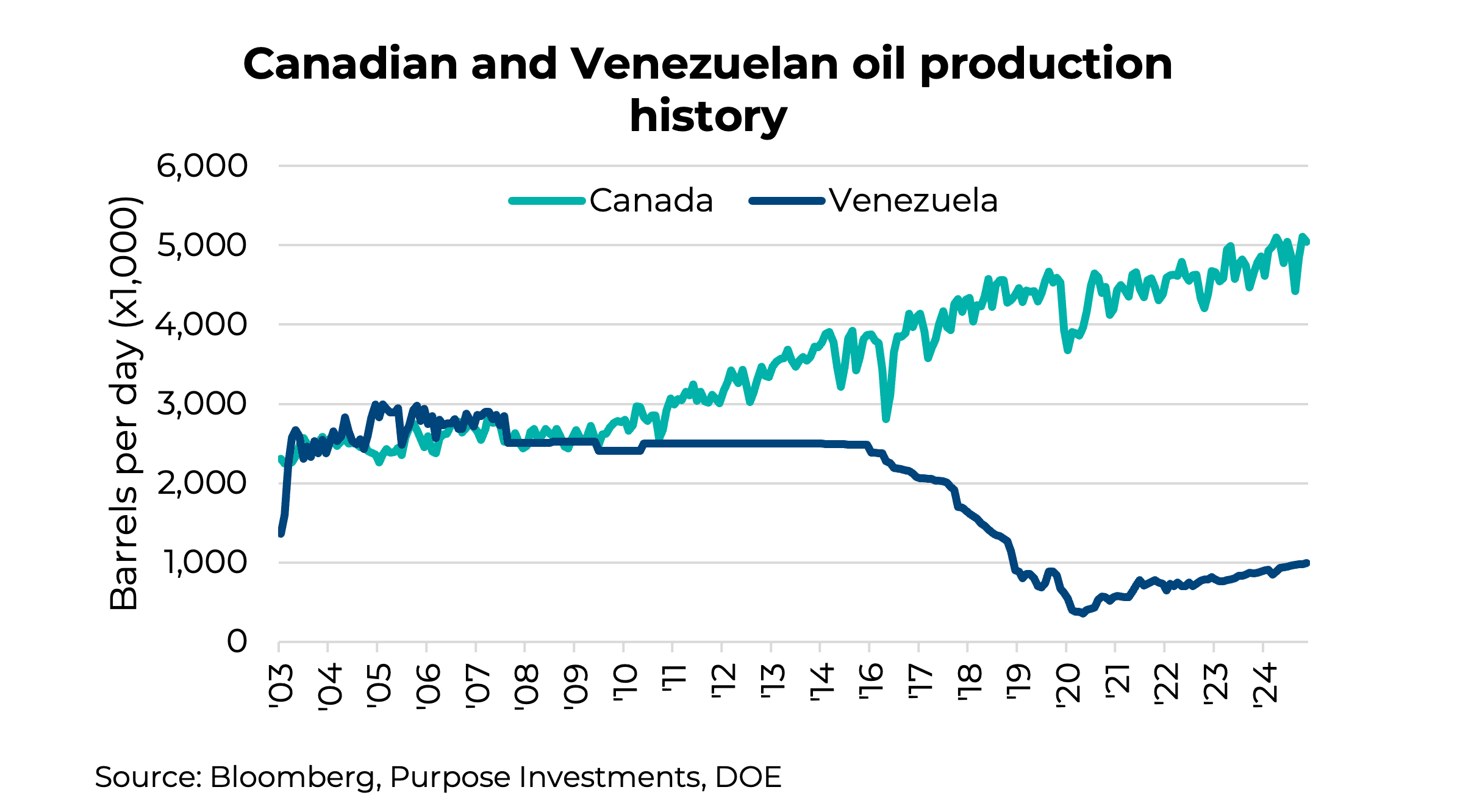
We could write multiple editions of the Ethos on everything that is still unknown about this evolving situation. On the surface, Venezuela still has huge reserves of heavy oil, which is primarily what we have in Canada, so it’s a direct competitor as a key feedstock for U.S. refiners. And before Venezuela gradually nationalized its energy assets a few decades ago, it produced three million barrels per day. Today, that figure sits at less than one million, with most exports going to China before last week’s events. As Venezuela’s exports fell, Canada and Mexico filled the void.
Will U.S. energy giants jump back in with investments, given their previous experiences? Some are still owed billions from Venezuela for seized assets. The structure of the fields and the status of infrastructure and port facilities are big variables in any capex required to start improving production. Companies remember past experiences and what can happen when new leadership takes hold, whether in Venezuela or in the U.S. Even the ways in which the Venezuelan government evolves in the near term are a big unknown.
Huge reserves with low cash costs are attractive. But there are likely additional costs from importing diluent, upgrading, transportation inefficiencies, and a history of theft. Bloomberg New Energy estimates break-even costs just under $40/bbl, roughly the same as in-situ oil sands. The timing of the production ramp is also pretty wide: most are clustering around two to five years.
Increasing production from Venezuela would put pressure on differentials, a negative for Canadian energy names. It’s worth noting that this production may start coming online when the world needs more oil, assuming the global surplus fades. If two million barrels of production hit the market today… yikes. If it happens in 2027–2029, it likely won’t be as bad.
At the very least, this should encourage policymakers in Canada to push harder for infrastructure to help reach new markets for our energy resources. We don’t think it is a coincidence that Prime Minister Mark Carney is visiting China shortly. Once Venezuelan oil shipments were curtailed a few weeks ago, China began quoting more Canadian oil for import.
Final Thoughts
We believe it’s a bit premature to take oil headlines at face value and make broad-based assumptions or guesses. Venezuelan developments add a smidge more risk, but at this point, we wouldn’t overreact and would view equity weakness as an opportunity. But we could see some weakness from a few factors:
- Global energy demand is seasonally weak during Q1; this may exacerbate talk around the size of the current global surplus.
- The Venezuelan situation may embolden the U.S. administration to be ‘extra prickly’ during the U.S.-Mexico-Canada Agreement (USMCA) renewal negotiations, which could weigh on equities.
In the meantime, we believe in patiently and comfortably holding pre-existing positions, clipping dividends, and hoping the market overreacts.
— Craig Basinger is the Chief Market Strategist at Purpose Investments
Get the latest market insights in your inbox every week.
Sources: Charts are sourced to Bloomberg L.P.
The content of this document is for informational purposes only and is not being provided in the context of an offering of any securities described herein, nor is it a recommendation or solicitation to buy, hold or sell any security. The information is not investment advice, nor is it tailored to the needs or circumstances of any investor. Information contained in this document is not, and under no circumstances is it to be construed as, an offering memorandum, prospectus, advertisement or public offering of securities. No securities commission or similar regulatory authority has reviewed this document, and any representation to the contrary is an offence. Information contained in this document is believed to be accurate and reliable; however, we cannot guarantee that it is complete or current at all times. The information provided is subject to change without notice.
Commissions, trailing commissions, management fees and expenses all may be associated with investment funds. Please read the prospectus before investing. If the securities are purchased or sold on a stock exchange, you may pay more or receive less than the current net asset value. Investment funds are not guaranteed; their values change frequently, and past performance may not be repeated.
Certain statements in this document are forward-looking. Forward-looking statements (“FLS”) are statements that are predictive in nature, depend on or refer to future events or conditions, or that include words such as “may,” “will,” “should,” “could,” “expect,” “anticipate,” “intend,” “plan,” “believe,” “estimate,” or other similar expressions. Statements that look forward in time or include anything other than historical information are subject to risks and uncertainties, and actual results, actions, or events could differ materially from those set forth in the FLS. FLS are not guarantees of future performance and are, by their nature, based on numerous assumptions. Although the FLS contained in this document are based upon what Purpose Investments and the portfolio manager believe to be reasonable assumptions, Purpose Investments and the portfolio manager cannot assure that actual results will be consistent with these FLS. The reader is cautioned to consider the FLS carefully and not to place undue reliance on them. Unless required by applicable law, it is not undertaken, and is specifically disclaimed, that there is any intention or obligation to update or revise FLS, whether as a result of new information, future events, or otherwise.


