
Here’s a fun format for the Purpose 2026 Outlook: it’s a conversation with a mythical client who is asking our macro team questions. The questions are based on survey feedback from a few weeks ago, and we’ll attempt to answer the most popular investor/advisor investment questions as we head into 2026. And if you don’t care for this conversational format, you can also jump to whichever section most interests you.
• I. Reflecting on an Awesome 2025• II. Economic Resilience
• III. Inflation Diverging
• IV. Central Bank Converging
• V. Do Tariffs Still Matter?
• VI. Allocating for 2026
• VII. How to Make, or Not Lose, Money in 2026 • VIII. Portfolio Construction & Final Thoughts
I. Reflecting on an Awesome 2025
— Spencer Morgan, Director of Portfolio Strategy
Client Question: I’m just going to say, “Wow!” In a year that included a trade war, some real wars, a U.S. government shutdown, and a steady flow of generally depressing headlines, my portfolio didn’t seem to mind at all. In fact, this has been a good year. Before we jump into 2026, can you please help this make sense?
If you gave an investor a crystal ball at the start of 2025, providing some of the headlines and events listed above, most would have assumed portfolios were destined for the shredder, or at least a challenging year. They would have been spectacularly wrong, with markets posting pretty incredible gains and the TSX leading the charge!
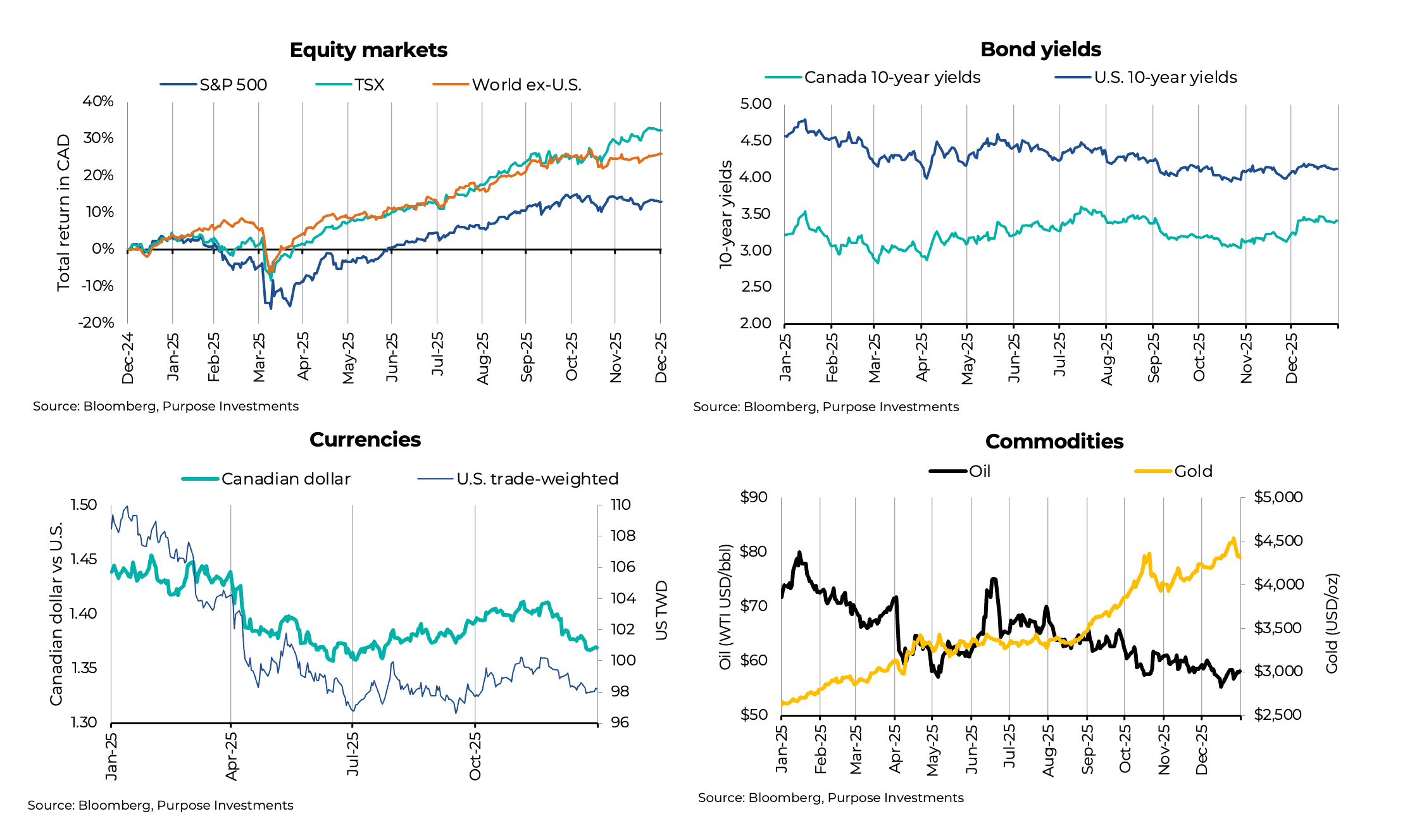
2025 turned out to be one of the better years in recent memory for portfolios across the board. Global equities returned strong double-digit returns. Gold had a banner year. Even bonds, still scorned from a challenging 2022, provided respectable income and some modest appreciation. A balanced global portfolio returned around 14% in CAD terms.
Q: So just how did markets shrug off all the news that was seemingly pure doom and gloom?
We think it came down to two things: a resilient yet not-too-hot economy and corporate earnings. Despite all the noise, the global economy proved remarkably resilient, weathering tariffs, softening labour, and still rather high interest rates. Inflation, while a little sticky in spots, did not reignite and continued to cool. This combo of resilient, albeit slow, economic growth and cooling inflation emboldened central banks to cut. The Federal Reserve ended a nine-month pause and resumed cutting in September, delivering three cuts by year-end. The European Central Bank was even more aggressive, cutting four times in the first half of 2025 alone. This monetary accommodation proved a powerful tailwind for risk assets.
And then there are earnings, which were unfazed by policy uncertainty. The bigger story was earnings growth going global. In the previous few years, the U.S. equity market enjoyed strong earnings growth while most other markets did not. This changed in 2025 as Canada, Europe, Japan and Emerging Markets all enjoyed strong earnings growth. Given the lower valuations in these markets, this created a strong tailwind for markets outside the U.S. Fund flows went more global too, helping boost performance in many non-U.S. markets as investors at least started questioning U.S. exceptionalism.
The TSX has had an incredible year, posting a +32% return and sitting near the top of the leaderboard. About two-thirds of this gain came from Financials and Materials, driven by banks and gold. Banks enjoyed a valuation lift, which was a global trend this year. Meanwhile, gold enjoyed an astronomical rise from $2,500 to $4,500/oz. Perhaps a little bubbly?
Speaking of bubbles, just about anything AI-related flew higher in 2025. There’s a race to build data centres to enable increased AI usage, with most major technology companies willing to spend billions in the hopes of leading this technological wave. More on this later.
The “buy the dip” mantra was once again the winning strategy. The U.S. tariff Liberation Day announcements culminated in global equities down -16% from highs in mid-February. And while trade uncertainty persisted, markets seemed to Shake It Off and climbed higher for the rest of the year. Perhaps they’ve learned to distinguish between alarmist headlines and real economic damage, or perhaps the economic damage simply takes longer to manifest.
Portfolios that performed best in 2025 were not the ones that predicted all twists and turns, but those that were diversified and maintained discipline, proving once again the importance of staying invested through uncomfortable periods.
As we turn attention to 2026, that principle will be tested again. The questions facing investors have evolved, but the temptation to react emotionally to headlines has not.
Let’s look at what lies ahead.
II. Economic Resilience
— Craig Basinger, Chief Market Strategist
Q: So we have a new leader who seems to be making good moves for the Canadian economy. Will that be enough to kick-start our economy, given a still-challenging trade situation and housing that seems dormant?
Is it just me, or does the Canadian economy never get any respect? Thanks to a strong Q3, the consensus has our economy growing by 1.7% for the year with just one quarter of data to go. It added +218k jobs this year, driven by health care, finance, and transport, with only a minor lift from government. It’s also notable that manufacturing jobs remained flat, and business bankruptcies are down around 20% from the pace a year ago, according to the Office of the Superintendent, despite the tariffs at the border. The Canadian economy is somewhat following most other economies, after a soft patch in the spring and early summer, and the economic data has been decent.
2026 may have many challenges in store, with some tailwinds as well. Tariffs got the headlines in 2025; 2026 is likely the year they start to meaningfully impact economies and business financial statements. Currently, Canada’s effective tariff rate is 3.9%, one of the lowest among U.S. trading partners. An upcoming review of the United States–Mexico–Canada Agreement (USMCA) is a first-half risk, but more on that later. Trade uncertainty remains a headwind for Canada.
Housing is so-so. Prices are somewhat flat to grinding a bit lower, yet activity is improving. The energy space is managing these lower oil prices, with some improved optimism. Higher gold and metal prices are helping boost activity in the mining sector. Overall, the Canadian economy is likely going to continue chugging along in 2026, albeit still at a muted pace.
And yes, new leadership and their direction are certainly a positive development. I’m a fan, but I have a soft spot in my heart for economists.
Q: Alright, that seems reasonable. What about those folks south of the border? I hear lots about a K-shaped economy and the consumer getting tired. Is 2026 finally the year that the American economy stumbles?
The K-shaped economy denotes a wealthy upper class doing very well and the lower-income cohorts doing poorly. That’s certainly the case today. Owners of assets have done very well of late, further boosted by three solid years in the markets. The lower arm of the K is certainly having a tough go, with inflation generally running higher than wage growth, and more recently, limited labour gains. There are rising delinquencies, especially among auto loans, as a sign of a struggling consumer. The U.S. economy has always been K-shaped; the question is whether the lower arm of the K will drag the economy down, given that the K continues to widen.
We’re increasingly seeing signs of a struggling U.S. consumer, and the labour market is becoming increasingly concerning. The three-month change in employment has fallen to zero, which historically has preceded or occurred early in a recession. Now there are many “excuses” being given for this trend. Lower population growth, due to much lower immigration, has made the steady state change in employment much lower than in previous years. The government shutdown muddied the waters a bit. We don’t believe this is AI-related because these days, it appears more companies are hiring people to help build/implement AI than laying off employees due to AI-created redundancies.
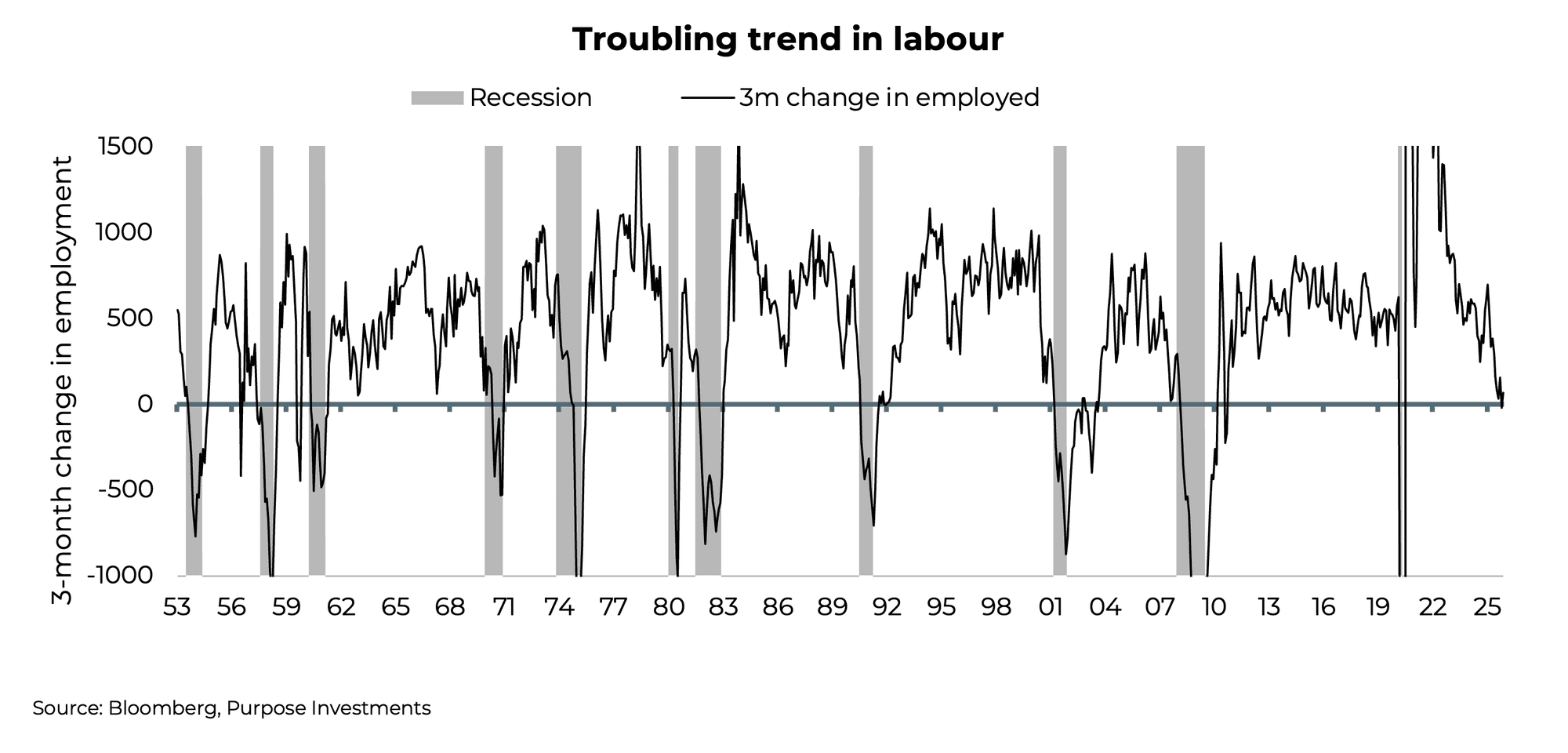
Ignoring bad economic data could be a recency bias issue. Remember in 2022–2023 when all those economists warned of a recession and none showed up? We were fooled too, as so many historical indicators flashed recession from the yield curve, sentiment, etc. We do wonder if now everyone is ignoring warnings after being fooled a few years ago, providing excuses as to why we should ignore bad data, like the previous chart. Nobody is talking recession at the moment.
It's probably justified, though, as there are some big positives to counter a weakening consumer, at least for now. The One Big Beautiful Bill Act (OBBBA, clearly some good marketing) is front-end loaded for 2026, and even has some provisions for lower-income consumers. Plus, oil prices are lower. However, the big tailwind for the U.S. economy is capex (capital expenditure) that’s being driven by AI-related data centre spending. The hyperscalers are expected to spend almost $150 billion per quarter by the end of 2026. That might not sound like a big deal for an economy with a nominal quarterly GDP of around $7 trillion, but capex carries such a strong multiplier effect for the economy it punches well above its weight.
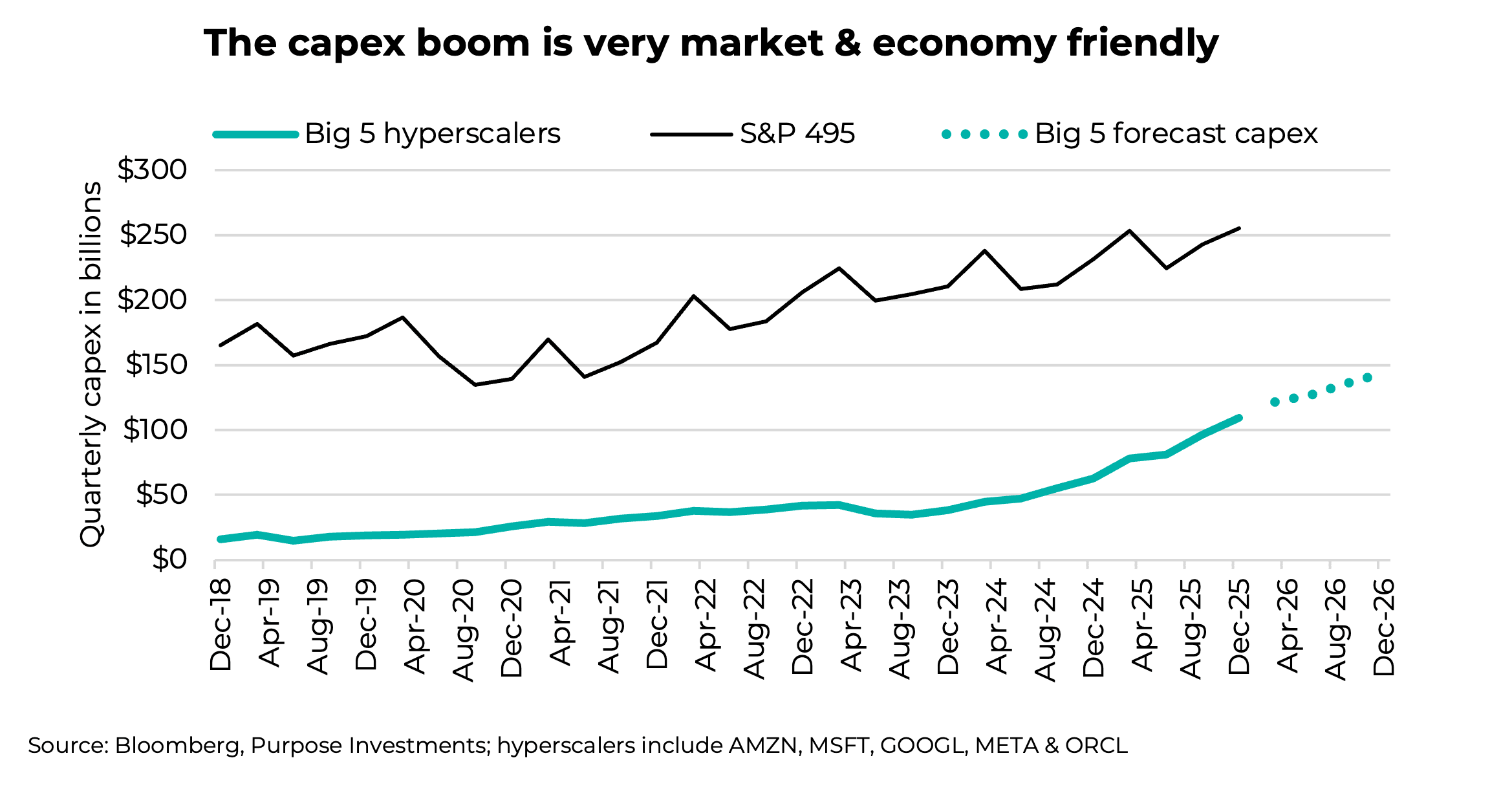
Continued fiscal impulse under the new budget and strong capex spending are offsetting a struggling consumer, lower immigration, and trade headwinds. We too don’t see much risk of recession, and currently expect the U.S. economy to continue along in 2026. Keeping a close eye on accelerating labour/consumer weakness would certainly raise some alarm bells, as would any hiccup in the AI-related enthusiastic spending. Hopefully, we’re not suffering from recency bias as well.
Q: You have a positive view on international markets based on our previous conversations. Does that extend to the global economy?
It certainly does, as there’s a broad trend afoot with more developed economies pivoting towards growth-friendly policies and stimulus. Germany, Japan, and France have some of the strongest fiscal impulses in 2026 among major economies. And an increasing focus of this spending is on defence and infrastructure, which also carry strong multiplier effects for their respective economies.
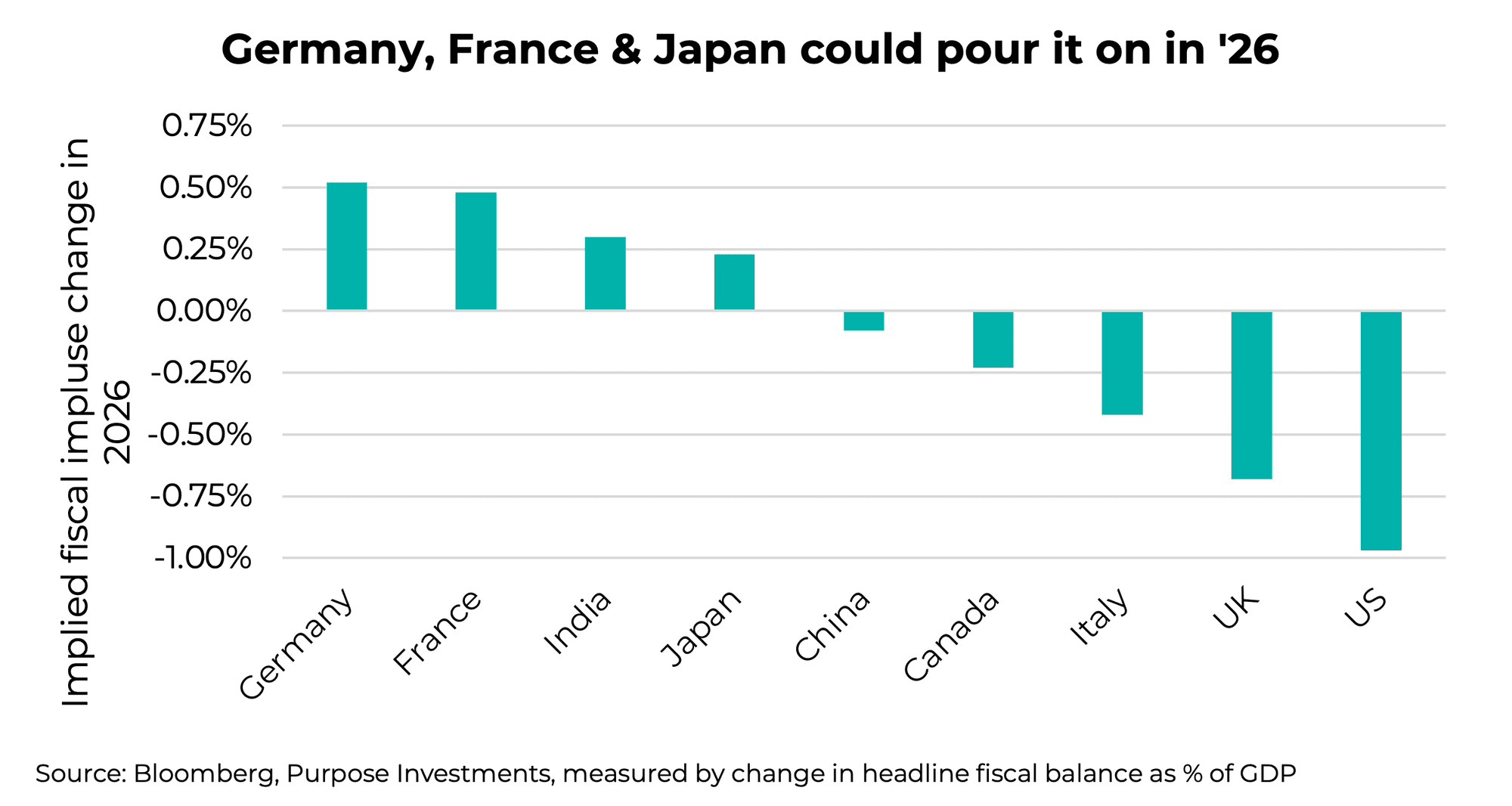
Given the size of the respective output gaps and an estimation of slack in the economy, Europe has more room to stimulate before it would become inflationary. We can add to the positives material rate cuts from the ECB in 2024 to early 2025, which are starting to impact economic activity. Changes in rates often take time to leave an impact. The European consumer is in great shape with less debt, as are their corporations. Tariffs with the U.S. and trade uncertainty represent headwinds, but overall rather encouraging.
Turning to Asia, we’re also encouraged. Japan’s Nikkei has finally bested its previous peak set way back in 1989 and moved meaningfully higher. Demographics and debt remain headwinds, but there’s positive change afoot as corporations are becoming more shareholder-friendly. The yen is very cheap, and the government is also becoming more growth-focused. On the developing economic side of Asia, there’s also decent news. Most of these countries were ahead of developed countries in hiking rates and then cutting them, which they’re benefiting from today. Add in our continued mild bearish view on the U.S. dollar and we do like developing economies and Emerging Markets for 2026.
Put it all together and, from an economic perspective, things are ok at the moment. There was an economic growth scare, albeit a minor one, in the summer of 2025, but since then, the data has firmed – not a lot, but enough to cool recession fears, and not too much to kickstart inflation. That did help markets rally into the year-end. Either of these could change quickly, so keeping an eye on trade, labour, and inflation remains top of our minds.
III. Inflation Diverging
— Craig Basinger, Chief Market Strategist
Q: Prices are still pretty high, but inflation appears to have continued to cool or decelerate in 2025. Will this trend continue in 2026, or will inflation become an issue once again?
Inflation did continue to cool last year, as the World Economy Weighted Inflation dropped from 4.4% to 3.3%. Supply chain pressures are low, and wage growth and wage intentions have moderated substantially. Let’s not forget that oil prices in the $50/bbl range are a big help too. And while money growth is creeping a bit higher globally, velocity is falling. That’s a long way to say the setup for an inflationary spike higher, similar to 2021/22, just isn’t there.
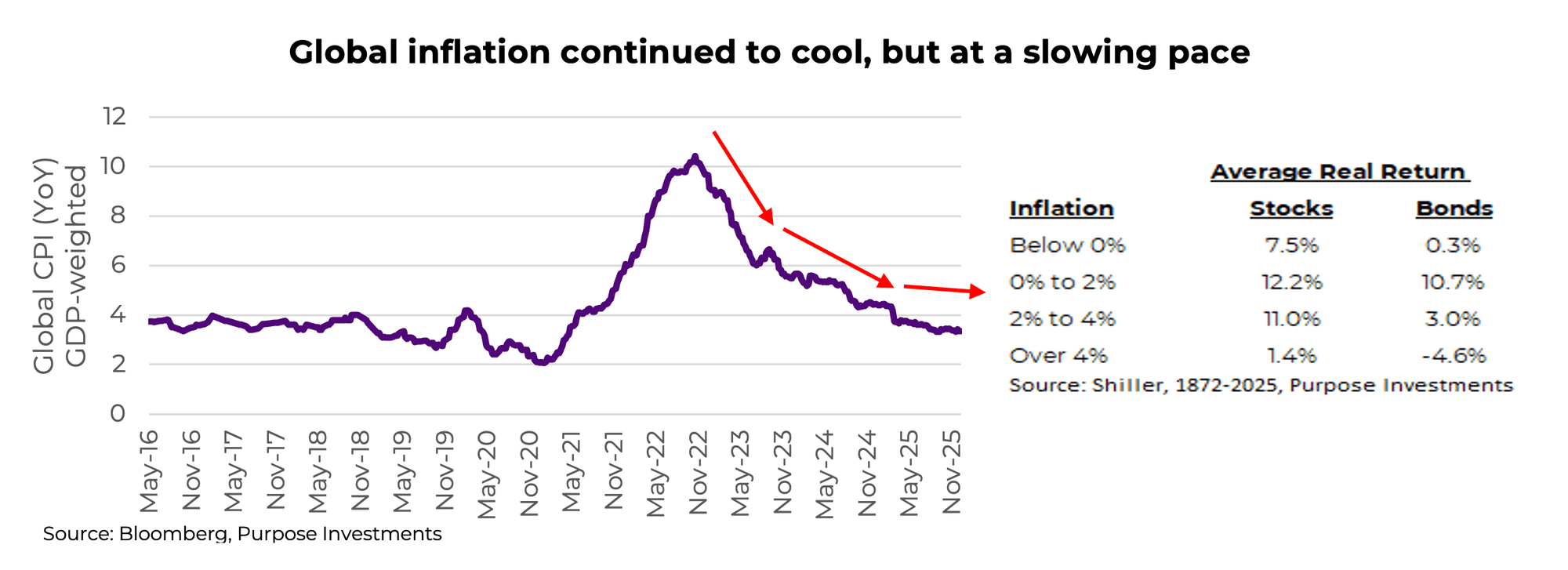
Inflation in the 2-4% range isn’t a bad thing; in fact, it’s sort of the sweet spot for equities, more so than bonds. Companies have pricing power and lots of top-line growth. It’s when inflation gets close to that 4% level that equity markets need to start to really worry.
Inflation may become an issue in 2026, but likely just in small pockets. The inflation spike that the global economy is still recovering from was driven by macro forces that were pervasive. It’s now more of a country-by-country issue. The U.S. is at higher risk given aggressive fiscal spending for a few years, some erosion of central bank independence, and an output gap that is positive (not a gap). The output gap measures the actual economic output compared to the estimated potential that would not be inflationary. The U.S. is running a little too hot. Germany, Japan, France, and Canada all have negative gaps, so if these economies accelerate, it shouldn’t be inflationary until the gap is closed.
Given that the U.S. is the most important inflation data point for markets, this is a risk in 2026. Fiscal spending, immigration policy, and tariffs are inflationary, as is the weaker US dollar. Technology, including AI, may prove disinflationary, but not today. Productivity gains are still a premonition; meanwhile, the data centre buildout is clearly inflationary. Just look at the price of memory or processors – it’s nuts. Low oil prices help, as does a softer labour market, but the risks are to the upside in 2026.
Q: Inflation over the past four years has eroded my purchasing power by over 20%. Thankfully, my portfolio has more than kept up. Beyond the near term, should we be concerned about inflation as it pertains to my long-term funding goals (a.k.a., a very comfortable retirement)?
Good point: inflation this year matters for markets, but over the longer term, inflation is a tax on the future you. We continue to believe that over the next five years or so, inflation will be higher than it was in the 2010s and much more volatile. Inflation in 2021/22 was a supply/demand shock, but secular factors have been gradually becoming more inflationary, or less disinflationary.
Here is our short take on them:
- Globalization – Whether driven by tariffs or supply chain diversification, the trend in globalization has certainly slowed. This has likely moved from a disinflationary factor to an inflationary one.
- Labour/Demographics – For many years, we have had more savers than borrowers, which puts downward pressure on yields and inflation. This balance is gradually softening, and with immigration restrictions, this pace may accelerate.
- Policy – This differs from country to country. Erosion of central bank independence will soften the market impact of monetary policy, the main tool to fight inflation. This is a bigger risk for the U.S. and a few developing countries at the moment, less so for most other central banks. However, one commonality globally is the rise of fiscal spending with limited political consideration of deficits. The hawks are gone as more countries pivot to fiscal spending to help drive economic growth. We celebrate it from a growth perspective, but it will lift inflation.
- Debt – Total debt is disinflationary, as it crowds out investment and consumes capital to maintain. And there’s a lot of debt out there.
- Technology – Anything that improves productivity is disinflationary. Even with all the technology spend over the past 30 years, productivity growth has not accelerated, typically hovering around 1-2%. Maybe AI accelerates this. However, as we’ve pointed out, this is a down-the-road belief, as the use cases and instances expand to become meaningful. In the meantime, the unbridled capex spending on AI infrastructure is certainly inflationary. This will likely feed into more cyclicality of inflation.
To counter the risk of higher and more volatile inflation to your portfolio and financial plan, there are some options. Equities, especially those that pay dividends, are a good defence. Dividend growth, paid out of nominal earnings, has a long history of growing faster than inflation. Real asset exposure also helps. While we are short-term cautious on Canadian equities because of the great run they enjoyed in 2025, which have valuations a bit pressed, the TSX is an index rich in real asset exposure. It’s certainly worth consideration for combating the impact of inflation.
IV. Central Bank Converging
— Brett Gustafson, Associate Portfolio Manager
Q: We got three rate cuts from the Fed and four from the Bank of Canada in 2025. Markets look to be pricing in another two or three from the Fed, which will have a new chairperson soon, and the Bank of Canada may hike. Does the market have it right: divergence in the direction of short-term rates? Anything to worry about here?
“Does the market have it right?” is one of those questions everyone wants a clean answer to, but markets rarely make it that easy. Based on what’s being priced in today, divergence does look like the most likely outcome for the path. That said, those expectations move around a lot. Looking further out towards the end of 2026, it feels less like central banks are going their separate ways and more like a transition toward rate levels that end up closer together.
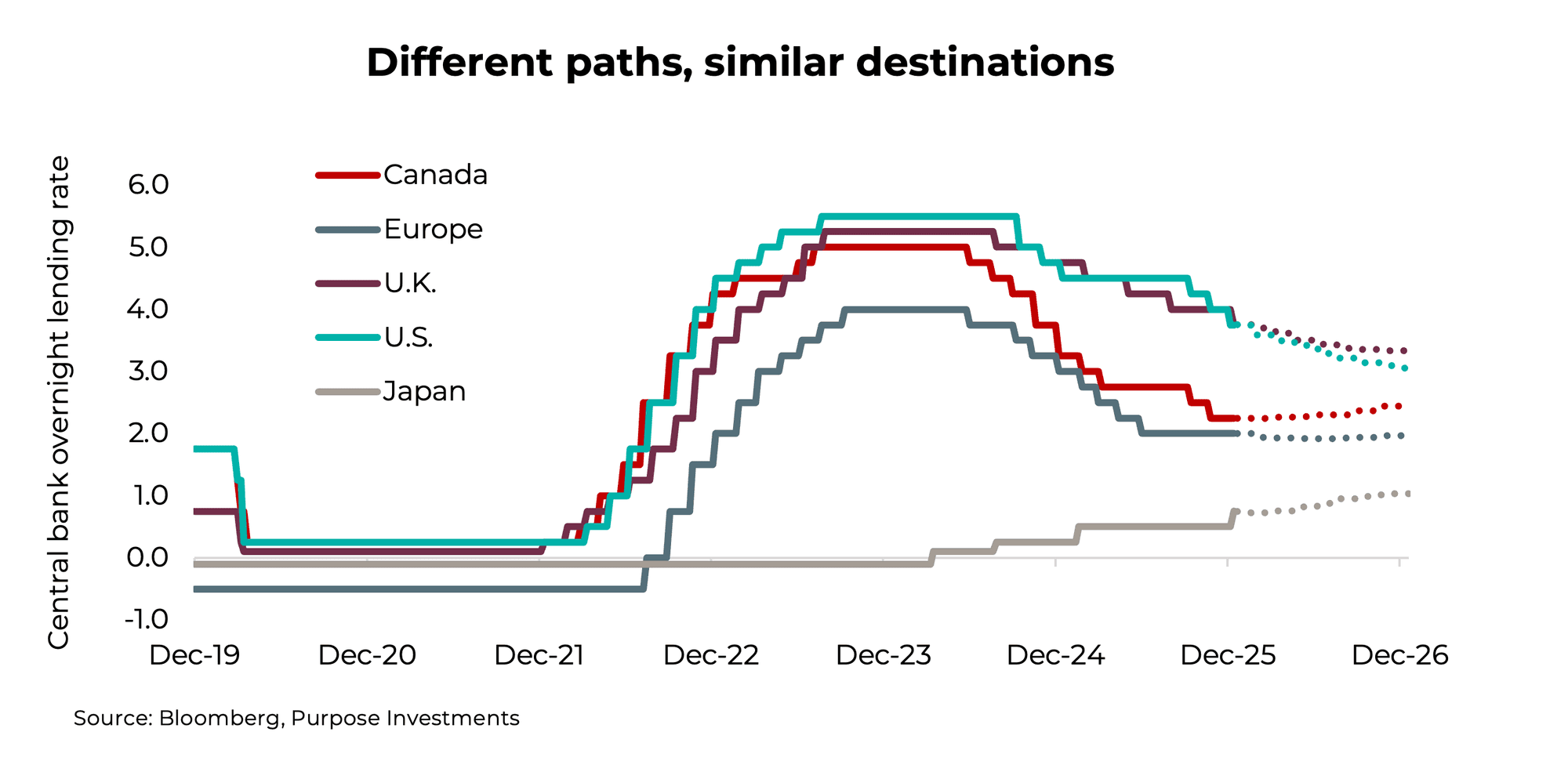
If you look back since 2019, Developed Market central banks took different paths but roughly arrived at the same destination (minus Japan). Canada, the U.S., Europe, and the U.K. all tightened aggressively and have since pivoted toward easing. However, what matters heading into 2026 is not the journey, but the starting point.
Currently, you have lower-rate economies like Canada, Europe, and Japan expecting to pause rate cuts or perhaps issue a hike or two. At the same time, there is an expectation that the Fed and the U.K. will continue easing because they have more runway. That looks like divergence on paper, but the direction of travel is toward global rate levels that are closer together than they are today.
The second layer is the element of politics. Fed independence will be tested in 2026, with a new Chair stepping in and political pressure sitting just below the surface – perhaps even above the surface, with some bad blood from the White House on their preferred level for rates. Markets seem to already be pricing in the idea of a more accommodative bias by expecting three cuts next year in the U.S. Whether that actually plays out in practice is another story. Futures curves have been quick to price in cuts before, only to reverse them when other economic indicators refuse to cooperate.
Context matters; the real shock from monetary policy is likely behind us. Going from 0% to 5% forced a major repricing of all assets. Moving from 5% to 4% or 4% to 5% will not have even remotely the same impact. It will tweak conditions within the regime rather than resetting the system entirely.
When it comes to the “anything to worry about?” part of the question, portfolios, including yours, are built to feel rate movements less than they were before. Compared to a traditional 60/40, the average advisor portfolio holds less fixed income and more cash and alternatives. Since bonds show up as having the most sensitivity, a lower exposure results in an effective portfolio with less beta towards changes in short-term rates.
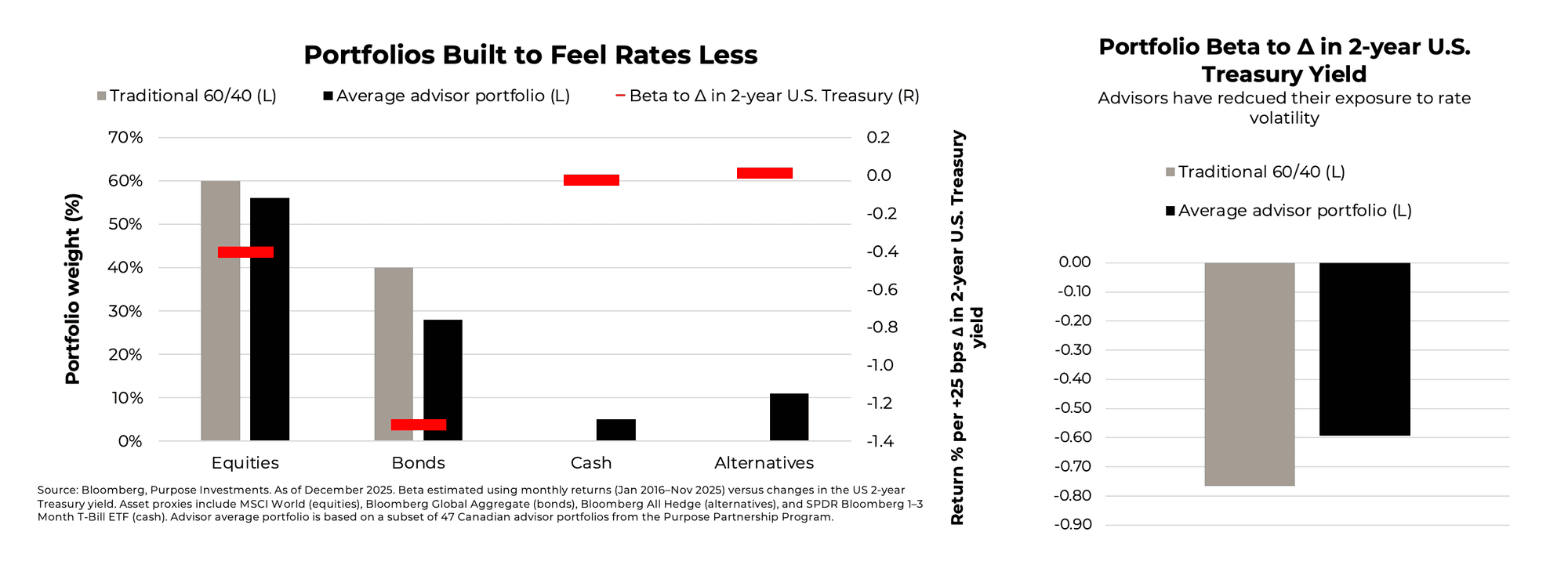
The takeaway is not that one portfolio is better than the other. It’s that the portfolio itself has reduced exposure to interest rate volatility. In theory, it means less downside when rates rise, but also less upside when rates fall. The portfolio is simply built to feel rates less, in either direction.
So yes, policy still matters, and divergence will certainly be in the headlines. But its impact on your portfolio will likely be smaller than it was a few years ago. The days when every CPI print or central bank meeting meaningfully moved balanced portfolios are likely behind us, for now.
Q: One quick question: My eldest is buying a new home. Variable or fixed?
Always a tough decision, let me find my crystal ball. The Bank of Canada has been clear that rates are roughly at the right level. Inflation is sticky, growth is holding up OK, and these rate levels don’t come across as restrictive. The average five-year fixed rates at some of the banks in Canada are only about 35 bps above variable, mainly because fixed is reflecting average rates over time, plus some certainty premium.
With limited visibility on further cuts and some risk, the next move is higher or sideways, locking in at these levels makes sense. This is less about predicting where rates go next and more about how much they value future consistency.
Q: Before we move on, are there any opportunities to capitalize on outside of Developed Markets?
Good question. Emerging Markets do look interesting from a policy perspective. Historically, EM run higher policy rates than developed markets, but it's not the same across every region. Many entered this cycle with higher starting rates and tightened earlier, which leaves more room to ease if inflation and other factors stay contained.
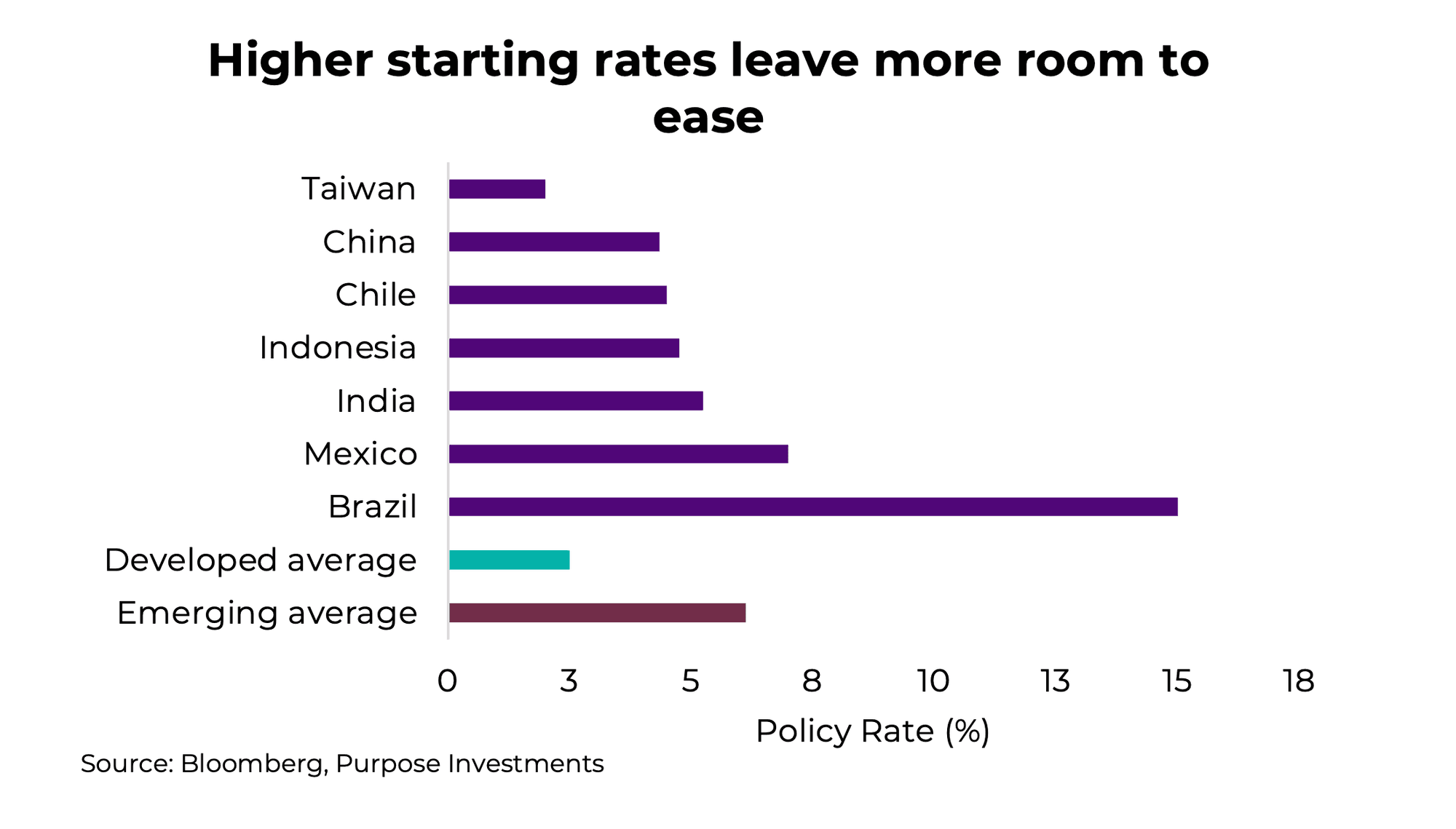
That doesn’t make emerging markets an all-in bet; some areas look better than others. It does mean the policy backdrop is potentially more supportive, especially if the U.S. dollar remains less of a headwind. However, policy alone won’t determine whether the asset class ultimately does well.
V. Do Tariffs Still Matter?
— Craig Basinger, Chief Market Strategist
Q: I learned more about tariffs in 2025 than I care to admit, and now it seems nobody really cares, or at least the market doesn’t seem to. Can I forget what I learned, or should I not be so hasty with the USMCA review scheduled for July? Is this a real risk?
Even though tariff risk was on everyone’s radar at the start of 2025, the way it was communicated was not in anybody’s Wildest Dreams. A cardboard cutout with flags and tariff percentages was a pretty absurd way to kick off a policy-driven market correction. As the tariff levels were delayed or negotiated lower, the market started to lose interest. And as the economy continued to show resilience, the market started to care even less.
But don’t forget what you’ve learned. Tariffs are a tax that is shared by the exporter, importer, and final consumer. The proportional sharing of this burden varies depending on the product and over time. Earlier, more was borne by the exporter and importer, but that may be starting to change. The more important lesson is that markets react to this kind of news very quickly, but the impact on the economy and corporate earnings takes longer and is gradual. In other words, the market may have moved on, but the earnings/economic impact may be just getting started.
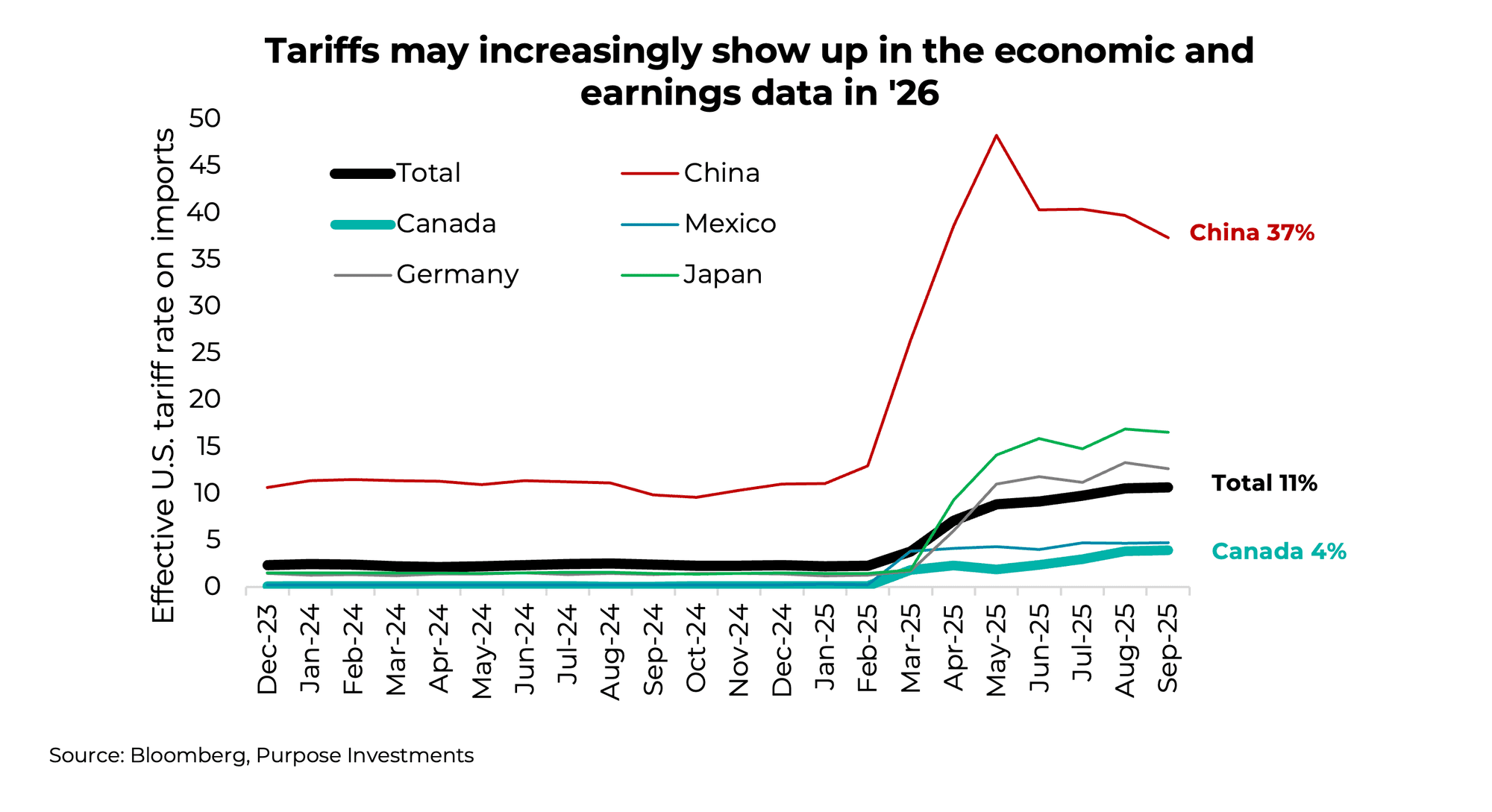
The above chart is the effective tariff rates for the biggest trade partners with the U.S. It’s certainly notable that Canada has the lowest effective tariff rate, as much of our trade with America qualifies under USMCA. That’s good news, but this agreement is scheduled for a review by all parties by this summer. If previous negotiation styles are any indication, we could very well see a lot of disturbing headlines and threats to end the agreement in the coming months during negotiations. That would certainly lead to a Cruel Summer, as it would cause many additional Canadian exports to be subject to tariffs. While we really doubt this would happen, the ebbs and flows of the negotiations could very well impact markets.
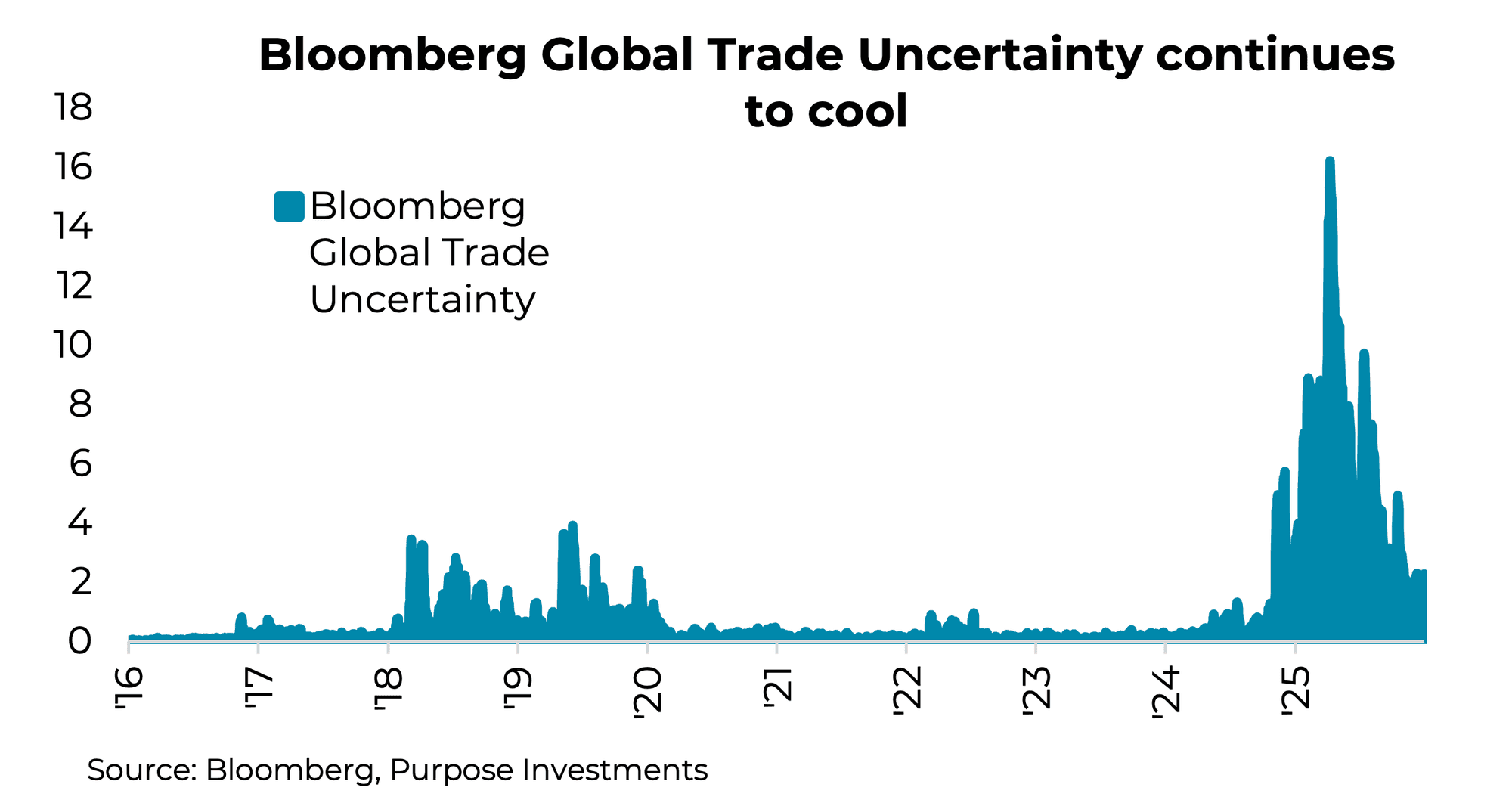
If this flare-up during negotiations does occur, it could certainly create a buying opportunity in 2026. Perhaps most impacted would be transportation stocks. However, it’s possible there is no material market reaction, as more often, these negotiations have been resolved in a market-friendly manner. Global trade uncertainty has continued to moderate or cool down.
VI. Allocating for 2026
— Craig Basinger, Chief Market Strategist
Q: Everything kind of worked out well in 2025, for the most part. And it seems everyone is kinda bullish heading into 2026. Should we be worried about such complacency or lean into it from an asset allocation perspective?
Cheers to 2025 – it really did turn out pretty great, and yes, the consensus is predominantly bullish for markets in 2026. Central banks lowering rates, economies growing at decent paces, more fiscal spending, valuations somewhat expensive but decent earnings growth expectations, some real hype around a new technology, all make for a decent foundation heading into 2026. Bloomberg’s monthly survey of strategists has all 21 pointing to a higher S&P 500 by the year’s end. As contrarians, this would have us concerned, but forecasting positive returns is the norm for this survey.
It's actually very challenging to understand where we might be in the cycle, given conflicting characteristics. Many years of strong markets without a recession are typical in the late stages of a cycle. The AI bubble also fits this mold, as does the elevated inflation and commodity prices.
However, rate cuts and increasing fiscal spending are things that often occur early in the cycle, not in the late stages. It’s possible that fiscal and monetary policy are a bit more experimental these days – current inflation levels certainly don’t support rate cuts. And ramping fiscal spending is supposed to occur when the economy is contracting, which it is not. Policy appears to be trying to goose more economic growth, which may prove to be poor policy. That’s the challenge with policy: you really don’t know if it was a correct decision for many quarters or even sometimes years. Let’s hope Karma doesn’t kick in here.
We believe this is a late cycle, with the big question being how late? Not many alarm bells are ringing, but we do have a mildly defensive tilt heading into 2026: a mild underweight in equities and bonds, while holding a bit more in diversifiers and cash. This mild defensive tilt is predicated on many factors, with these being the most salient:
1. Protecting what we got – We’ve enjoyed solid, above-historical-average returns over the past three years, thanks to allocations and markets. That could extend to a fourth year, but this is a rare occurrence. A mild defensive tilt enables us to reasonably participate if this bull keeps on rocking, but it has us closer to the exit door in case the music stops. We know All Too Well the market can giveth and taketh away.
2. Likelihood of a market stumble – We do agree recession risk is low, but this market may stumble from a few other issues. In 2025, the world trade environment changed, fiscal spending became en vogue, central bank independence is now an issue, global relationships have altered, any of which could manifest into a market stumble. The market cap, now supported by a few AI-related names, will magnify any stumbles along the way. More diversifiers and more cash enable us to be opportunistic if (or when) a stumble arises.
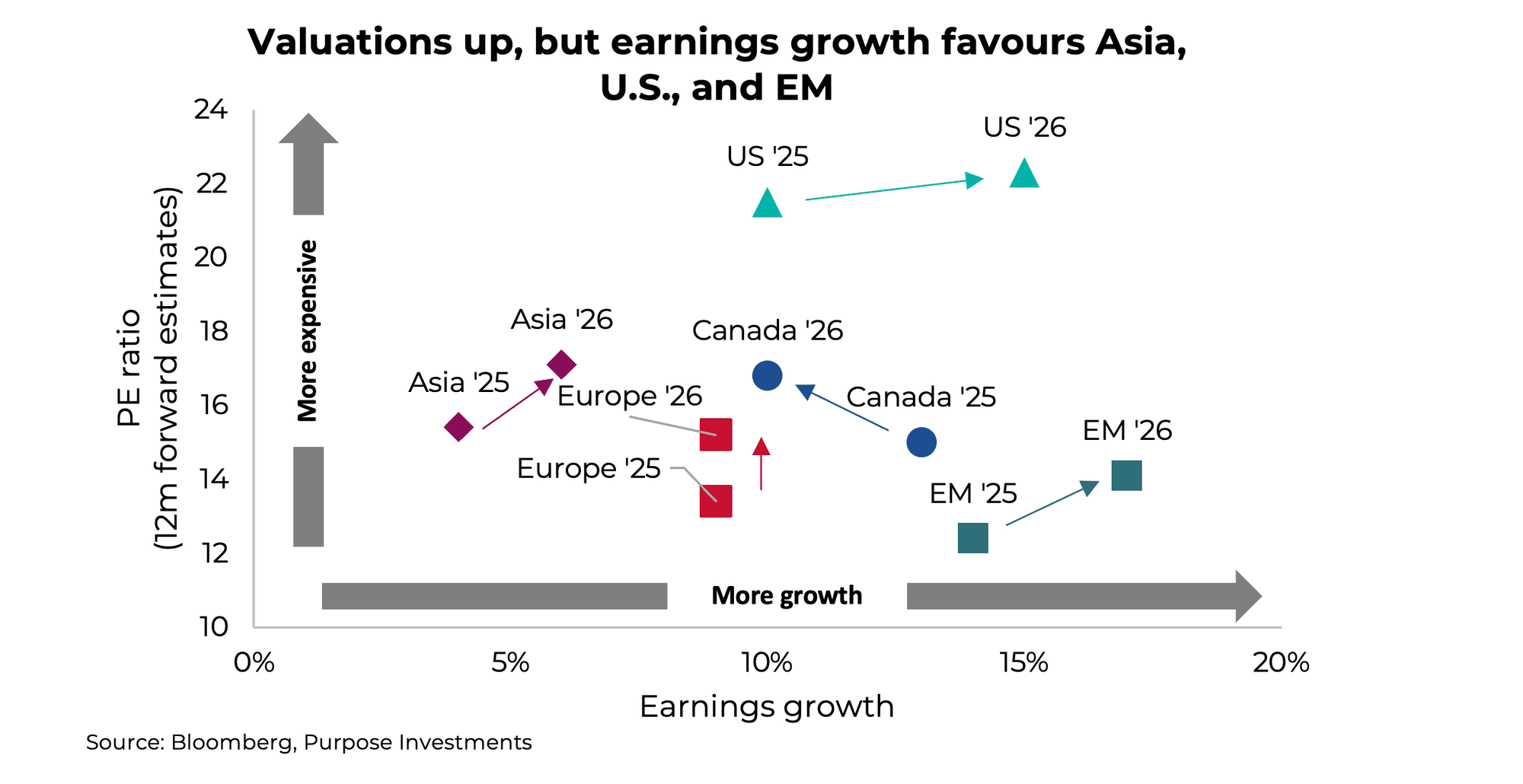
3. Muted return expectations – 2025 was an easier time. Gold was a cheap $2,600/oz, Europe was trading at 13x, a full eight points cheaper than the S&P 500, the TSX and Asia at 15x, and Emerging Markets at a lowly 12x. And earnings growth was returning, with Europe and Canada going from no growth in 2024 to 9% and 13%, respectively. It was a good setup. As we roll into 2026, things are somewhat more challenging. Gold is sitting at $4,400/oz, and it’s hard to say how much further it can go. Europe is now at 15x, with the TSX and Asia at 17x, and Emerging Markets at 14x. Basically, all markets are trading two points higher in valuation with a similar earnings growth forecast for 2026. The S&P is still pricey at 21x.
Add this all up, returns will likely be harder to come by in 2026.
Q: Let’s talk defence. Bonds are working, yields are attractive, but corporate spreads are very low. Any thoughts on bond allocations for 2026 and what could be above the other portfolio diversifiers?
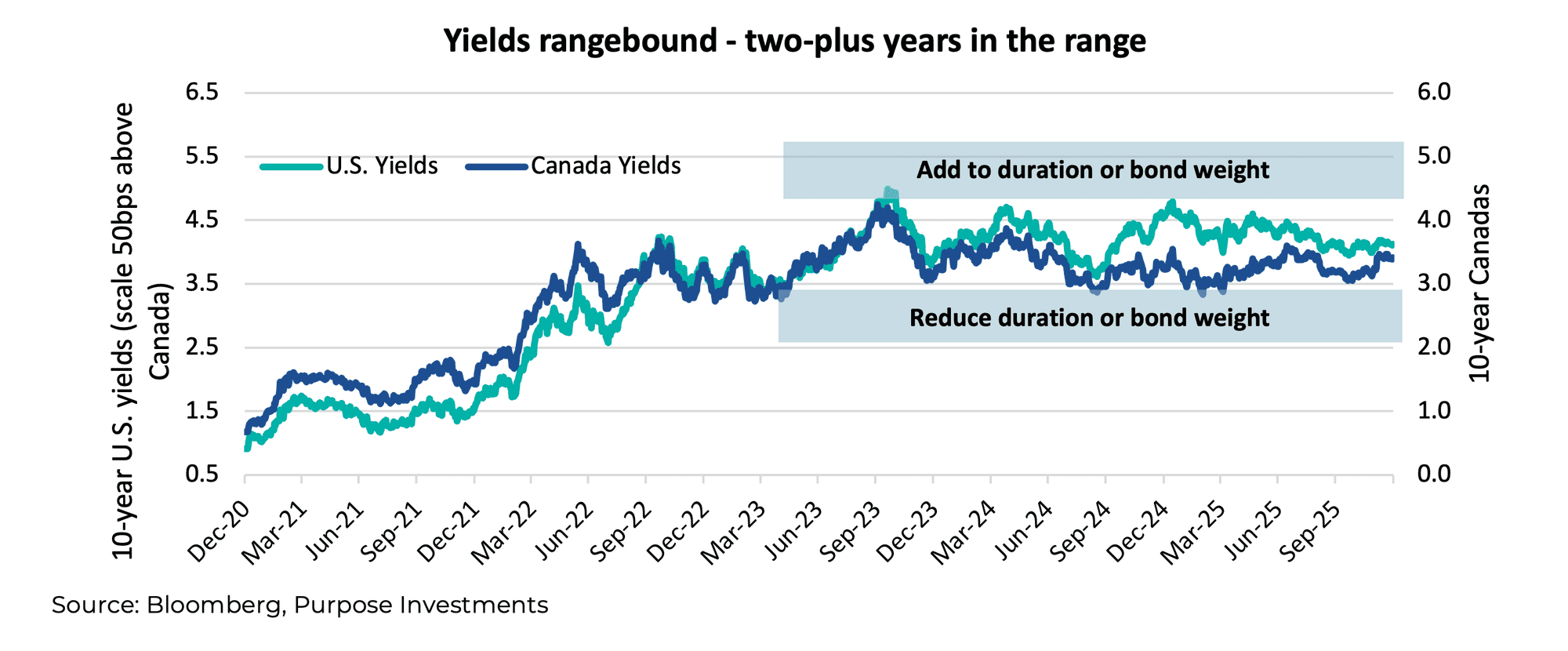
Our underweight in bonds is a little bit more than mild, with our balanced portfolio bond weight at 31% versus a 36% baseline. The good news on bonds is that they now carry a decent nominal and real yield. The not-so-great news is that equity/bond correlations remain elevated, which softens the defensive characteristics of bonds. We also believe bond yields will remain range-bound in 2026, given the higher proportion of buyers being sensitive to changes in yields. This has been the case for a few years now, causing us to reduce duration/bonds when near the bottom of the range and the opposite when yields are higher. Of course, a recession or inflation scare would likely push yields out of this range, but for now, they remain rangebound, which means the yield is likely the return.
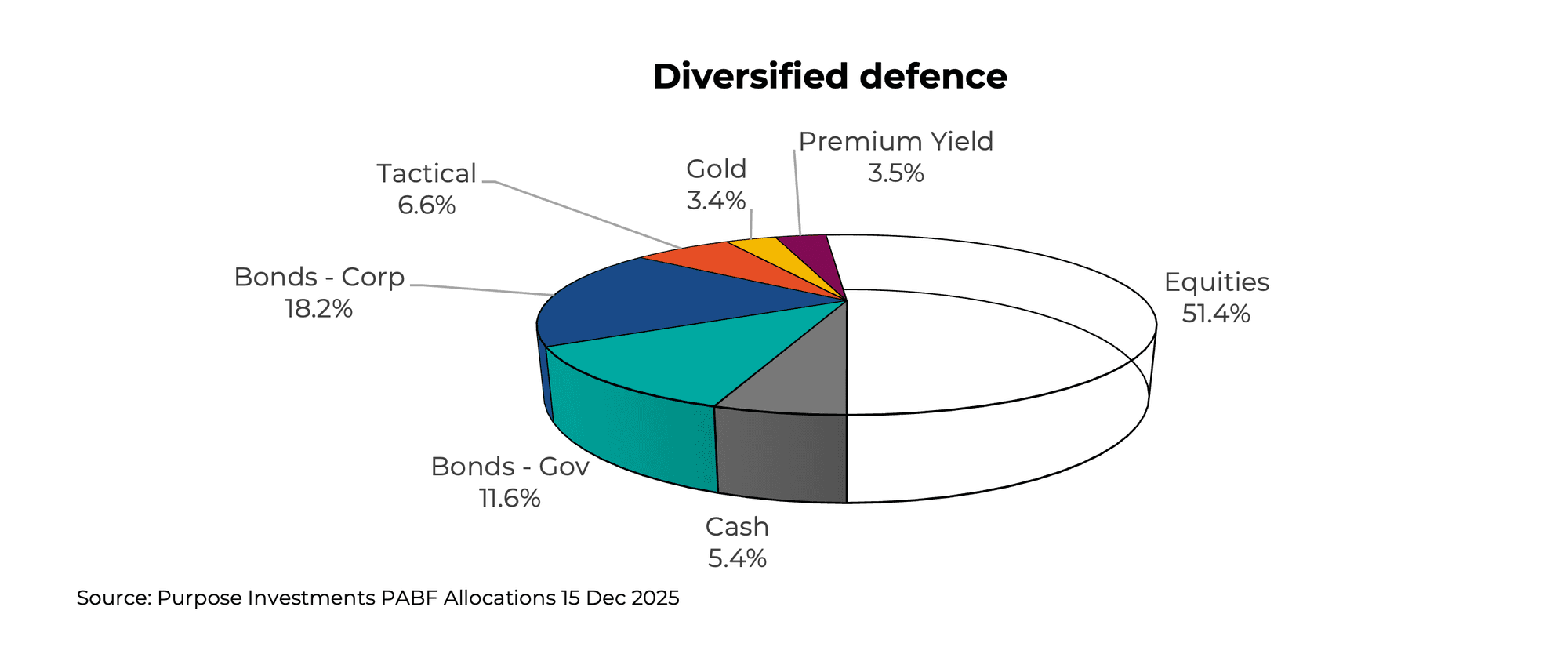
Given our underweight in bonds, we have turned to different types of defence for the portfolio. The past three corrections have been unique, ranging from an exogenous shock in 2020, an inflation scare in 2022, and a policy-induced correction in 2025. Maybe the next one will be a more traditional economic/earnings growth scare, but maybe not. As a result, we believe portfolios need more diversified defence, which for us includes core bonds plus option harvesting, momentum, gold, and cash.
Q: Great call on more international equities in 2025. What are your thoughts from an equity geographic allocation perspective in 2026?
International was certainly the place to be in 2025, and while the setup is a bit more challenging heading into 2026, we believe this trend has legs. Relative market performance often moves in long cycles, and this may be the start of an international-led cycle. U.S. exceptionalism is certainly more challenged given policy decisions and behaviours. Meanwhile, international markets still offer attractive valuations, and they are fixing things. Japan has enticed companies to be more shareholder-friendly. Europe is working on regulatory headwinds and turning on more fiscal spending to spur economic growth. Add to this that the U.S. dollar is still expensive, and we still like our overweight international equity tilt.
VII. How to Make, or Not Lose, Money in 2026
a. Artificial Intelligence
— Derek Benedet, Portfolio Manager
Q: I think AI is perhaps a bubble, but it’s really useful too. And thanks, AI, for providing a performance boost for my portfolio. Should we continue to ride this wave, or should we be pivoting? And don’t just tell me it’s going to be volatile – we all know that.
We agree: all the ingredients are in place to characterize the current AI phenomenon as a bubble. This includes the widespread acceptance of a fundamental paradigm shift, rapidly rising valuations, massive capital expenditure, and critically, a growing reliance on leverage.
Comparing the current AI trade to the dot-com era has become commonplace. While similarities exist, AI bulls often point to key differences, arguing that the infrastructure buildout is financed out of cash flow or that the sheer scale of the hyperscalers makes the bubble impossible to pop. However, the use of leverage, or debt, has begun to increase meaningfully, challenging the first point. The more significant concern regarding leverage sits outside of the public eye. Private credit is playing an increasing role in financing the necessary infrastructure, from new data centres to power-related projects. Much of this lending occurs outside public markets, which severely limits visibility into the true amount of systemic leverage. This cloudiness represents a key vulnerability that warrants better understanding.
It's also possible this bubble is already bigger because it is partially buried in trillion-dollar megacap technology companies. The dot-com bubble had many pure plays; the AI bubble doesn’t. That could mean it still has a ways to go, or that the bubble is partially hidden.
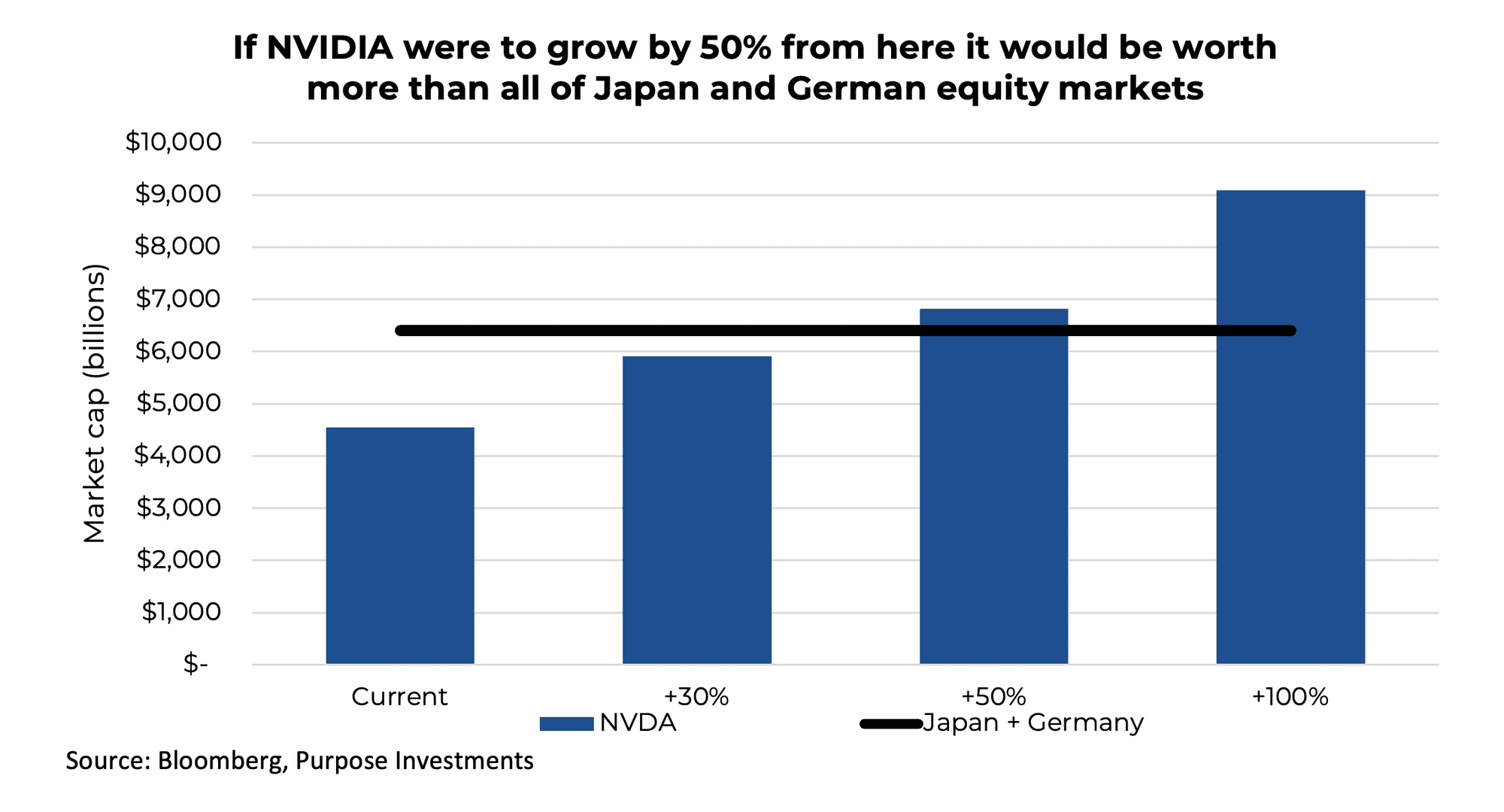
While it's impossible to pinpoint the exact inning of the bubble, the market's run is staggering. Since the release of ChatGPT in November 2022, NVIDIA’s stock is up nearly 1,000%, translating to an annualized return of 118% over slightly more than three years. For context, the only other "Magnificent Seven" member that comes close is Meta, with a still-impressive annualized return of 75%. The mantra has been "build it, and they will come," which has tremendously benefited this chip maker. However, at NVIDIA’s current market capitalization of $4.5 trillion USD, the law of large numbers begins to weigh heavily. A mere 50% increase from here would give it a larger market cap than the entire Japanese and German stock markets combined, as illustrated below.
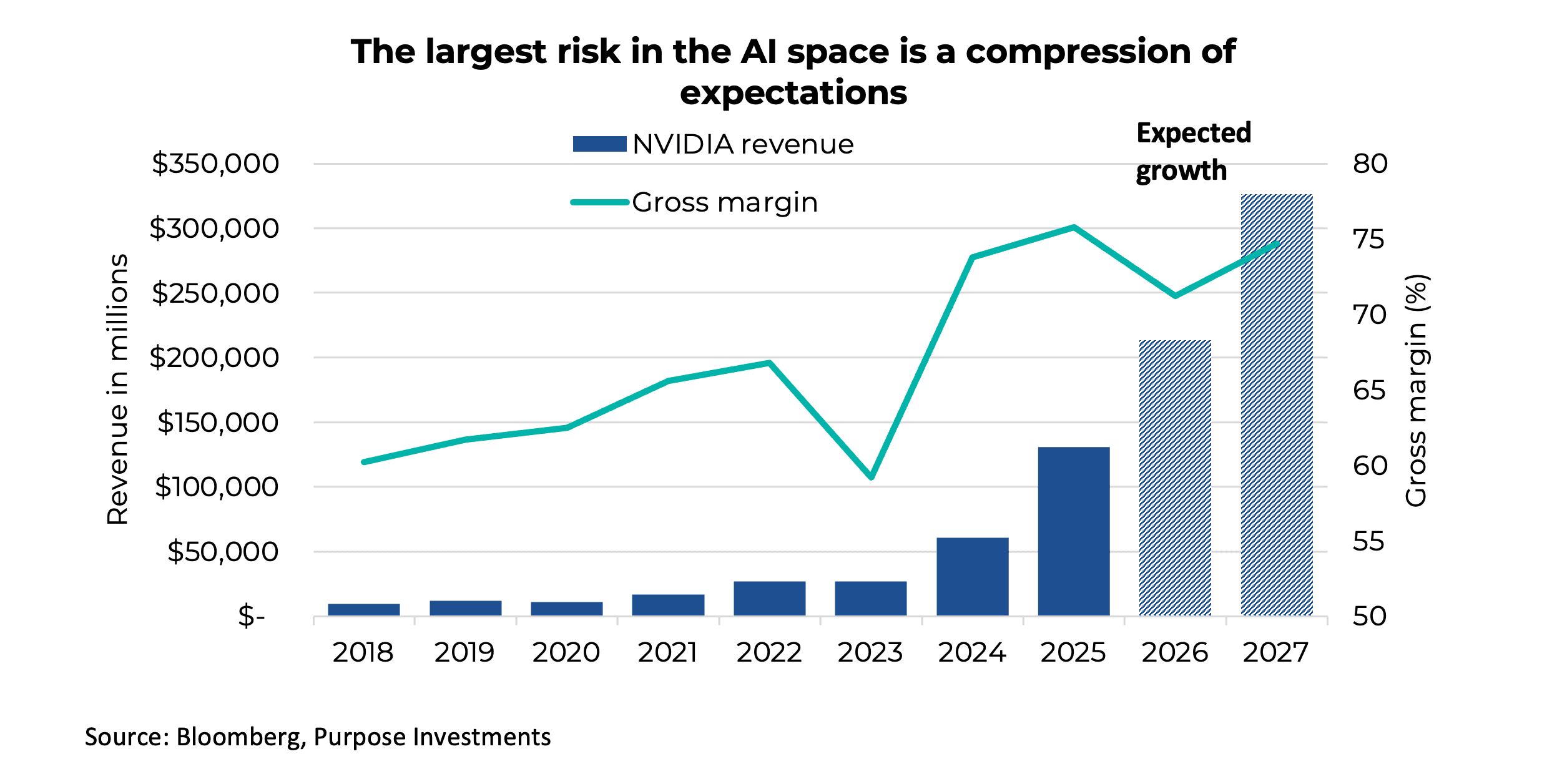
Sheer size or stretched valuations do not, by themselves, trigger a bubble to pop. However, valuations in the AI space are elevated, especially for more speculative names. Earnings estimates and margin expansion projections for future years are highly optimistic. Looking again at NVIDIA in the chart below, revenue was $27 billion in 2023 and has risen to $130 billion this year. Current estimates have it nearly doubling again to $326 billion by 2027. Investors who have held chipmakers or cloud providers over the past few years have been immensely rewarded. However, the market has already priced in this projected stratospheric growth. The greatest risk moving forward is a compression of these expectations, resulting in a swift multiple contraction.
This risk is compounded by both structural and intellectual constraints:
Structural risk: power as the binding constraint – The most significant bottleneck for the data centre buildout is power. Constructing new power generation sources is a prolonged, multi-year process. If AI data centre construction is substantially delayed due to these power constraints, hyperscalers will likely dial back chip orders, potentially reversing the virtuous cycle of demand.
Intellectual risk: diminishing returns on scaling – This risk strikes at the heart of the underlying technology assumption. The dominant thinking among the creators of Large Language Models (LLMs) is that models must continue scaling to achieve Artificial General Intelligence (AGI). However, there’s a growing minority opinion that continuing to scale is a dead end. Was there, for instance, a truly massive difference between GPT-4 and GPT-5? One of the original founders of OpenAI has been publicly vocal that scaling LLMs are reaching a point of diminishing returns, arguing that the industry must pivot back to fundamental basic research. If this minority view gains wider traction, companies may scale back their extreme growth plans, leading to fewer chip orders, again reversing the virtuous cycle of chip demand.
For investors, the decision for 2026 should be less about a full pivot and more about a strategic rotation. Selective profit-taking is the prudent choice. We believe it would be wise to audit true exposure by digging into stock and fund exposures to identify both pure-play AI names and incidental exposure.
Do not abandon the theme, but be nimble – Begin to lean away from the hardware names and reallocate toward second- or third-derivative beneficiaries. Buy the AI adopter on sale; software, health care, and professional services that successfully implement AI will be the long-term, non-consensus beneficiaries. As with most technological buildouts, infrastructure wins early, and the utilizers benefit later.
b. Laggards
— Derek Benedet, Portfolio Manager
Q: Performance has been very strong last year and in the previous few years, too. Are there any areas you think could play catch-up in 2026? Oil is certainly looking cheap. Or how about Industrials?
Performance has been abnormally strong over the past few years. Both the S&P/TSX Composite and the S&P 500 have annualized over 20% over the last three years, with the NASDAQ leading the advance at 33% annualized over 36 months. Big Tech has been the undisputed leader in this advance, but this concentration has created significant dispersion within the markets, drawing a clear line between the "haves" (anything AI-related) and the "have-nots" (real economy stocks).
So, where are the laggards that are due for a catch-up? At the sector level, the clear laggards include Real Estate and Consumer Staples. However, the disparity is clearest when digging down into industries within each sector. Even within the massive U.S. tech sector, semiconductors are up 47% year-to-date, while software stocks have significantly lagged, advancing only 11%. We see similar disparities in the Canadian markets. In Industrials, Capital Goods stocks are up 26%, while Transportation stocks are down 5%.
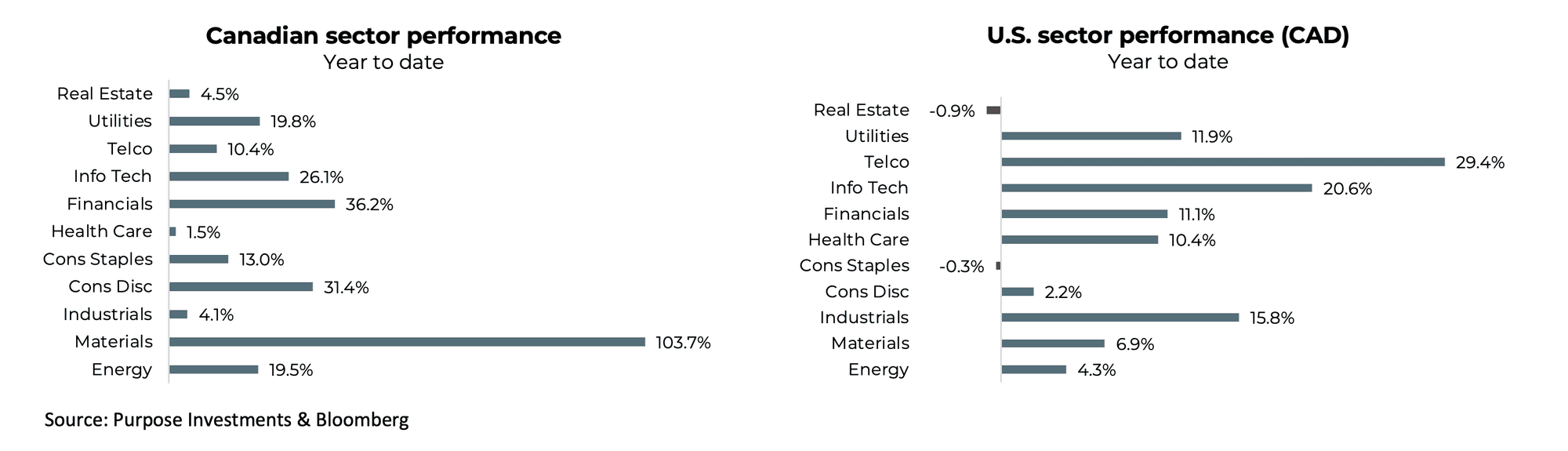
Transportation set for a reset - Transportation stocks have been weighed down by lingering recession fears, elevated labour costs, and a lack of freight volumes. This has led to an attractive valuation profile. While there may still be some bumps, freight rates look like they’ve found a floor, and 2026 looks set for modest inventory restocking. The transportation space, encompassing rail and trucking, looks attractive on a long-term basis, especially when compared to the stretched valuations of the rest of the industrial space. We expect capital to flow out of overbought capital goods and into the undervalued transportation segment as the economic outlook stabilizes.
The oil narrative will shift from glut to supply squeeze - Despite oil prices falling 20% this year, Canadian energy stocks have held up rather well, advancing roughly 15%. This resilience is due to solid fundamentals, decent gas and liquids exposure, and disciplined capital spending, which contrasts with struggling U.S. peers who are down around 3%. The current narrative in the energy space focuses entirely on a pending "supply glut" as OPEC+ continues to add and non-OPEC growth from Guyana and Brazil crests. You also have the potential for peace in Ukraine, leading to Russian barrels hitting the daylight of the open market in 2026. Geopolitics and oil prices will always be intricately intertwined.
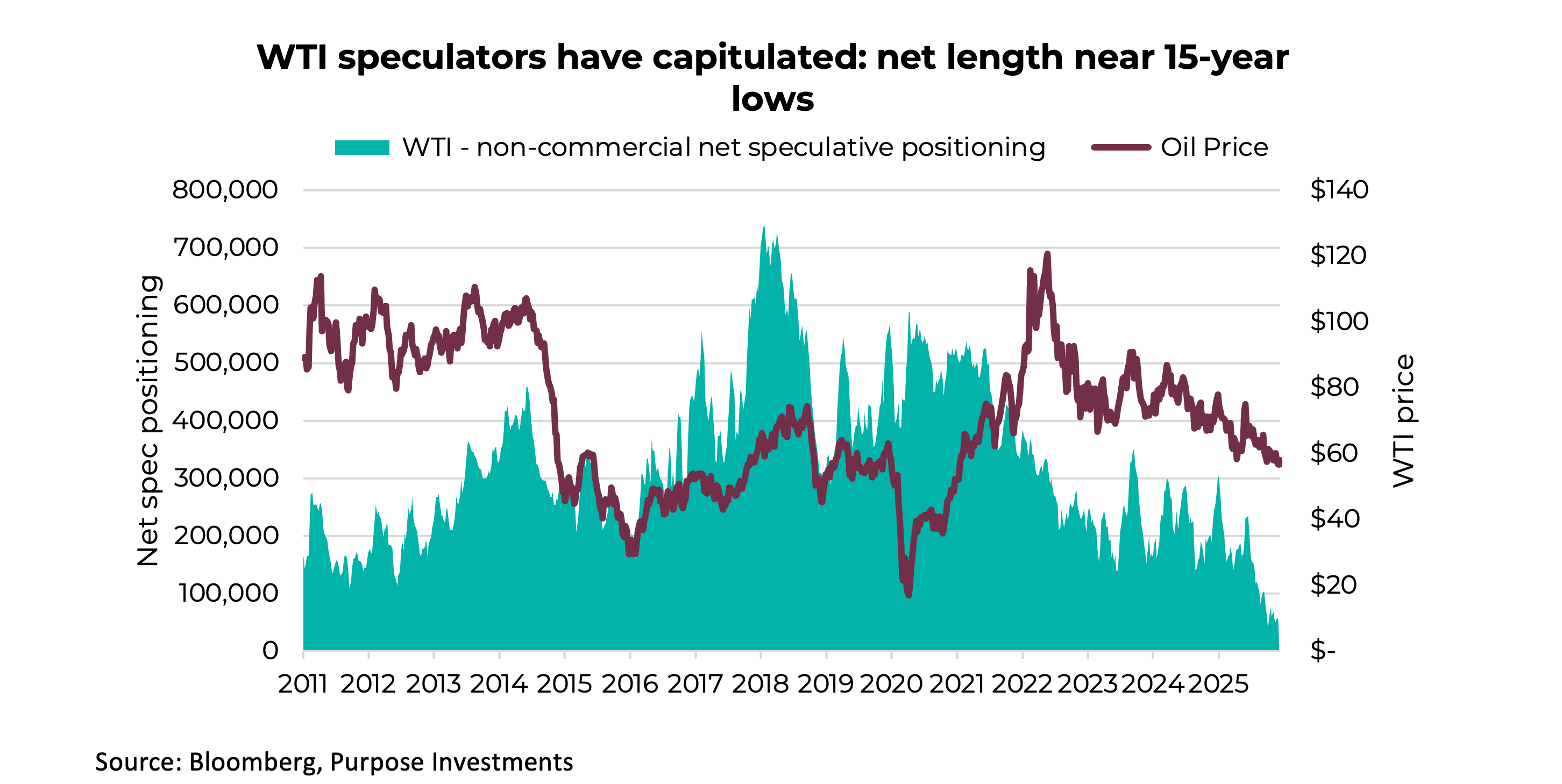
Because of this supply glut fear, speculative positioning is very pessimistic, and from a contrarian point of view, sentiment appears washed out. The fear of electric vehicles and perpetual demand destruction appears misaligned with reality; even the International Energy Agency’s (IEA) base case still forecasts demand growth for decades. With current WTI strip pricing in the mid-$50s, this is below the cost of capital and the reinvestment reality that likely requires sustained prices in the $70s to $80s to incentivize new exploration. The market appears to be sleepwalking into a supply problem 12–18 months out. While this may fully materialize as a 2027 issue, the market will undoubtedly take notice and begin pricing in the squeeze well ahead of that time. Oil stocks are positioned to benefit greatly when this occurs.
Defensives: the forgotten element - On the defensive side, the clearest laggards are Consumer Staples, alongside other rate-sensitive stocks like telecoms. Staples have been under sustained pressure for multiple reasons: they’re perceived as bond proxies and have suffered as rates remain elevated; they fared poorly as investors chased growth in 2025; and their performance has been hurt by tariffs and a struggling low-end consumer.
From a valuation perspective, Staples are now trading at a very attractive level. In fact, relative to their own history, they’re trading at the largest discount out of any sector. If 2026 brings slower nominal growth or any wobble in the AI story, prompting a market search for stable, predictable cash-flow compounders, we would expect Staples to mean-revert from multi-year underperformance. They offer a highly useful and necessary defensive counterweight within portfolios that have become increasingly growth-tilted.
c. Banks & Real Estate
— Michael McNabb, Portfolio Manager
Q: Globally, banks have done really well, even helping drive the TSX higher. Given the importance of banks for Canadian portfolios, what are your thoughts on financials as we head into 2026? And what about real estate?
First, let’s address the Canadian banks. They represent about 33% of the TSX index and, along with Materials, were key drivers of last year’s strong performance. The Big Six banks delivered over 44% total return in 2025 (as reflected by the ZEB ETF, an equal-weighted basket of Canadian banks). Over a three-year period, their total return has essentially doubled.
This raises the question: what should we do with our bank holdings now? Capital markets were a major earnings driver this year, fueled by the commodity rally and industry consolidation, but these are cyclical and unlikely to persist. While guidance calls for 15%+ ROE and mid-to-high single-digit EPS growth – achievable targets – I see limited room for multiple expansion given Canada’s current economic backdrop, which isn’t great.
Valuations tell the story: Price-to-Earnings ratios and Price-to-Book are both stretched compared to their five-year averages.
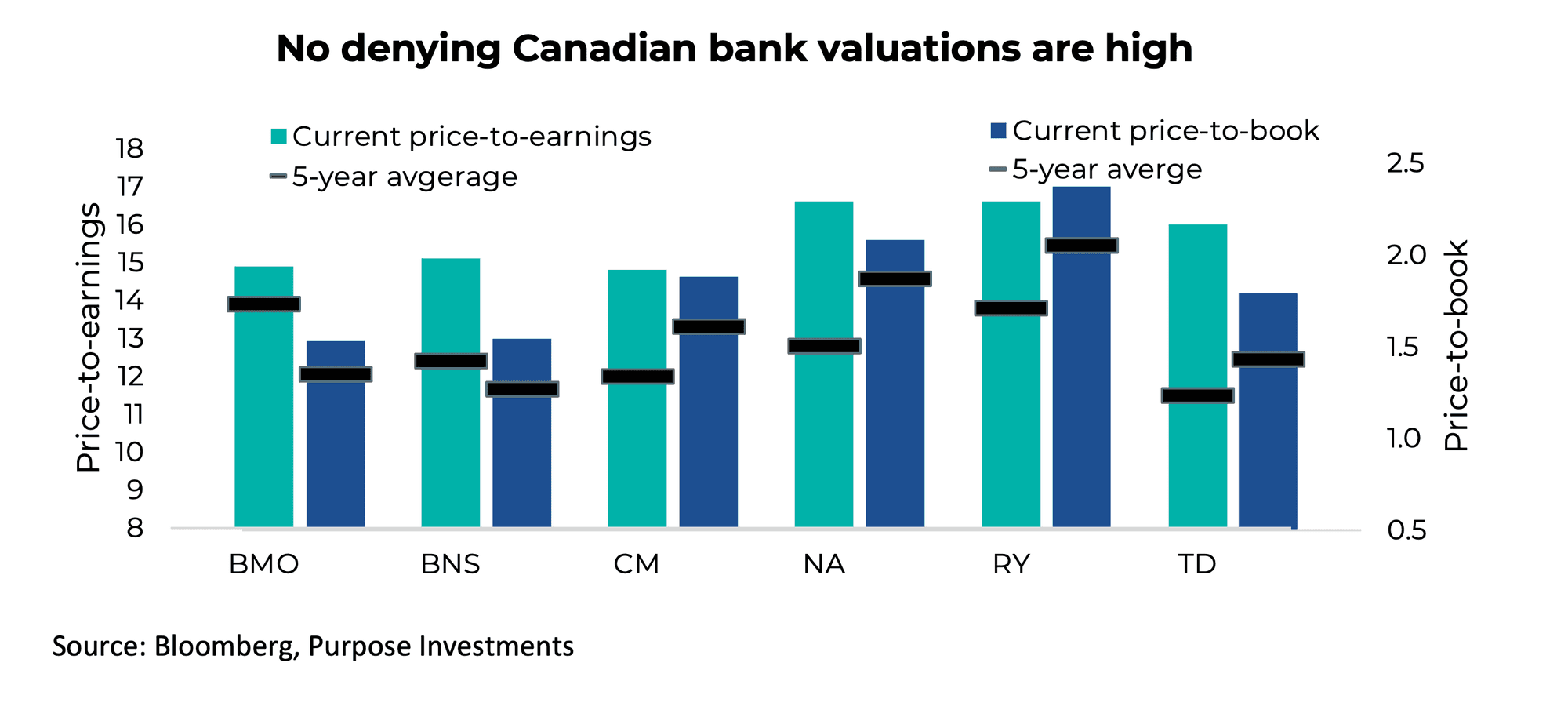
Canadian banks remain a cornerstone of most Canadian portfolios: stable, well-capitalized, and operating within an oligopoly, making exposure important. However, given current valuations, I would look to take some profits in 2026 and reallocate into Canadian insurance companies. In my view, going overweight insurers versus banks in 2026 offers better value and growth potential.
Q: What do you like about insurance companies versus the banks?
Insurance companies provide global diversification, fee-based revenue, and exposure to high-growth markets like Asia, making earnings less cyclical than banks. They also deliver similar ROE, maintain strong capital ratios, and trade at cheaper valuations, while offering attractive dividends and lower credit risk.
Q: Looking back at 2025, how would you characterize REIT performance overall?
Last year, REIT performance was modest and marked by continued underperformance relative to broader equity markets, with the TSX REIT Index returning about 6%, well below the TSX Composite’s 31%. The sector faced subdued investor interest, limited M&A activity, and macroeconomic uncertainties. Canadian REITs outperformed their US and European peers but lagged Asian markets. U.S. REITs had mixed results, with health care and industrial sectors leading, while office and multi-family sectors struggled.
Surprisingly, with all the fanfare around data centres and data centre spending in the market, data centre names in the US struggled, with EQIX down over 20% on the year, suggesting that valuations got far too stretched in the sector. Senior housing and retail REITs in Canada stood out with strong returns, driven by demographic tailwinds and resilient fundamentals. Overall, 2025 was a challenging year when compared to broader markets, but there were good opportunities in certain sectors.
Q: What do you expect for 2026?
I feel like a broken record (fourth year in a row) emphasizing the relative value of REITs. They remain cheap, and have been for a long time. Looking at historical price-to-NAV across all subsectors, valuations are still compelling.
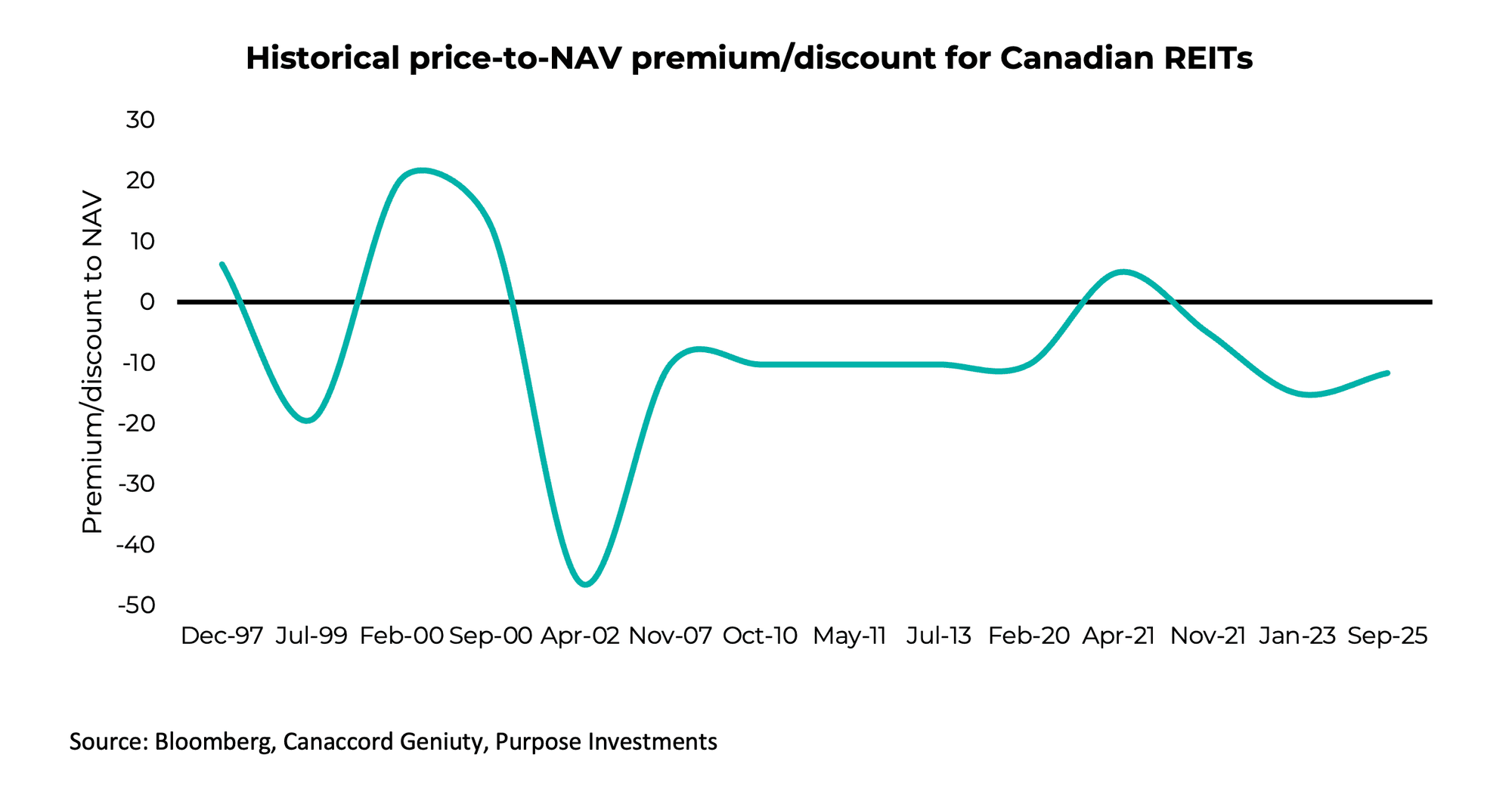
I expect low double-digit total returns from the sector next year, with potential for an even stronger performance if a flight to quality occurs and capital rotates out of overheated sectors. REITs provide stable cash flows and a natural hedge against inflationary pressures. Building a diversified REIT portfolio across multiple subsectors remains the best way to capture these opportunities.
VIII. Portfolio Construction & Final Thoughts
— Craig Basinger, Chief Market Strategist
Q: OK, this has been very helpful. Now can you provide a summary of your thoughts for portfolio construction for 2026? And equally important, what should we worry about or be potentially prepared for in the coming year?
After the tariff-induced drop early in 2025, this market really became Fearless. Instances of bad news from shutdowns, escalating conflicts, and wobbly economic data all pretty much witnessed the market shrug it off and move higher. This culminated in market returns well above average. It’s usually easier to make money when the market is fearful, so 2026 will likely be more balanced between finding opportunities and holding onto previous gains.
Here are the highlights:
- Mild underweight in equities – strong previous gains have lifted valuations. It’s very rare to see four consecutive strong years, and we face a more challenging starting point as we roll into 2026.
- Underweight bonds – while bonds are still core to a portfolio, given that bond yields are near the lower end of the trading range and spreads are very narrow, we’re less excited. Plus, inflation fears may limit their defensive attributes for the portfolio.
- More cash – cash to be opportunistic when this fearless market becomes a bit more fearful.
- Diversified defence – because corrections have become more unique, requiring a more diversified defensive suite within portfolios. We balance ours with bonds at the core, supported by some gold, momentum, and option harvesting strategies.
- More international equity – 2025 saw a market leadership change favouring international equities, which we believe could continue. Very often, leadership moves in long cycles, and the setup for international equities is supported by valuations, the U.S. dollar, improving policy/regulation environment.
- Keeping up with inflation – while inflation has cooled, we believe it will remain higher and more volatile, which is a risk to financial plans. The dividend factor and real assets provide portfolio defence from inflation risk, but we’re not sure we’d be chasing gold here.
- AI – having already provided a portfolio boost, we are more focused on harvesting and protecting previous gains than chasing.
- Laggards - there weren’t many laggards last year, but energy and industrials may become interesting in 2026. Surplus oil makes energy a bit contrarian, but we believe the stocks will start to look through the supply glut, perhaps later in the year. Industrials may take a hit on USMCA negotiations, which we believe could create an opportunity.
- Canadian banks – valuations are pressed, and our economy is only so-so. We’re harvesters and finding better opportunities in other financials, including insurance.
- Real Estate – could the winter be ending? These companies have endured a lot, and what’s that old saying? “What doesn’t kill you makes you stronger.” Valuations are compelling as well.
There’s plenty of good news as we head into 2026 from a global economy that is growing at a decent pace, inflation that has softened somewhat, yields that are stable, and good earnings growth around the world. Nobody is expecting a recession, which is good news unless everyone is wrong, like in 2023. Changing dynamics in trade, country relationships, fiscal policy, and monetary policy didn’t really upset the market or economy in 2025. That was a surprise that might not endure in 2026.
The market’s Love Story with AI appears to be transitioning from unbridled, wide-eyed concept optimism to focusing increasingly on revenues, returns, and fundamentals. That can be challenging, and given how much of the market is supported by this theme, this is a market risk. On the positive, AI capex spending and fiscal infrastructure spending are rocket fuel for the economy and earnings. 2026 is likely going to be another exciting one.
Get the latest market insights in your inbox every week.
Sources: Charts are sourced to Bloomberg L. P.
The content of this document is for informational purposes only and is not being provided in the context of an offering of any securities described herein, nor is it a recommendation or solicitation to buy, hold or sell any security. The information is not investment advice, nor is it tailored to the needs or circumstances of any investor. Information contained in this document is not, and under no circumstances is it to be construed as, an offering memorandum, prospectus, advertisement or public offering of securities. No securities commission or similar regulatory authority has reviewed this document, and any representation to the contrary is an offence. Information contained in this document is believed to be accurate and reliable; however, we cannot guarantee that it is complete or current at all times. The information provided is subject to change without notice.
Commissions, trailing commissions, management fees and expenses all may be associated with investment funds. Please read the prospectus before investing. If the securities are purchased or sold on a stock exchange, you may pay more or receive less than the current net asset value. Investment funds are not guaranteed, their values change frequently, and past performance may not be repeated. Certain statements in this document are forward-looking. Forward-looking statements (“FLS”) are statements that are predictive in nature, depend on or refer to future events or conditions, or that include words such as “may,” “will,” “should,” “could,” “expect,” “anticipate,” intend,” “plan,” “believe,” “estimate” or other similar expressions. Statements that look forward in time or include anything other than historical information are subject to risks and uncertainties, and actual results, actions or events could differ materially from those set forth in the FLS. FLS are not guarantees of future performance and are, by their nature, based on numerous assumptions. Although the FLS contained in this document are based upon what Purpose Investments and the portfolio manager believe to be reasonable assumptions, Purpose Investments and the portfolio manager cannot assure that actual results will be consistent with these FLS. The reader is cautioned to consider the FLS carefully and not to place undue reliance on the FLS. Unless required by applicable law, it is not undertaken, and specifically disclaimed, that there is any intention or obligation to update or revise FLS, whether as a result of new information, future events or otherwise.


