
Economics is pretty cool. Trying to understand how the whole thing works from the consumer to business behaviours, rates, jobs, prices, resource allocation, the list goes on and on. The impact of tariffs is on that list, but we are not going there, as everyone has likely read or heard enough about that topic over the past week. Instead, we are going to talk about what a few more dollars of debt and leverage means for the economy or markets.
The Austrian economists (who weren’t necessarily Austrian but that is another story) often put credit creation at the center of understanding what is going on in the economy. More recently in this century, Ray Dalio’s content, such as the Big Debt Crisis, really hammered the point of the importance of credit. If credit expands, those dollars are going to do something that has a positive economic impact. Vice versa, if credit contracts or its pace of growth slows, there is a negative economic impact.
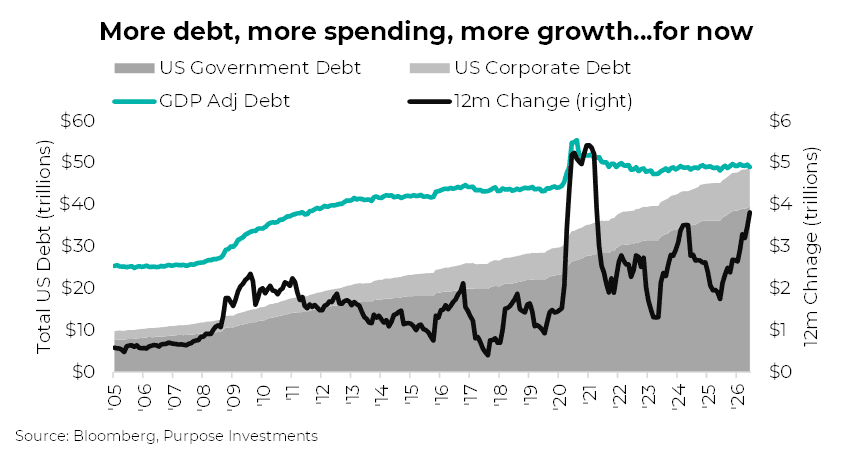
Let’s unpack this chart a bit. This is U.S. focused with the grey shaded areas measuring the total amount of debt, both government (darker grey) and corporate (lighter grey). Bit scary as it was a mere $10 trillion in 2005 and is now over $50 trillion. Obviously this is at the core of much of the recent banter around debt and deficits. But the aqua line is the debt adjusted for the size of the economy, as measured by nominal GDP. Point is that debt is going up but so is the economy, which has been keeping this aqua line relatively flat over the past few years. Not saying there isn’t a problem, but let’s keep things in perspective.
Of more interest is the black line. This is the net change in debt over the past twelve months, and it is rising quickly. Albeit not adjusted for the size of the economy, up is still up. Furthermore, a higher percentage of this new debt is corporate, driven partially by the issuance debt to build out AI infrastructure. More debt (or credit) equals more spending which equals more growth.
Not all credit growth is the same as it depends on where it is used. Increased government debt (credit) used for health care or social programs has a positive impact on the economy (and important social benefit). But the spending multiplier (aka ‘k’) is lower compared to infrastructure or defense spending from an economic perspective. We would also argue the ‘k’ multiplier for credit growth is even larger if it is tech spending related, which often goes global given supply chains.
The takeaway here is rising debt levels can lead to challenges (crowding out, imbalances, sustainability, cost), but in the near term can help drive economic growth. Plus, the mix of credit growth today and its increased destination towards tech spending is a big positive for the economy.
More Leverage, More Market Highs (For Now)?
So, credit growth could be a positive for the economy, with some potentially very serious side-effects. Does this apply for the stock market as well? Certainly some additional moving parts when it comes to the gyrations of the stock market, and in this case, we are talking leverage as opposed to bond issuance. Yet there are some similarities. If an investor was going to put $1 to work in the market but decided to open a margin account to use some leverage, they may end up putting $1.50 into the market.
Historically, leverage was easy to track for the U.S. via FINRA debit balances across brokerage firms. With thirty years of data, we plotted the six-month change in debit balances normalized to the S&P 500 Index level to adjust for the change in the size of the market over time. Note periods of declining debit balances, or declining margin, matches very well to periods of market weakness. Admittedly, it is a bit of a chicken and egg riddle. Does a falling market cause investors to dial in leverage or does a falling risk appetite to take on leverage lead to a falling market?
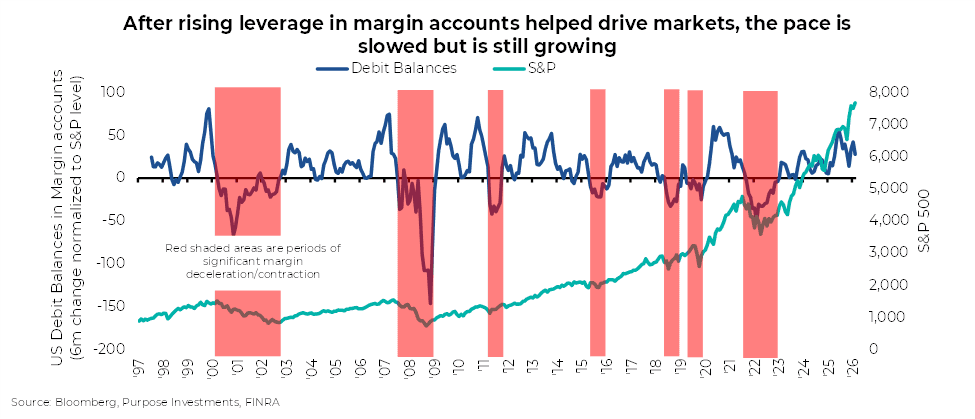
Either way, debit balances are still growing, and this is helping put more dollars to work in the market. But debit balances may underestimate market leverage in today’s market. With the rise of leveraged investment vehicles, investors don’t need to open a margin account to apply leverage in their portfolio. The number of investment vehicles that incorporate mild leverage, 2x, 3x, 4x, probably some 5x vehicles, have dramatically increased in popularity over the past few years.
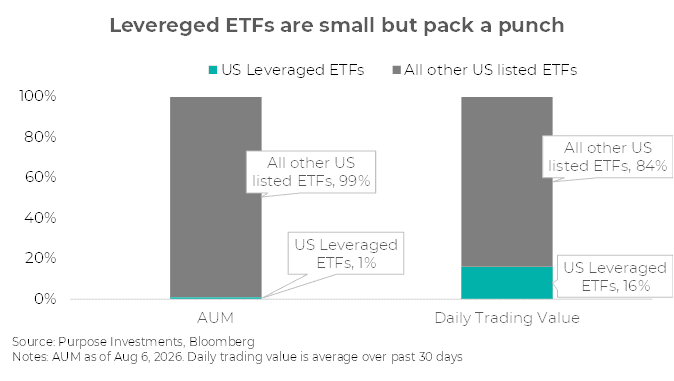
Currently there are an estimated 868 U.S. listed leveraged ETFs with almost $200 billion in assets, according to Bloomberg. Popularity is rising elsewhere from Canada to Europe and in Asia. That is not a huge amount of assets compared to the overall ETF market, totally around 1%. But this small cohort of ETFs punches well above its weight in the market. Investors use these leveraged ETFs as short term trading vehicles, often not staying put for long. As a result, that small 1% of AUM in leveraged ETFs represents 16% of daily trading volumes.
Making things easier is a sign of progress and leveraged ETFs certainly make it easier for investors to use leverage. But there are some challenges including increased knowledge. Leverage has lifted parts of the market higher, but it can also work in the other direction. This was on full display in South Korea this year. Their market is very concentrated with a few names comprising very large index weights that also happen to be at the center of the AI infrastructure buildout. Adding to the boom was increased use of leverage from margin accounts to leveraged investment vehicles. This helped drive the KOSPI (Korea Composite Stock Price Index) up 122% this year before giving back about ½ of those gains.
Clearly leverage contributed to these moves. Now regulators are trying to rein in leverage including required education on using such vehicles. While the adoption in North America pales in comparison, flows into or out of leveraged investment vehicles can exacerbate the moves in the underlying holdings. This has led to more volatile intraday trading.
Final Thoughts
More debt is not a bad thing. Neither is more leverage. Increased debt issuance can lead to higher economic activity; increased leverage can lift markets. But with much in life, too much of a good thing can become very bad. Maybe society has already gone too far with government debt, we are certainly in uncharted territory. Maybe the corporate credit creation to build data centers will unleash a global productivity boom. Or maybe they will have trouble earning high enough returns to justify or service the debt. Maybe investors will responsibly use leveraged ETFs as a new tool in the portfolio construction toolbox. Or maybe they will use them to speculate on a day-to-day, hour-to-hour basis.
That is too many ‘maybes’ for one paragraph. The takeaway is to better understand the implications. Credit growth is helping economic growth but adding to the risks going forward. Just like leverage is helping lift markets but is adding to the risks going forward.
— Craig Basinger at Purpose Investments.
Get the latest market insights in your inbox every week.
Sources: Charts are sourced to Bloomberg L.P., as of August 28, 2026.
The content of this document is for informational purposes only and is not being provided in the context of an offering of any securities described herein, nor is it a recommendation or solicitation to buy, hold or sell any security. The information is not investment advice, nor is it tailored to the needs or circumstances of any investor. Information contained in this document is not, and under no circumstances is it to be construed as, an offering memorandum, prospectus, advertisement or public offering of securities. No securities commission or similar regulatory authority has reviewed this document, and any representation to the contrary is an offence. Information contained in this document is believed to be accurate and reliable; however, we cannot guarantee that it is complete or current at all times. The information provided is subject to change without notice.
Commissions, trailing commissions, management fees and expenses all may be associated with investment funds. Please read the prospectus before investing. If the securities are purchased or sold on a stock exchange, you may pay more or receive less than the current net asset value. Investment funds are not guaranteed; their values change frequently, and past performance may not be repeated.
Certain statements in this document are forward-looking. Forward-looking statements (“FLS”) are statements that are predictive in nature, depend on or refer to future events or conditions, or that include words such as “may,” “will,” “should,” “could,” “expect,” “anticipate,” “intend,” “plan,” “believe,” “estimate,” or other similar expressions. Statements that look forward in time or include anything other than historical information are subject to risks and uncertainties, and actual results, actions, or events could differ materially from those set forth in the FLS. FLS are not guarantees of future performance and are, by their nature, based on numerous assumptions. Although the FLS contained in this document are based upon what Purpose Investments and the portfolio manager believe to be reasonable assumptions, Purpose Investments and the portfolio manager cannot assure that actual results will be consistent with these FLS. The reader is cautioned to consider the FLS carefully and not to place undue reliance on them. Unless required by applicable law, it is not undertaken, and is specifically disclaimed, that there is any intention or obligation to update or revise FLS, whether as a result of new information, future events, or otherwise.


