
Conversations with investors during client events and advisors from one off meetings or during the many investment committees we participate in, provide us insights as to what is top of mind. In this Ethos we will tackle three of the most recurring of late. 1) As several trillion-dollar companies tapping the markets via IPOs, what does this mean for markets and indices? 2) Why didn’t oil go higher during the shutting of the Strait of Hormuz and what could be next? And 3) Gold has fallen 25%, from $5,400 to $4,100/oz, since the outbreak of hostilities. Why? Here is our take.
Mega IPOs tapping the markets
SpaceX and the IPO Bonanza
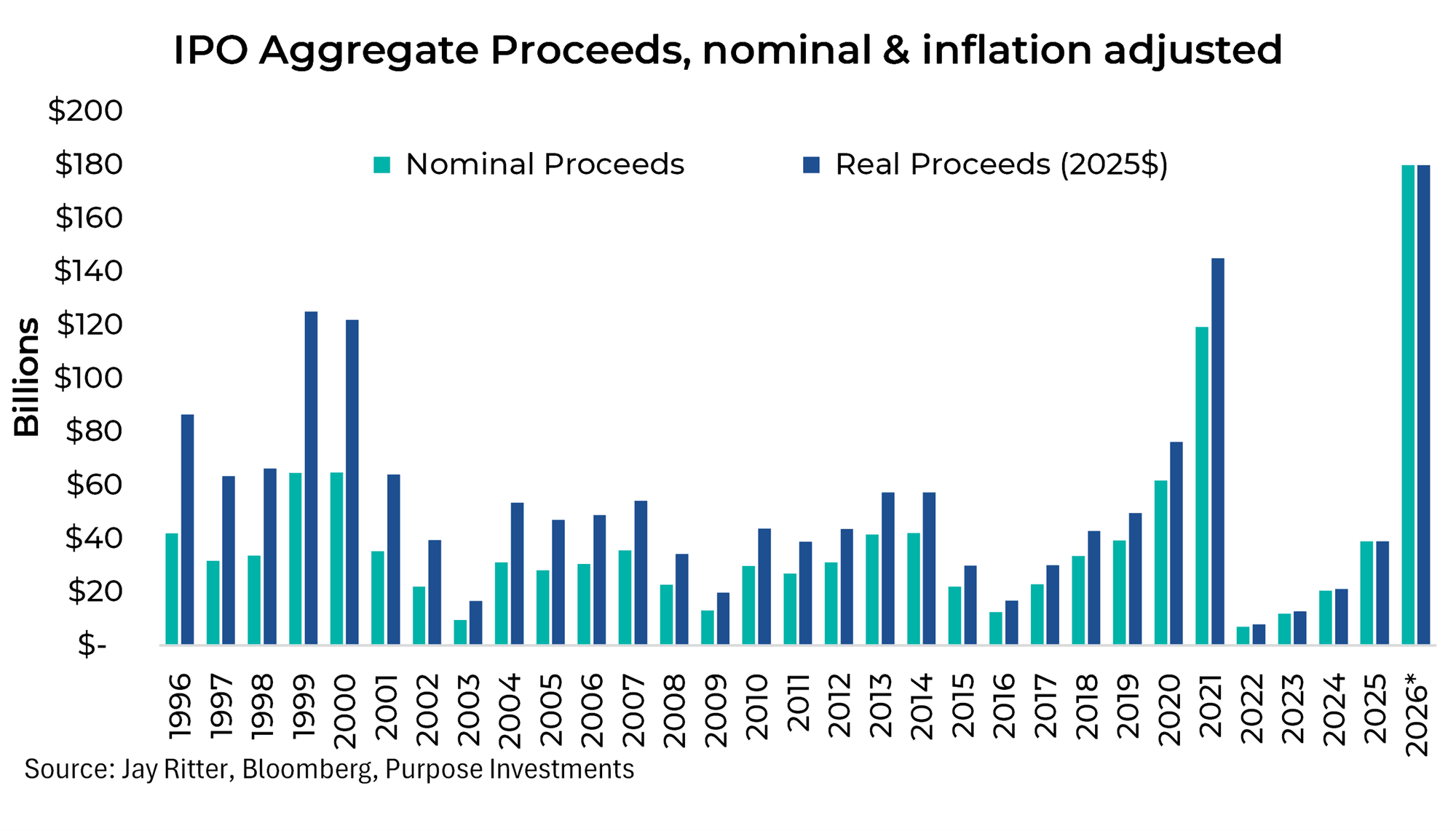
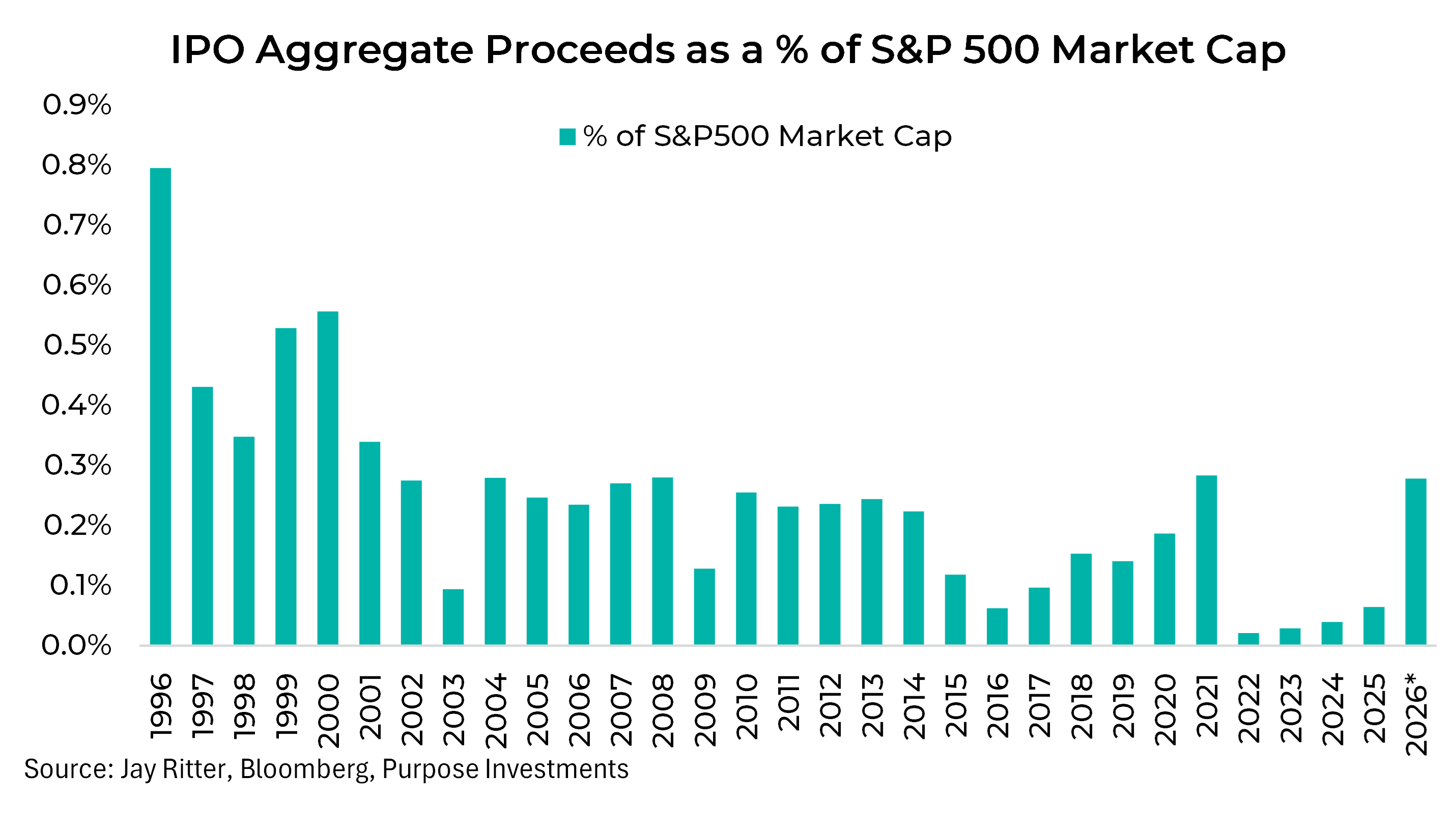
The hype surrounding the SpaceX IPO, with others to follow in Anthropic and OpenAI, is ushering in a new era. The anticipated IPO numbers this year are substantial. Bloomberg estimates around $180 billion, and that doesn't even include the surge in secondary issuance we've seen, like Google's $80 billion raise. Even adjusted for inflation over the past few decades, 2026 sits in a league of its own, as the charts below show, surpassing the 2021 highs as well as the lofty amounts raised during the IPO era of the late 90s and 2000. One aspect that isn't getting enough attention, and why would it, because it could dampen the hype around the big event, is putting the size of this year's anticipated IPOs into context against the market cap of the rest of the market. With 12 trillion-dollar companies now in the S&P 500 Index, the index's total market cap is just under $65 trillion. That number is so staggeringly large it makes the anticipated $180 billion of 2026 IPO proceeds look somewhat unexceptional. As a percent of S&P 500 market cap it would be 0.28%, matching the 2021 high, which was itself the highest since 2008 (the Visa IPO), but well below the highs seen during the dot-com craze. So the "IPO surge" framing hitting the headlines is largely a market-size and inflation illusion. From this perspective, we believe the dot-com era remains the king of IPOs.
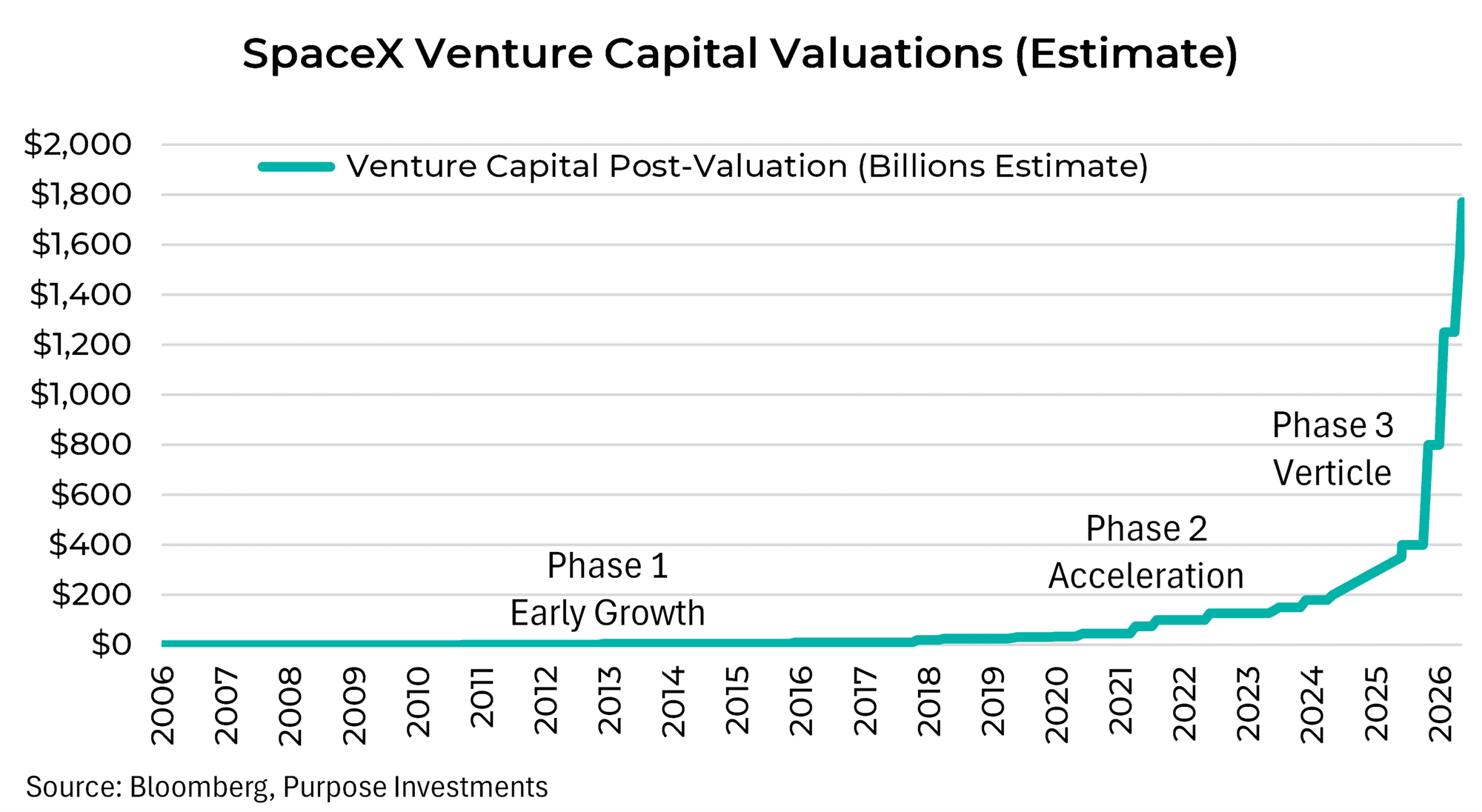
Valuation Reaching for the Stars - The SpaceX IPO priced at $135 a share, raising ~$75 billion at a ~$1.8 trillion valuation, and given shares are up +27% at time of writing, which is the afternoon of June 12, 2026, you do the math. It's believed to be the largest IPO ever (roughly triple the prior record) and instantly became the world's seventh-largest publicly traded company according to Bloomberg. This price is a massive bet on milestones and future promises, not cash flows. Even Goldman, who is leading the deal, noted that AI revenue must grow 100-fold to $322 billion by 2030 to justify the valuation. The chart below shows SpaceX's private valuation history since inception. It has three distinct phases: early growth (~2006-2015), acceleration (~2015-2022), and the vertical growth (~2022-2026). When it merged with xAI in February it was valued at $1.25 trillion, and since then the price has only gotten richer, a 91% CAGR from 2022 to June 12, 2026.
Elon Musk is no stranger to fantastical targets, and his track record with Tesla has created somewhat of a cult following. The company was built to reach for the stars, and that's exactly where these sky-high valuations are pointing. From our point of view, the current valuation is so extreme that you're basically buying Starship at scale and orbital data centers at full price today, which leaves very little room for error.
Investor Implications - Whether you'll own SpaceX isn't necessarily your choice. It comes down to which index exposure you hold, and the two big providers split the decision. If your U.S. equity exposure is an S&P 500 fund, you'll own none of it for some time, as S&P refused to bend its rules: SpaceX can't join the S&P 500 until June 2027 at the earliest, and only if profitable, as per eligibility rules. The majority of retail investors will be sitting this out by default. But growth-oriented portfolios almost always carry a Nasdaq carve-out, and these funds will get force-fed the stock. Nasdaq scrapped its 10% float minimum and adopted "modified market cap" weighting, this could hand SpaceX a ~$225 billion Nasdaq 100 weight despite the company selling less than 5% of its equity, an unusually small free float that, despite the huge dollar value. We believe weighting could drive around $3 billion of Nasdaq related buying within 15 days of launch, just part of the roughly $16 billion in total passive demand across major indices excluding the S&P 500 Index. The number could grow from the first trading day, with nearly a dozen ETFs from various U.S. issuers set to launch leveraged single-stock exposure to the name.
The forced buying on a relatively small float could surely impact prices. There could be a rush from the onset to get ahead of it, at least that's what those jumping in from the start are hoping for. The small float, though, cuts both ways. The guaranteed buying is finite, and when lock-ups expire and insiders sell, passive demand may not be enough to support the stock. Broadly speaking, index ETF buying is concentrated in June and July. In August the insider lock-ups start to come off through the rest of the year.
Governance is also a bit of a red flag. Musk will hold around 80% of the vote and can't be removed, and shareholders waive the right to sue, with disputes going to arbitration in Texas. Before participating in any IPO, especially one this volatile and widely followed, it's important for investors to inform themselves about exactly what they're buying and how much they're really paying for the underlying assets and future cash flows.
But oversubscription in no way guarantees the stock will perform after the initial demand surge once it begins trading. Retail investors, especially those always wanting to chase the hottest narrative, are likely chomping at the bit to participate. They are often derided by professionals as "price-insensitive buyers," and that speculative demand is exactly what makes the setup both exciting and fragile. No one can know where the stock will trade in the near term, but the sheer anticipation of the IPO was already being blamed for selloffs in everything from tech stocks to gold and crypto. Could it pull those assets down further? Possibly. It's plausible this IPO, and those soon to follow, will be a liquidity-drain event in the near term, but to blame it all on them is a stretch. Anything could happen. And if something scary does, an escalation in Iran or a big tech slump, that speculative demand could disappear in a flash.
Oil’s Baffling Journey
Just our luck as we start putting pen to paper to share our thoughts on oil the headlines are abuzz that a deal has been reached. Potential solution coming, then again, we have heard this many times over the past few months. Let’s start with why hasn’t oil gone higher during this strait blockage, then get into where it might go next.
Most energy experts, those with deeper understanding of how it all flows together, largely expected oil to move materially higher, create demand destruction to alleviate the supply shock. Meanwhile, those not as deep in the energy sector seemed less concerned. This isn’t over but so far, the tourists appear to have the possible edge on the pros.
If taken in isolation, this blockage should have sent oil prices to the moon, but the economy often proves much more resilient and flexible than most believe. This blockage was partially offset by other pipelines maxing out capacity in the region, avoiding the strait. Most oil producing nations globally reacted to the price spike by increasing production. This softened the impact somewhat.
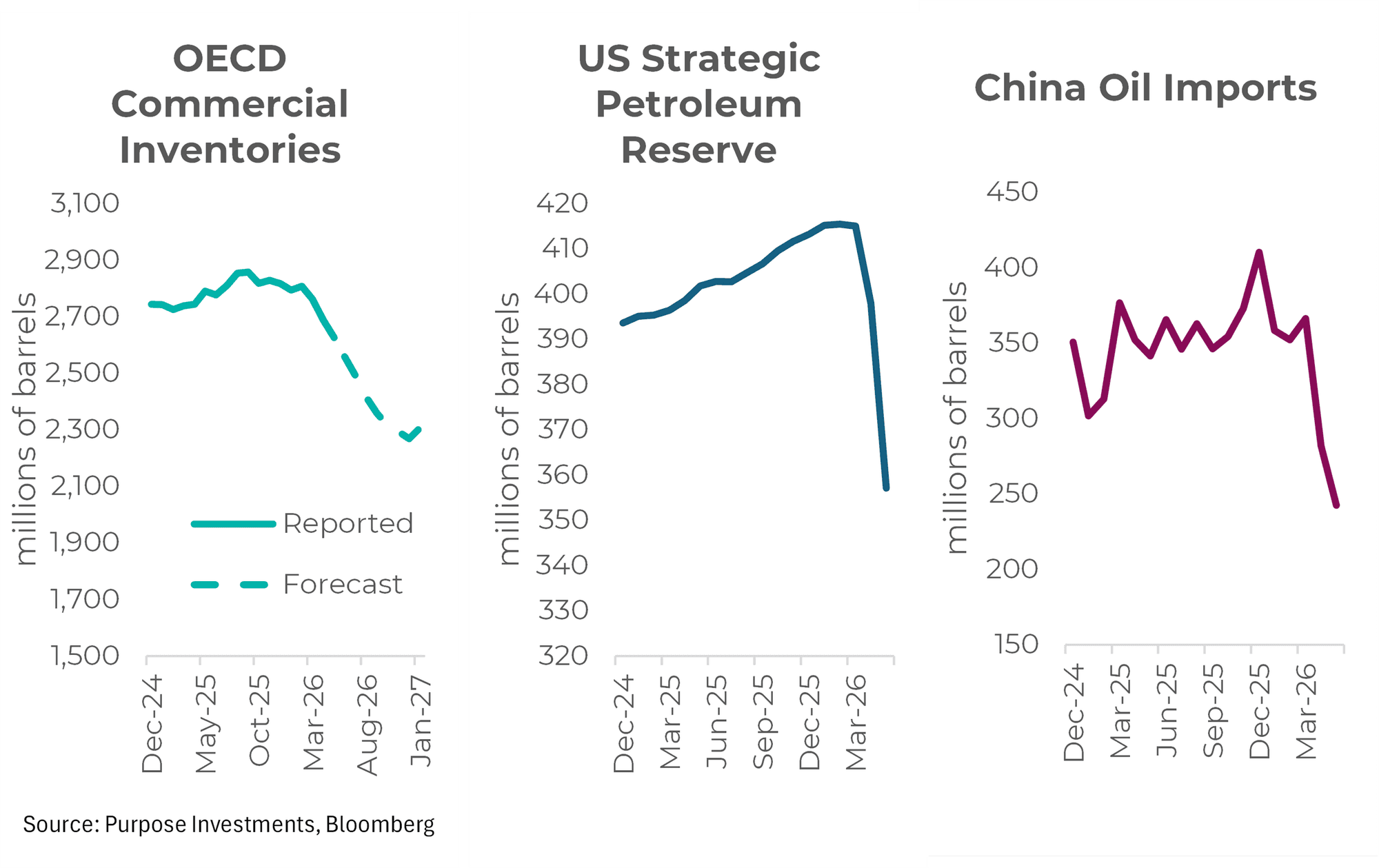
Before this conflict, the global supply/demand dynamic had been in a large surplus for a long time (years). This bloated inventories, which have now fallen substantially. There was also active use of strategic reserves, releasing oil into the market. The U.S. SPR (middle pane) dropped a lot. China has a very large strategic reserve, but its size and inventory levels are not reported. Safe to say they are tapping it as well, given a larger drop in monthly oil imports (right pane) than during COVID shutdowns. Meanwhile numerous secondary data points out of China that gas prices are not abnormally higher, people still driving, etc.
These are some of the buffers that kept oil from moving up too far. Of course, their effectiveness is being depleted, the timing of any tipping point being the big question. There is also a delay in flow even if the Strait of Hormuz opened this weekend. Muting the oil price move also comes from the demand side, as the global economy is not as sensitive to oil as it once was. There has been some demand destruction, mainly in countries with less wealth.
So, if this is resolved soon, there may be some continued disruptions as the system get back towards normal, but that might be it. Or if it persists much longer the risk of shortages start to become more material. We have remained in the camp a solution would be found, not necessarily to solve the dispute but to solve the flow of goods through the Strait. Still our view, but it certainly has taken longer than we expected.
Longer term, things get a bit more constructive. Hormuz as a leverage point will be greatly diminished in the coming couple of years. The number and speed of pipelines being built across the desert to avoid the Strait of Hormuz will put Canadian pipeline construction pace to shame. This infrastructure will ensure the Strait of Hormuz is not as big a supply choke point in the future. That will improve supply resiliency. On the negative, drone technology has advanced to a point that interfering with shipping channels has become far less costly.
There is likely increased oil demand out there as more countries consider holding larger inventories in the future. The world is becoming a bit more volatile, demand for more diversified supply chains is rising and holding higher inventories. This is becoming the norm for many commodities and inputs, beyond oil.
The path forward is rather binary. If this latest chatter on a deal is true, and holds, lower. If not, as the buffers deplete further, the risk of a material spike rises. At the moment, the first scenario appears to be what the market is expecting.
Gold Losing Its Luster
As we have said for years, “if you invest in gold you must be prepared to be frustrated 80% of the time, not knowing why it is behaving the way it is”. This is precisely why it is a good diversifier. 2026, and 2025 are no exception. Gold went up 65% in 2025, inflation didn’t accelerate, there was no big crisis of confidence, no justification from real yields or the US dollar. Even the gold bugs were having trouble justifying the move.
The upward trajectory continued, or even accelerated, earlier this year, before reversing course as hostilities broke out between the U.S. and Iran. It went down on the outbreak of war, and it kept going down as hostilities de-escalated. Gold living up to its unpredictability.
We own gold, so keep that in mind. Gold is down 3% this year, with equity markets up 10%. That actually seems reasonable. And the drop in gold may be re-installing its defensive characteristics. The 2025 rally, which was awesome, probably somewhat unjustified. And as we noted months ago, gold started trading almost entirely on flows. We have a kind of fun multi-regression model that incorporates the U.S. dollar, real yields, inflation break evens, volatility, money supply and flows. Recently, flows have been the only factor moving gold.
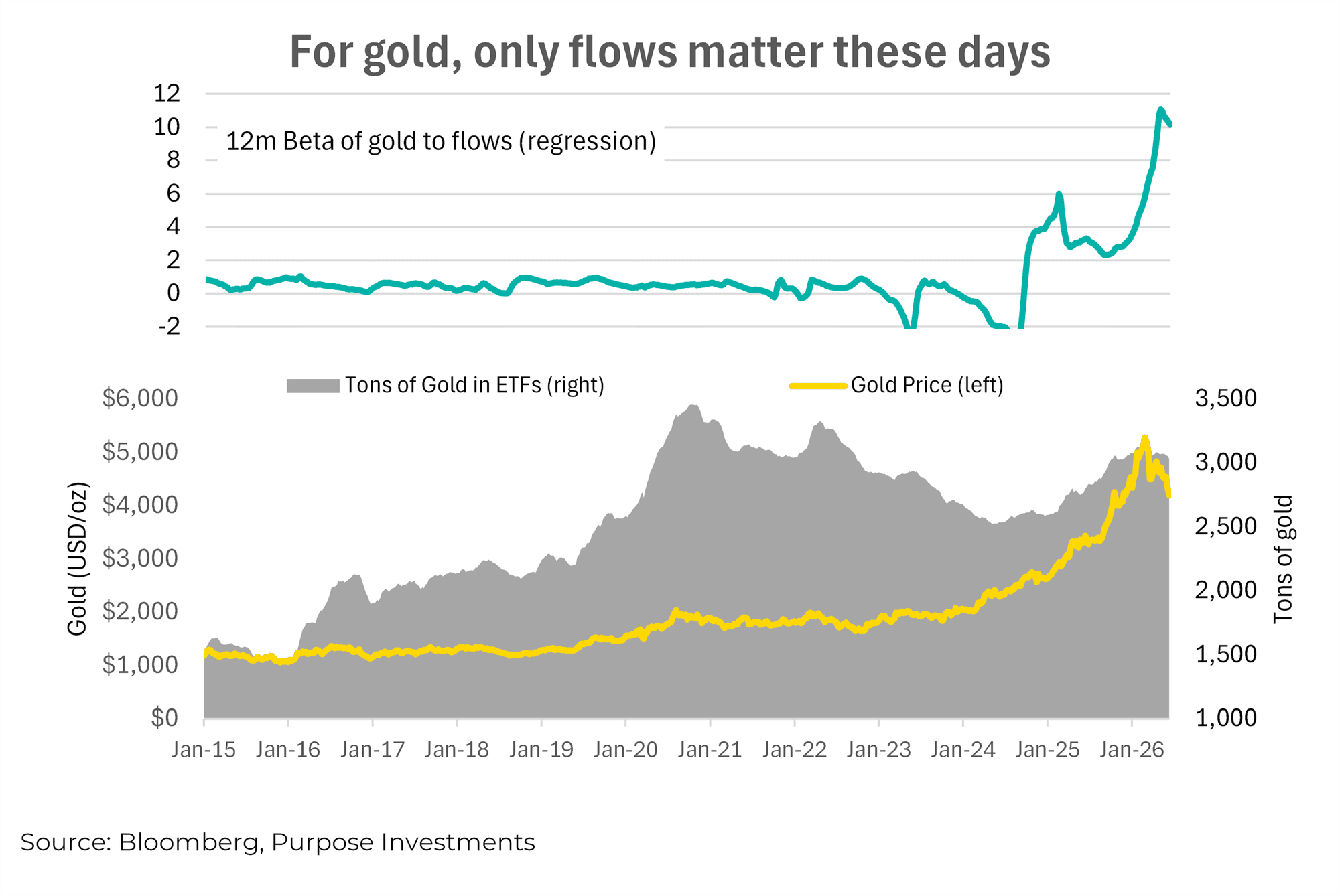
The good news as gold has come back down, the other factors appear to be starting to have a bigger influence. Don’t want to jinx it. This does have us starting to become a bit more constructive on the yellow metal.
Got a question?
Few topics this week. If there is something top of your mind, don’t hesitate to lob a question in or idea on a topic. Ask you advisor to send it along, ask one of our salespeople or email any member of the team.
— Craig Basinger & Derek Benedet at Purpose Investments.
Get the latest market insights in your inbox every week.
Sources: Charts are sourced to Bloomberg L.P.
The content of this document is for informational purposes only and is not being provided in the context of an offering of any securities described herein, nor is it a recommendation or solicitation to buy, hold or sell any security. The information is not investment advice, nor is it tailored to the needs or circumstances of any investor. Information contained in this document is not, and under no circumstances is it to be construed as, an offering memorandum, prospectus, advertisement or public offering of securities. No securities commission or similar regulatory authority has reviewed this document, and any representation to the contrary is an offence. Information contained in this document is believed to be accurate and reliable; however, we cannot guarantee that it is complete or current at all times. The information provided is subject to change without notice.
Commissions, trailing commissions, management fees and expenses all may be associated with investment funds. Please read the prospectus before investing. If the securities are purchased or sold on a stock exchange, you may pay more or receive less than the current net asset value. Investment funds are not guaranteed; their values change frequently, and past performance may not be repeated.
Certain statements in this document are forward-looking. Forward-looking statements (“FLS”) are statements that are predictive in nature, depend on or refer to future events or conditions, or that include words such as “may,” “will,” “should,” “could,” “expect,” “anticipate,” “intend,” “plan,” “believe,” “estimate,” or other similar expressions. Statements that look forward in time or include anything other than historical information are subject to risks and uncertainties, and actual results, actions, or events could differ materially from those set forth in the FLS. FLS are not guarantees of future performance and are, by their nature, based on numerous assumptions. Although the FLS contained in this document are based upon what Purpose Investments and the portfolio manager believe to be reasonable assumptions, Purpose Investments and the portfolio manager cannot assure that actual results will be consistent with these FLS. The reader is cautioned to consider the FLS carefully and not to place undue reliance on them. Unless required by applicable law, it is not undertaken, and is specifically disclaimed, that there is any intention or obligation to update or revise FLS, whether as a result of new information, future events, or otherwise.


