
Sneak peak – Our plan for next week’s ethos is to dive back into AI. Not from a bubble / not bubble perspective but a framework to understand market exposure to AI. AI exposure has become pervasive. Not just in the tech space, ranging from hyperscalers, chips, memory, routers to fiber, but industrials, energy and utilities. And its global, emerging markets arguably have more AI exposure than the S&P, Japan has lots from hardware, Europe & Canada less exposure. Finally, what kind of exposure? Enablers, LLMs, infrastructure, etc. Understanding AI exposure is becoming increasingly important. It will be a fun one.
For today, we are going to talk about something equally exciting, the Canadian consumer. The global economy is in good shape largely thanks to tech spending, fiscal stimulus, a manufacturing upturn and a spendy consumer. Yes, the consumer is bifurcated into the wealthier and less wealthy, with the less wealthy struggling. But it has always been the wealthy consumers globally that have had a bigger economic impact (past ethos on this: Don’t Fret the K). So, let’s check in on the wealthy consumer then turn to Canada.
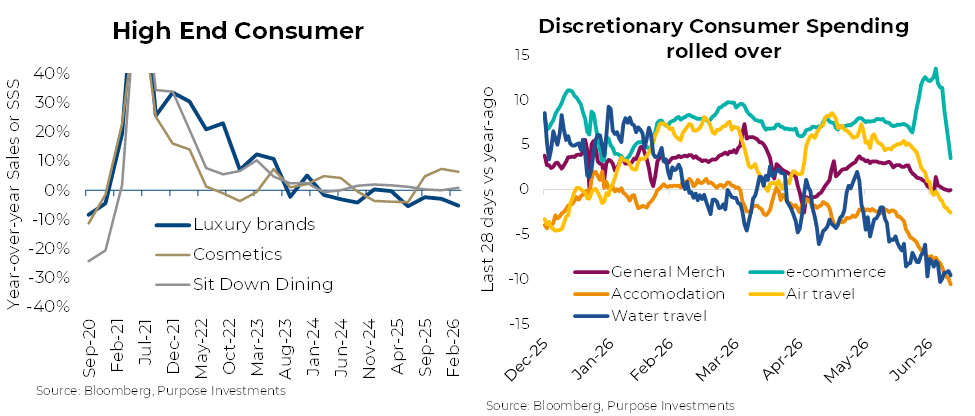
We have some good news and some troubling news. On the good side, our tracker of higher end consumer spending remains decent. This includes cosmetic, sit-down restaurant and luxury brand spending. This measures either same-store-sales or overall sales on a year-over-year basis, which mitigates seasonality factors. The downside: this is quarterly data from earnings, so important but slow. And we know in this world, nothing is allowed to be slow.
So, we will combine our slower High End Consumer canary measurements with card spending data on categories that are more discretionary. The trend of this type of consumer spending has been falling fast. Perhaps the higher energy prices are starting to take a bite. Of additional interest will be the slower readings once Q2 earnings reporting season is done.
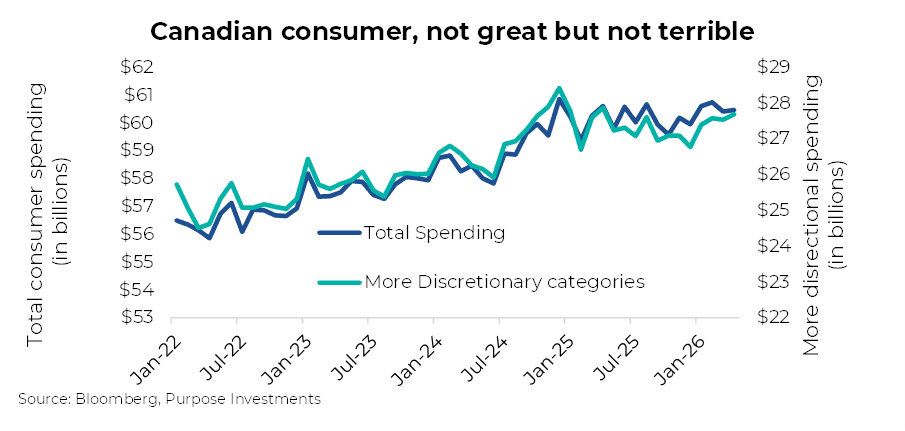
We typically focus on the U.S. and European consumer, but the Canadian consumer matters too. Especially for us Canadians. Unfortunately, we don’t have the depth of data on the Canadian consumer compared to the U.S., but still enough to work with. Not overly surprising, the Canadian consumer has been struggling a bit more. Based on retail sales, inflation adjusted, spending has flatlined starting early in Q1 of 2025 and has remained so since, as have the more discretionary categories. Flat isn’t bad. Employment, which has seen a bit of an upturn of late, has certainly helped on the consumer spending side.
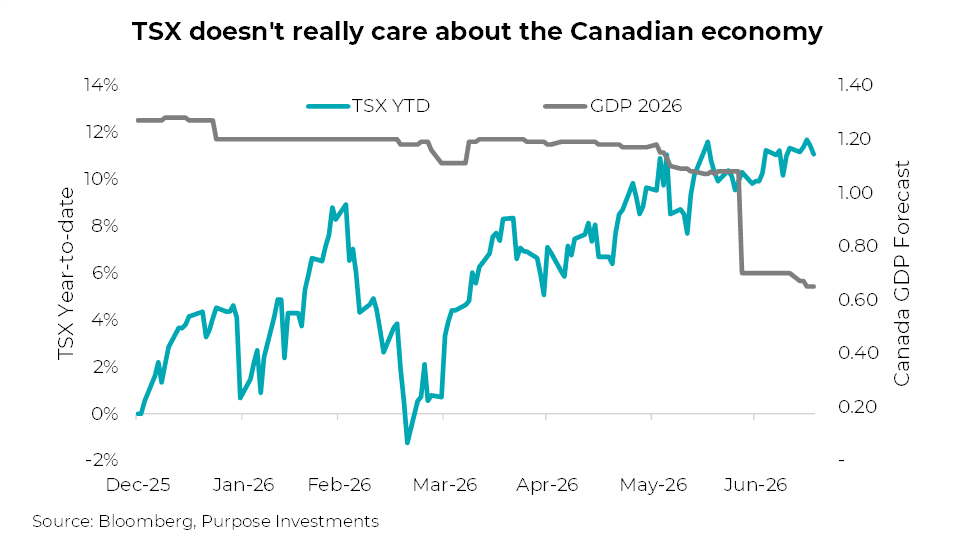
Despite the consumer hanging in, Canada has posted two back-to-back quarters of negative GDP. A rule of thumb is two consecutive quarters of negative GDP is a recession. We don’t buy that. The negative GDP was largely triggered by trade and inventory volatility, which isn’t good news, but not a recession just yet. The trend in investment is not encouraging but rising exports are. Let’s just say the Canadian economy is fragile.
Fortunately, the market really doesn’t care. Even with the Canadian economy near stall speed, the S&P/TSX marches upward. One could attribute this to the S&P/TSX weighting in energy, materials and technology, sectors not so sensitive to the domestic economy. But that doesn’t add up. Energy is up this year but the other two are down, for a net contribution of a little more than 1%. The Financials are the biggest lifter for the S&P/TSX, with the Canadian big six banks contributing 7.5% of the overall market advance. Let’s hope the Canadian banks can keep ignoring the economy.
Final Thoughts
This market continues to be dominated by AI related news and excitement, either ebbing or flowing. The other big factor is flows, which remain strong. That has helped the Canadian market and contributed to this divergence from what is going on within the economy. The Canadian economy has cooled, and the U.S. consumer appears to be showing some softening signs as well. For now, the markets don’t care, or mind. But if the data gets worse, we will wake up one day and realize the market decided to start caring. Until then, party on.
— Craig Basinger at Purpose Investments.
Get the latest market insights in your inbox every week.
Sources: Charts are sourced to Bloomberg L.P. unless specified otherwise.
The content of this document is for informational purposes only and is not being provided in the context of an offering of any securities described herein, nor is it a recommendation or solicitation to buy, hold or sell any security. The information is not investment advice, nor is it tailored to the needs or circumstances of any investor. Information contained in this document is not, and under no circumstances is it to be construed as, an offering memorandum, prospectus, advertisement or public offering of securities. No securities commission or similar regulatory authority has reviewed this document, and any representation to the contrary is an offence. Information contained in this document is believed to be accurate and reliable; however, we cannot guarantee that it is complete or current at all times. The information provided is subject to change without notice.
Commissions, trailing commissions, management fees and expenses all may be associated with investment funds. Please read the prospectus before investing. If the securities are purchased or sold on a stock exchange, you may pay more or receive less than the current net asset value. Investment funds are not guaranteed; their values change frequently, and past performance may not be repeated.
Certain statements in this document are forward-looking. Forward-looking statements (“FLS”) are statements that are predictive in nature, depend on or refer to future events or conditions, or that include words such as “may,” “will,” “should,” “could,” “expect,” “anticipate,” “intend,” “plan,” “believe,” “estimate,” or other similar expressions. Statements that look forward in time or include anything other than historical information are subject to risks and uncertainties, and actual results, actions, or events could differ materially from those set forth in the FLS. FLS are not guarantees of future performance and are, by their nature, based on numerous assumptions. Although the FLS contained in this document are based upon what Purpose Investments and the portfolio manager believe to be reasonable assumptions, Purpose Investments and the portfolio manager cannot assure that actual results will be consistent with these FLS. The reader is cautioned to consider the FLS carefully and not to place undue reliance on them. Unless required by applicable law, it is not undertaken, and is specifically disclaimed, that there is any intention or obligation to update or revise FLS, whether as a result of new information, future events, or otherwise.


