
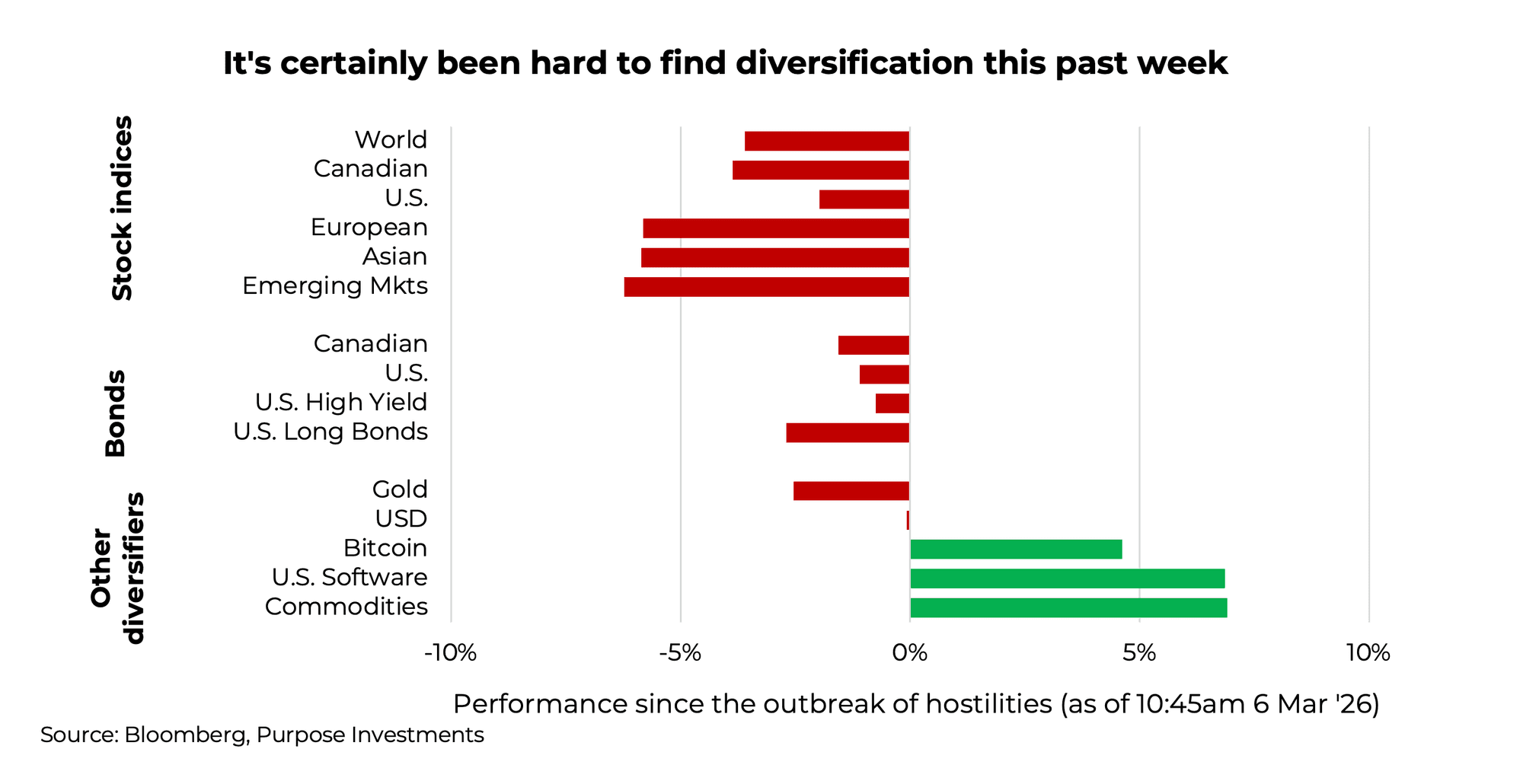
One would think that if markets sell off due to a material rise in geopolitical risk from the outbreak of war between the U.S./Israel and Iran, then gold should be a good diversifier. Clearly, that wasn’t the case this past week. Bonds aren’t doing so great, either. Riding to the rescue of portfolios are bitcoin and software stocks; that certainly is not following the traditional script. And of course, commodities are surging thanks to a huge rise in oil prices.
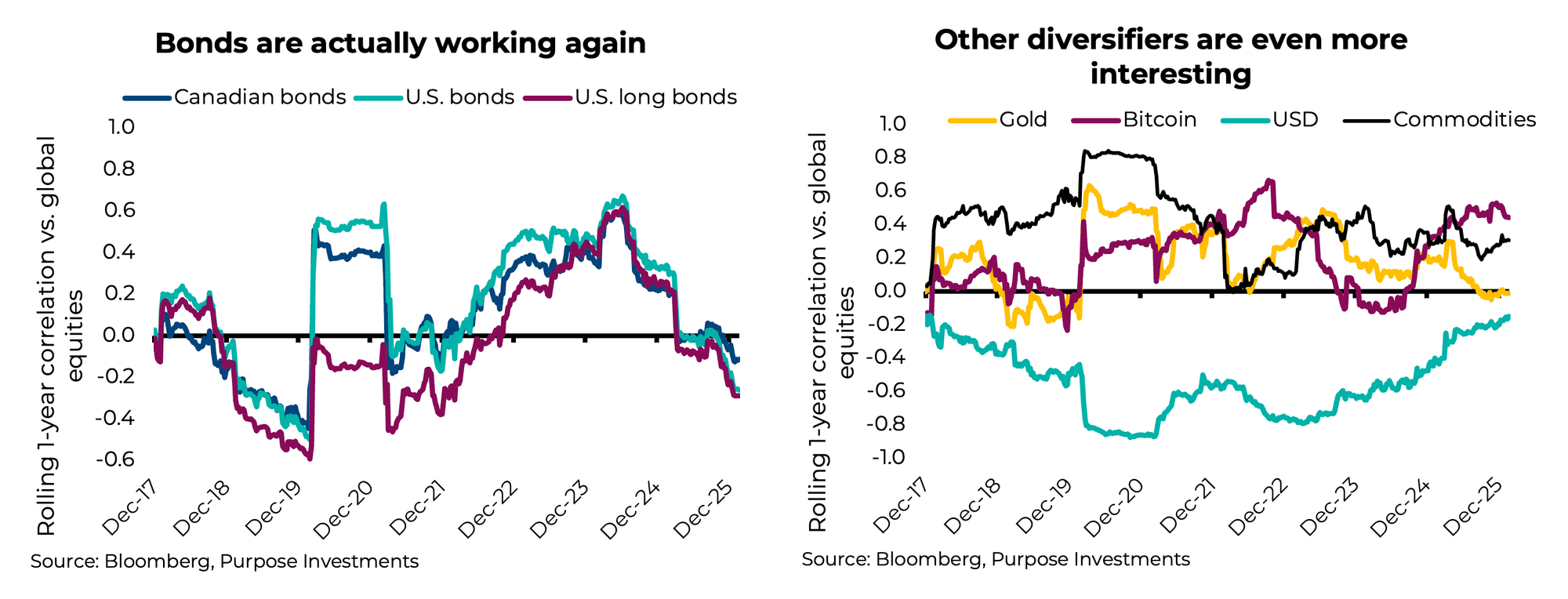
It isn’t just this past week that portfolio diversification has been more challenging. Everyone remembers 2022/23 when the bond/equity correlation became much more positive than in previous years, which made the market drop of 2022 much more painful. Bond/equity correlations actually remained strongly positive into 2024, but nobody minded as both equities and bonds were moving higher in price. Funny that.
While bonds haven’t helped much this past week, we would point out that their correlation to equities has been falling, which is good news. Certainly a vast improvement from 2022/23. International equities, while pretty strongly correlated given they are part of global equities, have seen their correlations fall a bit, too.
The other unique diversifiers are perhaps even more interesting. For many years, U.S. dollar exposure has been a really good diversifier for Canadian investors. From a correlation perspective, this has been diminishing of late. Bitcoin, gold, and commodities all generally have positive correlations to global equities, but it’s certainly on the lower side.
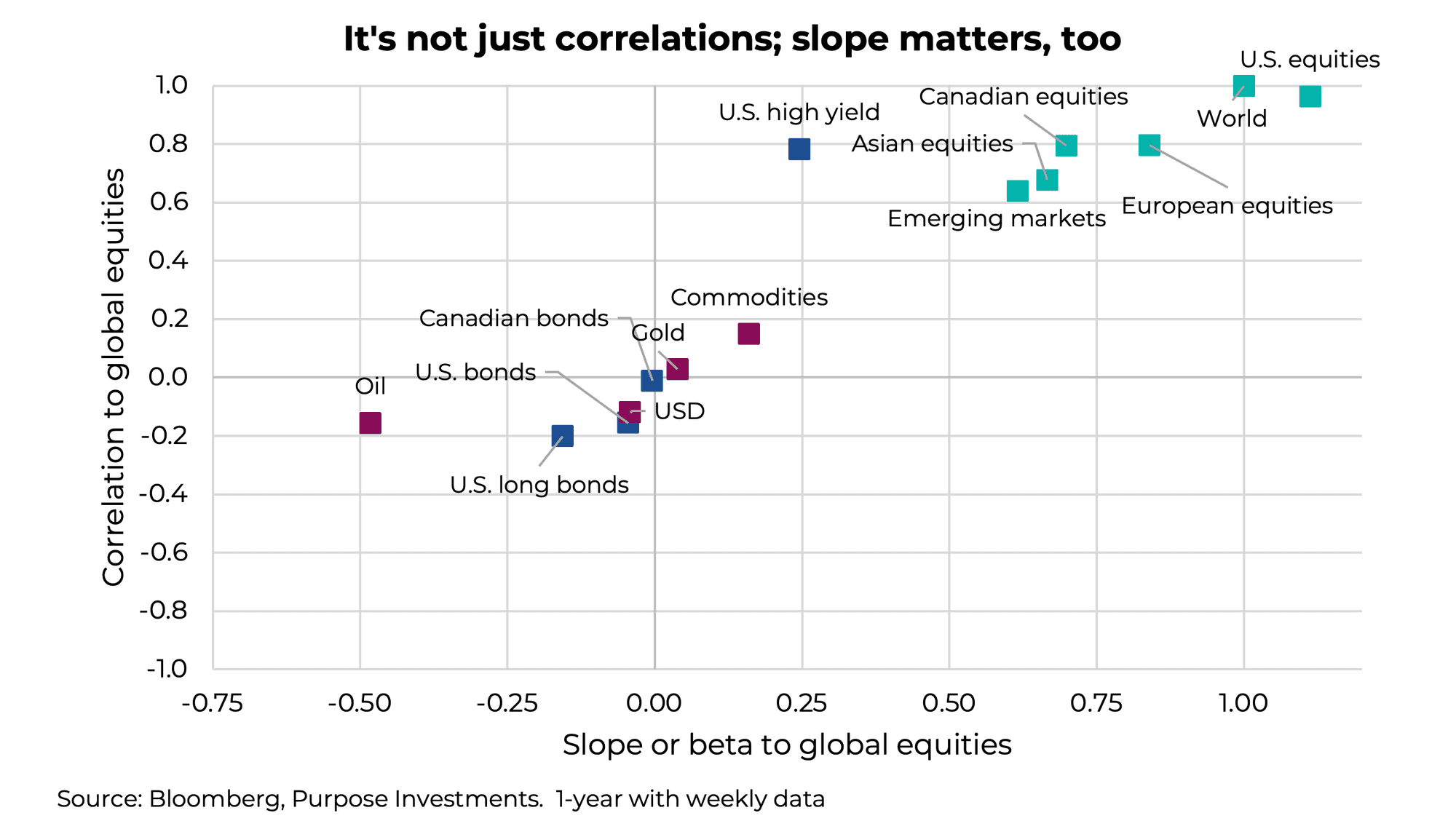
Correlations tell just one part of the story: the average relative direction. The other part is the degree of the move. The following scatter chart shows a basket of asset class categories plotted with correlation to global equities on the y-axis and slope on the x-axis. For example, U.S. high yield is strongly correlated to equities, but the slope is much lower, which means the direction will often be the same, but high yield will move much less. This helps diversification.
This is just one week of market weakness that once again is highlighting the need to really think about portfolio construction, namely diversified defence. With the Covid correction in 2020, bonds worked well after liquidity was restored, as did the U.S. dollar. During the inflation correction of 2022, bonds sucked and gold did well, as did more exotic income strategies that were less interest rate sensitive. The Liberation Day tariff-induced correction saw different defensive strategies work best. It’s a simple fact: these markets require multiple types of defence as corrections have become less atypical.
We were joking in the opening by highlighting bitcoin and software as diversifiers this past week. The math adds up, given that they went up this week as most things went down. But don’t read too much into this: they went up because they had already fallen so much. Bitcoin was over $120K in October and had fallen to the low $60Ks. One of the more popular ETFs tracking U.S. software equities had fallen from over $115 to below $80.
Final Thoughts
This market is fragile, and the sudden ramp of geopolitical risk is clearly being felt. Bombing campaigns can end as quickly as they began. But risks are now high, and while markets have fallen, they’re still not anywhere near correction territory. We do wonder: if markets fall more, will the Trump Always Chickens Out (TACO) playbook apply to armed conflicts, or is it just tariffs?
For now, we believe it’s important to stay a bit defensive and, most importantly, have a diversified defence within portfolios. We combine our core bond positions with gold, higher cash, momentum, and option harvesting. This allows optionality to act should parts of the market become too oversold. Never a dull moment.
— Craig Basinger is the Chief Market Strategist at Purpose Investments
Get the latest market insights in your inbox every week.
Sources: Charts are sourced to Bloomberg L.P.
The content of this document is for informational purposes only and is not being provided in the context of an offering of any securities described herein, nor is it a recommendation or solicitation to buy, hold or sell any security. The information is not investment advice, nor is it tailored to the needs or circumstances of any investor. Information contained in this document is not, and under no circumstances is it to be construed as, an offering memorandum, prospectus, advertisement or public offering of securities. No securities commission or similar regulatory authority has reviewed this document, and any representation to the contrary is an offence. Information contained in this document is believed to be accurate and reliable; however, we cannot guarantee that it is complete or current at all times. The information provided is subject to change without notice.
Commissions, trailing commissions, management fees and expenses all may be associated with investment funds. Please read the prospectus before investing. If the securities are purchased or sold on a stock exchange, you may pay more or receive less than the current net asset value. Investment funds are not guaranteed; their values change frequently, and past performance may not be repeated.
Certain statements in this document are forward-looking. Forward-looking statements (“FLS”) are statements that are predictive in nature, depend on or refer to future events or conditions, or that include words such as “may,” “will,” “should,” “could,” “expect,” “anticipate,” “intend,” “plan,” “believe,” “estimate,” or other similar expressions. Statements that look forward in time or include anything other than historical information are subject to risks and uncertainties, and actual results, actions, or events could differ materially from those set forth in the FLS. FLS are not guarantees of future performance and are, by their nature, based on numerous assumptions. Although the FLS contained in this document are based upon what Purpose Investments and the portfolio manager believe to be reasonable assumptions, Purpose Investments and the portfolio manager cannot assure that actual results will be consistent with these FLS. The reader is cautioned to consider the FLS carefully and not to place undue reliance on them. Unless required by applicable law, it is not undertaken, and is specifically disclaimed, that there is any intention or obligation to update or revise FLS, whether as a result of new information, future events, or otherwise.


