
Most would likely agree the world has generally become a noisier place over the years, which is cranked up to 11 in 2026 with the hostilities in the Middle East. The onslaught of headlines has been almost deafening, terrifying at times, helping drive markets up one day and down the next. Or in simpler terms, cause investors to become fearful or greedy on a day-to-day basis.
Let’s just walk through the past six weeks. Hostilities broke out at the end of February and markets moved higher when they opened on Monday. But as the conflict wore on, markets started to be worn down by the headlines. The size and duration of the conflict were becoming larger, and oil through the Strait of Hormuz became blocked. Take your pick from headlines warning of global inflation, recession, running out of gas, energy emergencies, etc. Meanwhile the war of words was just as dramatic, often oscillating from ‘it is almost over’ to ‘we will destroy everything’ to ‘two-week ceasefire’ to ‘[insert your best guess for the next twist]’.
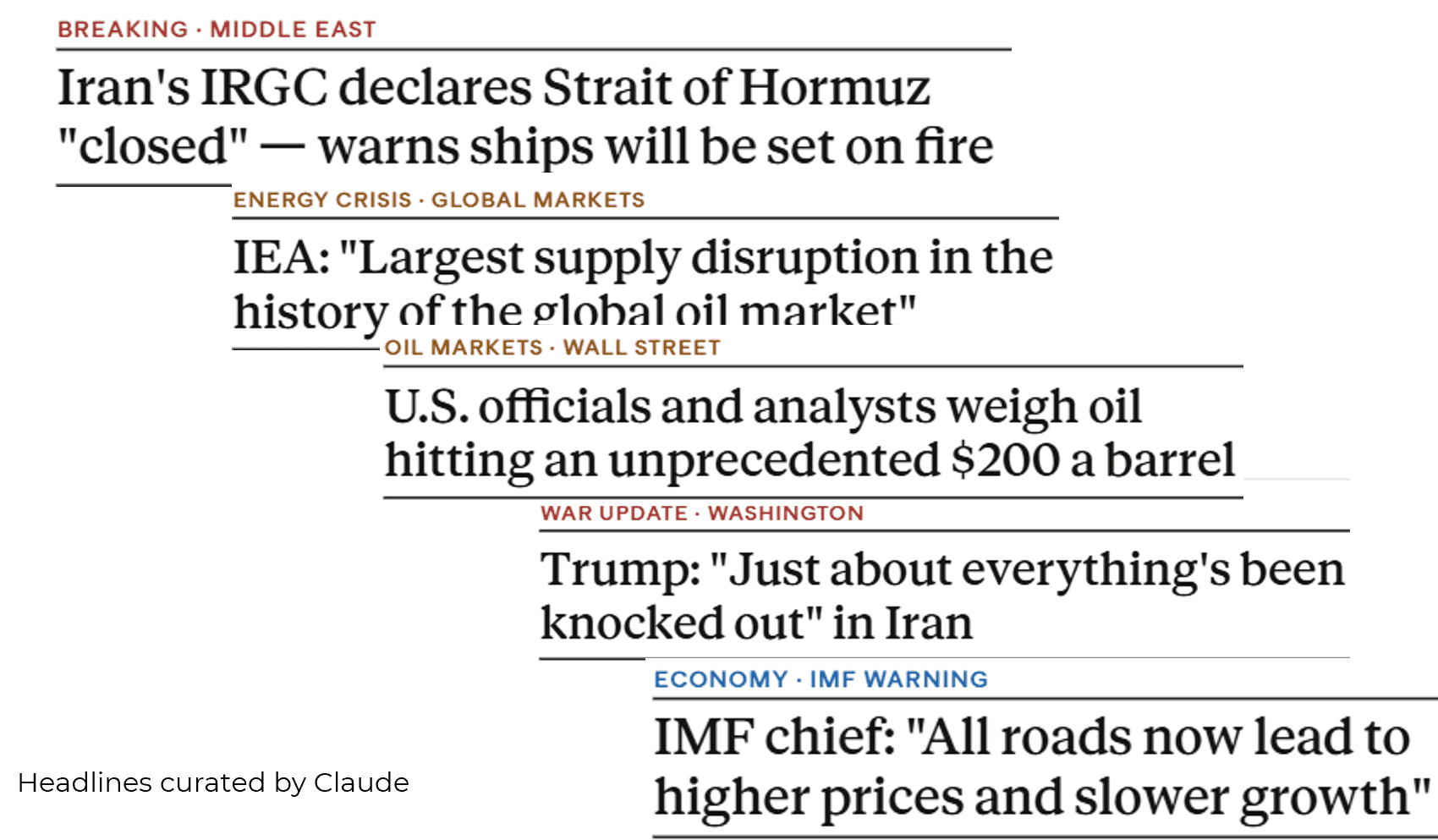
The challenge is how content has evolved. Let’s go back to a simpler time: news of global events was published in newspapers and carried on the evening news. Biases certainly existed back then but we would argue the content was more objective, perhaps more researched and the news was less entertaining. You paid for your newspaper subscription or your monthly fee to the cable provider. While these providers still exist, their prominence has diminished as content evolved into its current model.
Most content today, you don’t pay for. Free is better, right? The challenge now is that the content creator’s economics are driven by ads or reader engagement of followers in some form. This is a problem because to garner more eyeballs ($$$), the content has to be somewhat inflammatory or often extreme. Publishing that the conflict will only have a minor drag on economic growth and an offramp will be found to de-escalate is NOT going to lure many readers. Saying the oil crisis is bigger than the 1970s and will reach $200/bbl, will fetch more eyeballs.
Take some open source financial blog economic models. The author isn’t paid on the quality of their analysis, or if the idea works out; they are paid based on the number of people who read it. So nobody is going to write about something boring like Loblaws. It is all going to be Tesla, Nvidia or other glam stocks. Clearly, topic selection is skewed by economics. The algos feed this as well: more extreme stories get read more, which triggers other algos to distribute more widely.
The challenge with these economic models is that to succeed, the content needs to be more extreme. Now, with over 25,000 podcasts focused on investing, you had better have a really loud voice to be heard.
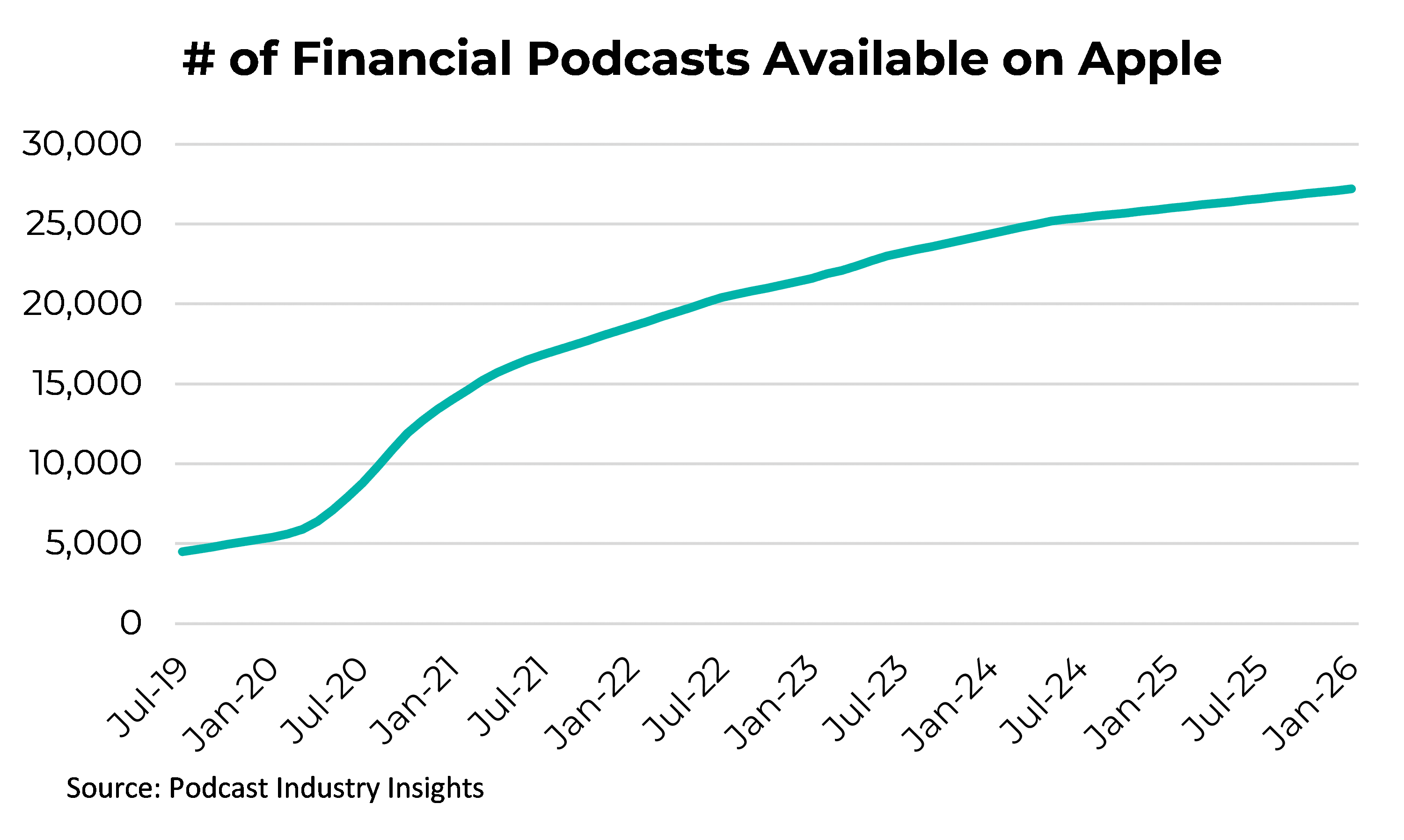
It isn’t just the blogs and podcasts that suffer from this. One could argue mainstream media has gone at least partially down this road with attempts to increase viewership. Even research reports are often trying to elicit an action to buy or sell which is easier with a more emphatic view.
Artificial Intelligence
This perhaps creates another wrinkle. The ease of creating content has now become much easier as AI tools can help in the writing process (no AI writing in Ethos so far but AI did help create that table above and find some headlines). Or perhaps more impactfully, it can help improve graphics, video or other content enhancements. That should be a positive, but if it is enhancing more extreme views to make content more compelling, that may prove detrimental to investors. Tools are tools; they can be used for good or bad. Don’t blame the tool, though.
In the end, this is a noisier world. We have more content than ever before, that is increasingly compelling, but not always motivated in the reader’s best investing interests.
How to Navigate
For investors, advisors and portfolio managers, we would not suggest ignoring all the headlines, news, blogs or podcasts. To varying degrees all offer something whether it be a different perspective, nugget of information or even simple entertainment. But reacting to such information is more likely a detriment to your investment process.
Ideally, find a few or a handful of ‘trusted sources.’ Understand their economic model, as this helps put their content or views into perspective. As Charlie Munger often highlights, understanding someone’s incentives can most often explain their behaviours. This doesn’t make the view right or wrong, but it is an added lens of consideration when consuming their content.
Follow your trusted sources with continuity. Investing isn’t about running around trying to find the next good idea somewhere and then moving to find the next one. Nor is it reading some content, which sounds convincing, and adjusting your portfolio accordingly. Portfolio profits come from the ‘sitting’ on a position much more than trading into or out of something. Ideally the continuity of following your trusted sources will lead to a more stable portfolio. On occasion, explore new trusted sources, after following them for some time to ensure they are a good fit.
Look for content that is more balanced. Or content that attempts to clarify, not elicit, an emotional response. Finally, don’t overreact to headlines or flashy stories. We believe markets often overreact to the news flow, and that is likely where the opportunity lies. Be a bit contrarian and don’t knee-jerk react to the news.
— Craig Basinger is the Chief Market Strategist at Purpose Investments
Get the latest market insights in your inbox every week.
The content of this document is for informational purposes only and is not being provided in the context of an offering of any securities described herein, nor is it a recommendation or solicitation to buy, hold or sell any security. The information is not investment advice, nor is it tailored to the needs or circumstances of any investor. Information contained in this document is not, and under no circumstances is it to be construed as, an offering memorandum, prospectus, advertisement or public offering of securities. No securities commission or similar regulatory authority has reviewed this document, and any representation to the contrary is an offence. Information contained in this document is believed to be accurate and reliable; however, we cannot guarantee that it is complete or current at all times. The information provided is subject to change without notice.
Commissions, trailing commissions, management fees and expenses all may be associated with investment funds. Please read the prospectus before investing. If the securities are purchased or sold on a stock exchange, you may pay more or receive less than the current net asset value. Investment funds are not guaranteed; their values change frequently, and past performance may not be repeated.
Certain statements in this document are forward-looking. Forward-looking statements (“FLS”) are statements that are predictive in nature, depend on or refer to future events or conditions, or that include words such as “may,” “will,” “should,” “could,” “expect,” “anticipate,” “intend,” “plan,” “believe,” “estimate,” or other similar expressions. Statements that look forward in time or include anything other than historical information are subject to risks and uncertainties, and actual results, actions, or events could differ materially from those set forth in the FLS. FLS are not guarantees of future performance and are, by their nature, based on numerous assumptions. Although the FLS contained in this document are based upon what Purpose Investments and the portfolio manager believe to be reasonable assumptions, Purpose Investments and the portfolio manager cannot assure that actual results will be consistent with these FLS. The reader is cautioned to consider the FLS carefully and not to place undue reliance on them. Unless required by applicable law, it is not undertaken, and is specifically disclaimed, that there is any intention or obligation to update or revise FLS, whether as a result of new information, future events, or otherwise.


