
News from October 9 of Trump announcing a "deal" for Russia to lift the diesel export ban for the U.S. (and rest of the world in the footnote) is making the rounds, with the U.S. refining complex selling off towards the end of the week. Now the media is jumping on board as if this is some game changer that's going to bring diesel prices down significantly. Of all the times Trump has successfully jawboned the markets in and out of a war, this one might be the best one yet (that is completely unhinged from reality, and comical considering the Lindsey Graham Act that was supposed to sanction Russia hard didn't even reach its one-month anniversary). Here is our take on the set up and why the refining sector is likely to continue to outperform.
The numbers that are widely circulated are for "immediate" delivery of 300k tons of diesel exports, followed by 500k tons in November, 1 million tons in December, and then another 3 million tons "within a short period of time depending on the state of Russian refineries". Call it 1.8 million tons of "sure bet" over the course of 3 months, assuming 100% of it went to the U.S., with ~7.5 barrels of diesel per ton. That's about 150kbpd of incremental supply going into the U.S. Some have correctly pointed out that U.S. domestic diesel demand is running at ~3.7 Mbpd, so the incremental supply is a drop in the bucket of what's required to substantially bring diesel prices down in the U.S.
With the announcement of any "deals" from Trump it's always important to read the fine print and also what the relevant parties are saying (in the majority of the cases it's news to them too). In this case, Putin has agreed to release diesel "to the American and the global marketplace" with the second part doing a lot of heavy lifting there. In September, as per Vortexa, Russia still exported ~144kbpd of diesel despite their product export ban. That works out to be almost 600k tons. No one who's reporting on this deal knows what the actual deal is, but if taken at face value, it looks like Russia is technically satisfying the 500k tons out of the gate with significantly less exports required to get to their targets, i.e., a big political win with very little incremental change to what they're doing already.
Diesel is a fungible good that can generally be transported around the world with ease, Middle East chokepoints aside, and is thus priced globally net of transportation costs in getting it to the end destination. When you're increasing exports while supply is the same, all else equal, you are depriving someone else of the barrel, and vice versa on the consumer side where if you receive that extra barrel, that is one barrel you didn't need to source elsewhere assuming demand is the same, hence the musical chairs nature of energy flow. With every barrel of Russian diesel that hits the East Coast, that is one less barrel that they need to import from PADD 3 / Texas via Colonial Pipeline and around the U.S. coast to a smaller extent with the waivers of the Jones Act (tankers carrying cargo between U.S. docks must be owned / flagged / crewed by U.S. personnel), and as an extension of that the Gulf Coast can subsequently have one more barrel to export to the rest of the world and we end up back at equilibrium and nothing material happens to diesel prices at the pump. We have seen this movie before, post-Ukraine invasion, where Europe stopped buying oil and gas from Russia, but eventually more Russian oil just went eastwards instead of west, and gas went back to Europe via Russian LNG. With Russia cutting off their energy statistics since around the invasion of Ukraine it's hard to say exactly how much they are importing today unless you count barrels for a living and/or have better proprietary data, but the key point is we know for a fact that they are importing diesel today with the latest controversy around South Korea shipping products to Russia leading to a fallout in diplomatic relations between Ukraine and South Korea, pretty significant for a country that had 6.5 Mbpd of refining capacity that got cut close to half as the war dragged on. What this means is that extra barrel coming out of the Gulf Coast is ultimately making its way back to Russia one way or another, except everything costs more because you're artificially increasing the costs of transportation as the tankers have to cover more distance around the world and diesel prices end up more expensive for everyone by the time it goes full circle.
While the conversation around diesel has generally been focused on the flow and the price, not enough attention is paid to the refineries themselves, and unlike diesel, refineries are not fungible and are all operated and maintained very differently with unique facility setups. We have also seen this movie before circa 2022, when refineries around the world were pushed to the max to capture the outsized refining cracks post-invasion, as global refining economics were driven by European gas prices (takes a lot of gas to heat up the crude distillation units). We think refineries being blown up in Russia in recent years as well as the Strait of Hormuz outage are on a completely different timescale than in 2022. When refineries were pushing utilization to the max, what we saw was more and more refineries having unplanned outages (i.e. stuff blowing up) as refineries need regular maintenance to keep things running optimally and safely and many refineries were opting to delay that maintenance to capture outsized returns. We think the refiners' space will increasingly become a game of Whac-a-mole as ones that are not up to date with their maintenance and/or not used to operating their facilities at high throughputs will start having more and more outages which feeds into the high refining margins for the ones that remain standing.
We continue to like the U.S. independent refiners with great operational track records in an area that has stable and cheap feedstock.
Refining flowsheet
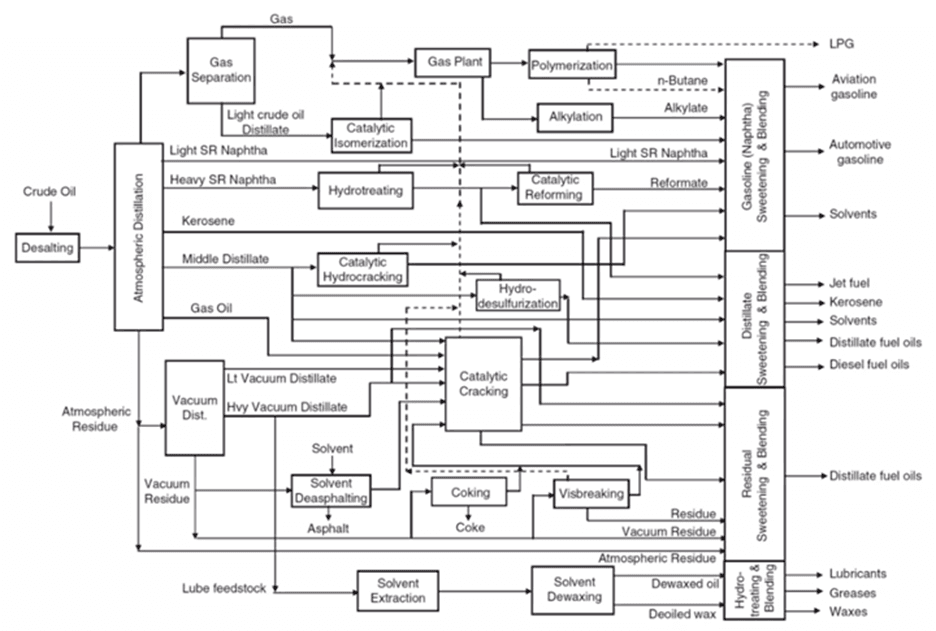
Source: Charts sourced to Bloomberg unless specified otherwise, as of October 13, 2026.
This if intended for informational and educational purposes only, and not investment, financial or other professional advice.
Certain statements in this document are forward-looking. Forward-looking statements (“FLS”) are statements that are predictive in nature, depend on or refer to future events or conditions, or that include words such as “may,” “will,” “should,” “could,” “expect,” “anticipate,” “intend,” “plan,” “believe,” “estimate” or other similar expressions. FLS are not guarantees of future performance and are by their nature based on numerous assumptions. Although the FLS contained in this document are based upon what Purpose Investments believes to be reasonable assumptions, Purpose Investments cannot assure that actual results will be consistent with these FLS. Index returns referenced are historical and do not reflect fees or expenses. Past performance may not be repeated. Third-party data and research cited herein are the property of their respective owners.