
Part One: From Blank Stare to Daily Habit
Most technology waves hit our industry twice. The first hit is in portfolios and stock selections. Questions come up about what they own, how much, and is it a bubble yet? We wrote on that already (see How Much AI Do I Own?). The second hit is quieter. What, if any, does this technology do to the way an advisory practice is run? That's this piece. A practical look at how advisors could use AI today, and a roadmap for going from "I opened ChatGPT once and it wrote me a mediocre limerick" to genuinely running parts of your practice with it.
Fair warning: this is a two-parter. Part one covers: what the adoption data says, why most current AI use barely scratches the surface, and how to get from zero to daily habit. Part two goes deeper into the power-user end: turning entire workflows over to AI, measuring the payoff, and repositioning your team for a world where the routine stuff can become automated.
Everyone Is “Using AI.” Few Are Actually Using AI.
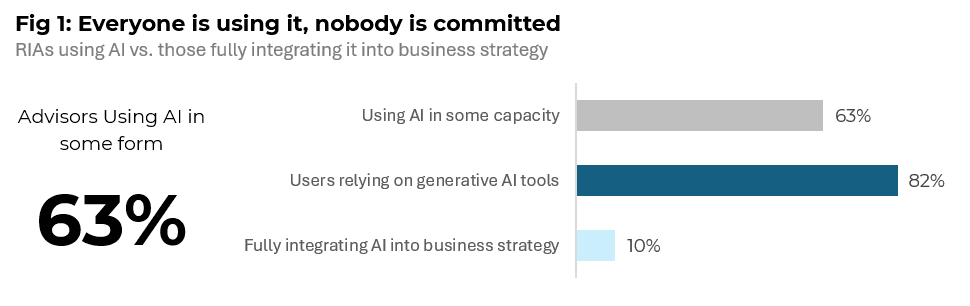
We were lucky enough to attend a presentation on this topic at a Morningstar conference, and the message matches what the public data shows. Charles Schwab's latest RIA study found that 63% of advisory firms are using AI in some capacity, more than double where adoption stood in 2023. It sounds impressive until you look one layer down (Fig 1): 82% of those users are leaning on generative AI tools: the chat window, and most adoption is happening through individual experiments rather than anything firm wide.
Meanwhile, only about one in ten firms have fully integrated AI into their business strategy. In other words, most AI use today is typing a question into a chat and copy/pasting the answer. That's not nothing, but it is the technological equivalent of buying a truck to listen to the radio.
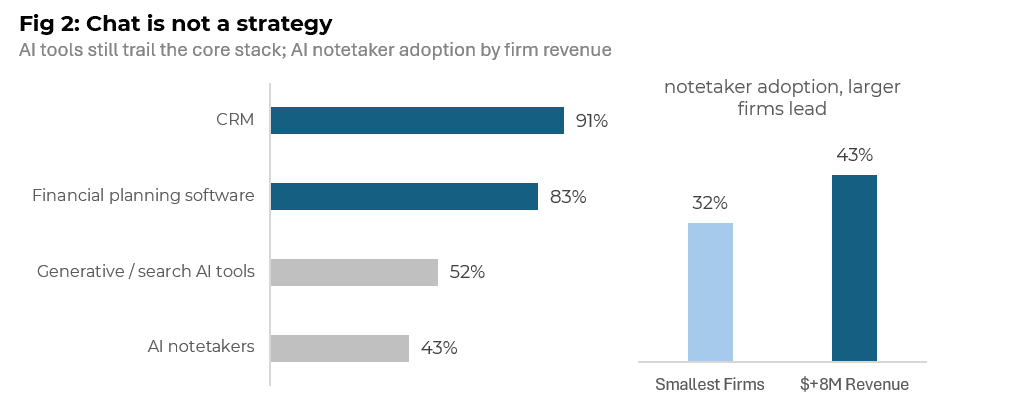
The tool data tells the same story in Fig 2. In a survey of nearly 3,000 advisors, CRM adoption was 91% and financial planning software came in at 83%, while generative and search AI tools sit at 52% and AI notetakers at 43%. Give AI its due here, as it is climbing fast with generative AI use increasing 11% less just a year earlier. But the fact remains it still trails the core stack, and what is there is overwhelmingly chat.
There is also a size effect worth noting. AI notetaker adoption runs north of 43% at firms with $8M+ in annual revenue versus 32% at the smallest practices. The bigger teams simply have the scale to assign someone to figure it out. The good news for everyone else is that the tools have become cheap and general enough that "assigning someone" can now mean you for an hour a week.
Skate Where the Puck Is Going
Here is why "chat and done" is a mistake. Research from METR shows the length of task that frontier AI models can complete has been doubling roughly every ~4-7 months, with the pace accelerating the past two years. In 2022, models could answer a question. By 2024–2025 they could use tools, search, run code and control software. The direction of travel is from answering → doing → running entire workflows. If you build your AI habits around what the tools could do last year, you'll be permanently a generation behind. Plan for where the technology is headed, not where it is today.
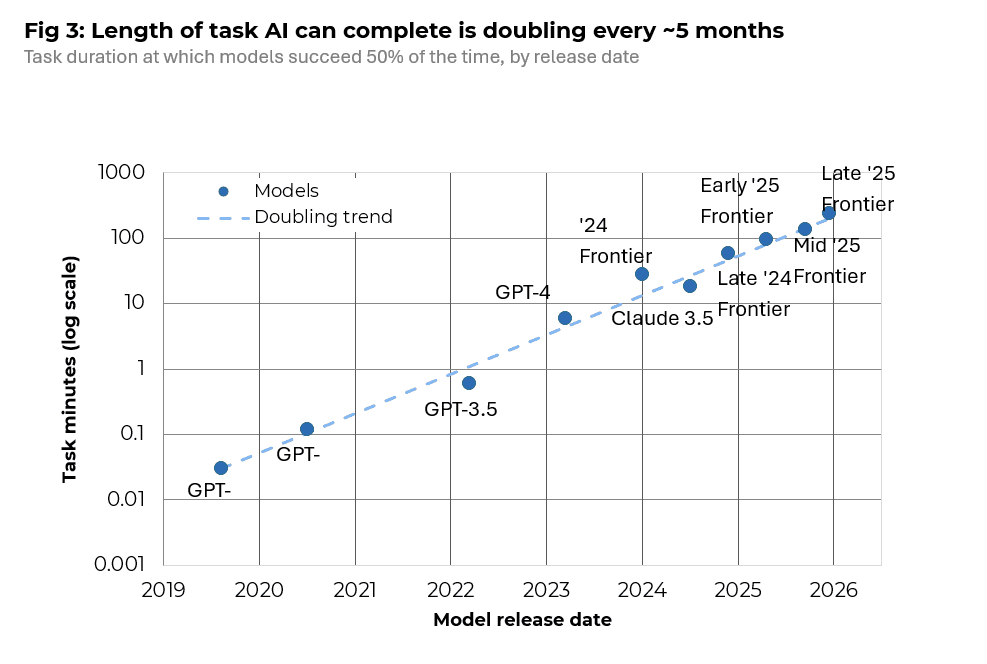
One important callout to make clear: AI has what researchers call a ‘jagged frontier’. It is superhuman at some tasks and confidently wrong at others. It can summarize a 90-page essay in seconds, then easily get the authors name wrong in the first line. This jaggedness is exactly why the human aspect is the operating model. Roles shift from doing the work to framing it, guiding it, and editing it. More on that below.
Mapping This to Practice
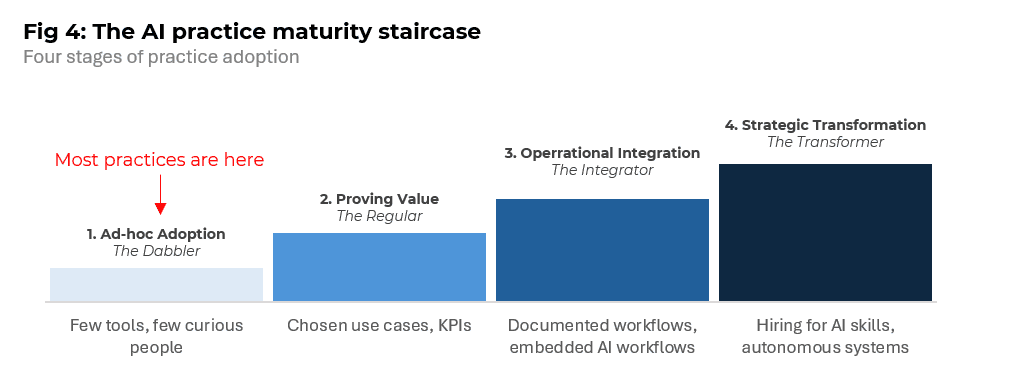
Below is a framework for AI adoption, and it lands on four stages of practice maturity.
- Ad-hoc adoption (the Dabbler). A few tools, a few curious team members, no policy. Wins are personal and accidental.
- Proving value (the Regular). Deliberately chosen use cases, defined KPIs, someone accountable, measured pilots.
- Operational integration (the Integrator). Documented workflows, unified data, AI embedded across operations; not just individuals.
- Strategic transformation (the Transformer). Hiring for AI skills, prioritizing outcomes, deploying autonomous systems.
This article is about getting you through stages one and two. Part two will cover stages three and four.
Most advisory practices in Canada today are firmly in stage one. Which means the competitive gap between stage-one and stage-three practices is currently a wide-open field.
Stage One Done Right: The Dabblers Field Guide
If you're starting from zero, then one simple method is the core-and-satellite approach. This term should feel comfortable to anyone who has built a portfolio. The core is simply one general purpose AI platform (Microsoft Copilot, enterprise versions of ChatGPT, Gemini or Claude, whichever your firm has approved). The satellites are a small number of specialized tools that plug into specific jobs: an AI notetaker, your CRM's AI features, maybe a planning or document tool. One core, a few satellites. Resist the urge to collect apps like Pokémon.
Then adopt the three-role model for all AI interactions. When you work with AI, your role changes and you become:
- The Framer —provide context. Who you are, what the situation is, what role you want the AI to play, what outcome you want, what format you want it in. The difference between "write a client email" and "write a 150-word email to a 62-year-old client who is nervous about equity volatility, reassuring in tone, grade-8 reading level, no promises about returns" is the difference between garbage and gold.
- The Guide — steer mid-task. Correct wrong assumptions, point it to credible sources, and give it documentation.
- The Editor — own the output. Verify facts, check logic, make changes. Nothing AI-generated goes out the door without human review. Not because the regulators or compliance say so (though they do), but because the jagged frontier says so.
Start with low stakes, high annoyance tasks: summarizing research, drafting internal notes, prepping meeting agendas, translating "portfolio rebalancing rationale" into plain English. Our take is to keep client PII (Personally Identifiable Information) out of AI tools entirely. Whether approved or not, there's no reason a prompt needs a client's full name, SIN or account number. That one rule should help to solve a good portion of the compliance anxiety.
Stage Two: From Party Trick to Proof
The move from Dabbler to Regular is deliberate use case selection and some measurement. Fig 5 below shows where the traction exists and how far trust has come. Top use cases are meeting summaries, CRM updates, meeting prep and routine client communications. A third of advisors said they would let AI generate and send routine communications, schedule meetings or update the CRM without even reviewing the output first. Now look at the bottom bar. Only 8% would let AI rebalance a portfolio or execute a trade. Advisors have drawn a bright line on where they want to focus their time.
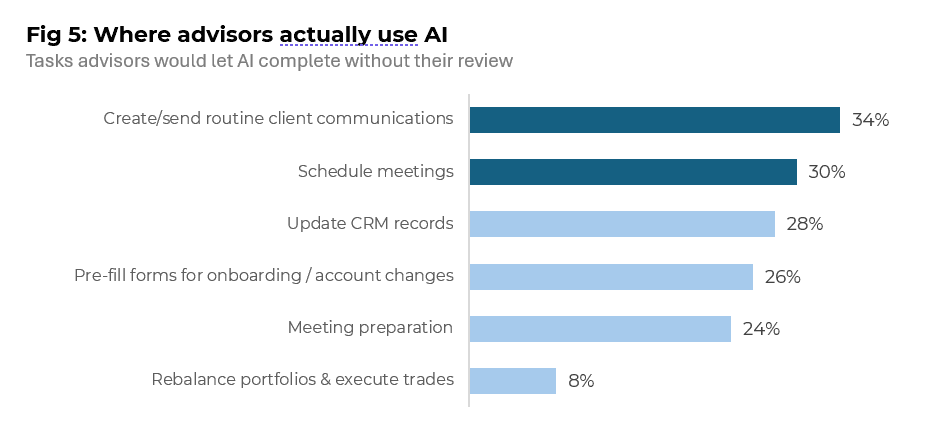
That line is also a useful lens for choosing your first serious use cases. AI is currently best at two extremes: open tasks with no single right answer (e.g. drafting a newsletter) and binary tasks with a clearly checkable answer (does this document contain X?). It struggles most in the murky middle. Pick one growth use case and one efficiency use case run each for a month and track the hours.
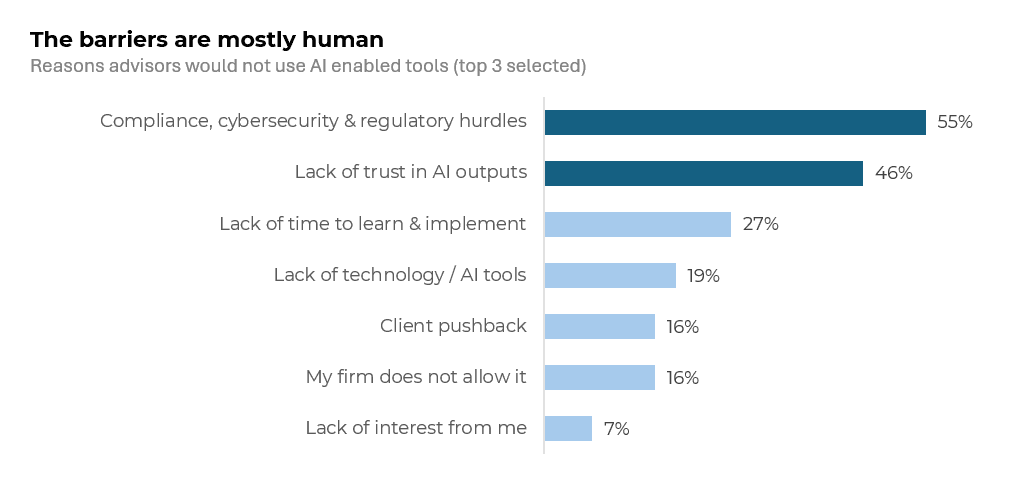
We’re going to be honest; the obstacles are real. When the same survey asked advisors why they wouldn't use AI enabled tools, the top answers were compliance, cybersecurity and regulatory hurdles. But look down the full list and only one item (lack of the tools themselves) is about the technology. The rest are about us. Compliance risk is managed with your firms AI policies, approved tools, PII rules, and mandatory human review. Trust and time are solved the same way you get comfortable with anything in life — reps.
Your Stage One & Two Checklist
- Inventory what's approved. Understand the AI tools your firm has sanctioned and standardize on one core assistant plus one or two satellites.
- Write the two rules down. No client PII in any AI tool. Describe the situation, never the person, no AI output leaves without human review. Two sentences. Circulate them.
- Pick a couple use cases. One growth, one efficiency. Commit to 30 days of actual use. Track time saved, honestly.
- Practice the Framer-Guide-Editor loop. Better prompting genuinely equals better output: clear instructions, broken down tasks, examples of what good looks like, specified format and tone.
Try it for a quarter and you'll be ahead of many in the industry, which remember is still asking the chatbot to write limericks.
In Part Two: what the power users are doing — mapping entire workflows, building system prompts for your team, measuring the payoff in hours per week, and repositioning your practice around the things AI can't commoditize: judgment, trust and behavioural coaching.
— Spencer Morgan & Brett Gustafson at Purpose Investments
Date of Publication: August 27, 2026
The content of this document is intended for advisors for informational purposes only, and is not being provided in the context of an offering of any securities described herein, nor is it a recommendation or solicitation to buy, hold or sell any security. The information is not investment advice, nor is it tailored to the needs or circumstances of any investor. Information contained in this document is not, and under no circumstances is it to be construed as, an offering memorandum, prospectus, advertisement or public offering of securities. No securities commission or similar regulatory authority has reviewed this document and any representation to the contrary is an offence. Information contained in this document is believed to be accurate and reliable, however, we cannot guarantee that it is complete or current at all times. The information provided is subject to change without notice.
Certain statements on this site may be forward-looking. Forward-looking statements (“FLS”) are statements that are predictive in nature, depend on or refer to future events or conditions, or that include words such as “may,” “will,” “should,” “could,” “expect,” “anticipate,” intend,” “plan,” “believe,” “estimate” or other similar expressions. Statements that look forward in time or include anything other than historical information are subject to risks and uncertainties, and actual results, actions or events could differ materially from those set forth in the FLS. FLS are not guarantees of future performance and are by their nature based on numerous assumptions. Although the FLS contained in this document are based upon what Purpose believes to be reasonable assumptions, Purpose cannot assure that actual results will be consistent with these FLS. The reader is cautioned to consider the FLS carefully and not to place undue reliance on the FLS. Unless required by applicable law, it is not undertaken, and specifically disclaimed, that there is any intention or obligation to update or revise FLS, whether as a result of new information, future events or otherwise.