
Teaching a 3-year-old to share is an ongoing lesson in letting go. I am currently in the thick of it. I'm learning that when a child has plenty of toys or snacks, asking them to make room for someone else can be surprisingly difficult.
There's a useful parallel in portfolio construction. Firms naturally have conviction in the products they create, as they should. At Purpose, we're proud of our strategies, but we also recognize that building a portfolio means making room for other firms' strengths, too.
We recently celebrated the 3-year anniversary of the Purpose Active Suite, our multi-asset portfolio solutions. We thought it was a good opportunity to take a closer look at one of the things that differentiates our approach to portfolio construction. We don’t believe a portfolio should be built around a single firm’s product lineup, even when that firm is our own.
Belief in our products doesn’t mean believing they’re the best fit for every allocation. Different investment firms have different strengths, and we think proper portfolio construction means being willing to recognize that. In essence, familiarity and comfort are not reasons alone to choose an investment.
We believe the portfolio should come first. Generic statements like that usually upset me, but this one does have meaning. It means evaluating our own strategies alongside those offered by other firms and choosing those based on the role they can play, rather than who makes them. It’s a philosophy that shapes how we build our portfolios, how we work with advisors, and why we have put a mandated limit on how much of our own products we can use.
Different Firms, Different Strengths
Managing Canadian equities requires a different set of skills and perspectives than managing international equities or fixed income. Even within the same asset class, firms can have different approaches to their management. We have strategies we are proud of at Purpose, but we don’t believe we are the best at everything. And we don’t think any firm is, either. To put that into perspective, we looked at the 10 largest Canadian mutual fund categories by AUM and identified the 10 funds with the highest five-year annualized returns in each category. The results were even shocking to me; those 100 funds represent 40 different firms.
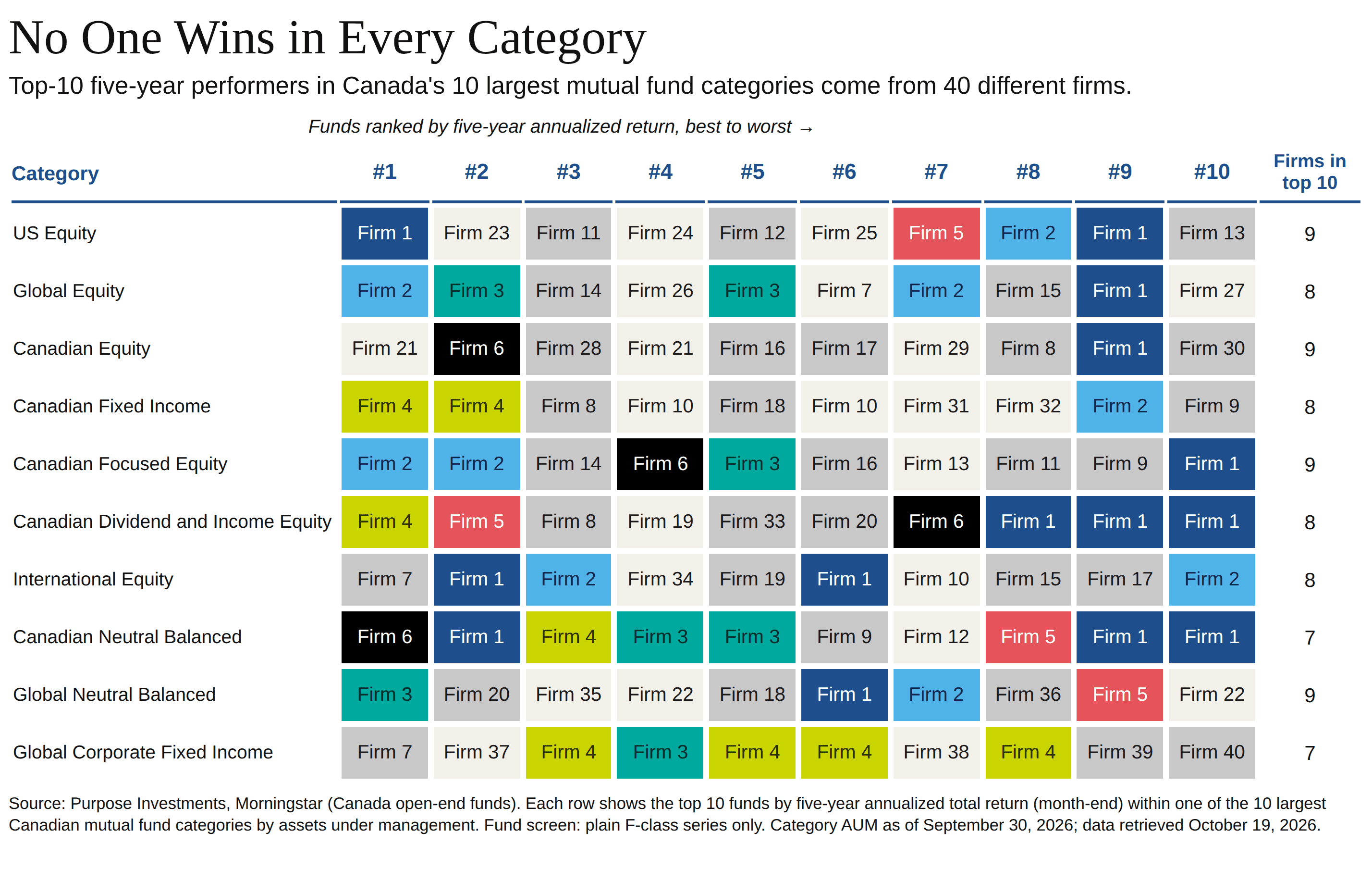
We've kept the firms anonymous, but anyone who spends enough time in the investment industry might recognize a few patterns. Think you can identify the firms? I'm open to guesses, though I'll leave the official scorekeeping to someone else.
Jokes aside, look across the categories, and you’ll see different firms appearing among the leading funds. The results are not concentrated in any single provider's lineup. Of course, historical performance does not tell us who will be best going forward. Five-year returns are simply a point in time; they don’t tell us about risk, consistency, fees or suitability for a portfolio. Nor does appearing in the top performers make a fund the right choice.
The point is simply that investment opportunities and historical results span a broad range of providers. If we are truly trying to build the best portfolio possible, the proof is right there that we should be looking across the universe rather than assume one firm has the right solution for every allocation.
The objective isn’t to use as many managers as possible either. There will always be some overlap, especially in a Canadian portfolio. The point is to have the flexibility to consider different approaches and select investments that best serve the portfolio.
How This Shapes Our Portfolios at Purpose
So, what does this look like in practice? We compared Purpose Active Balanced with five peer balanced funds, looking at the proportion of each portfolios fund and ETF holdings invested in products managed by their associated firm.
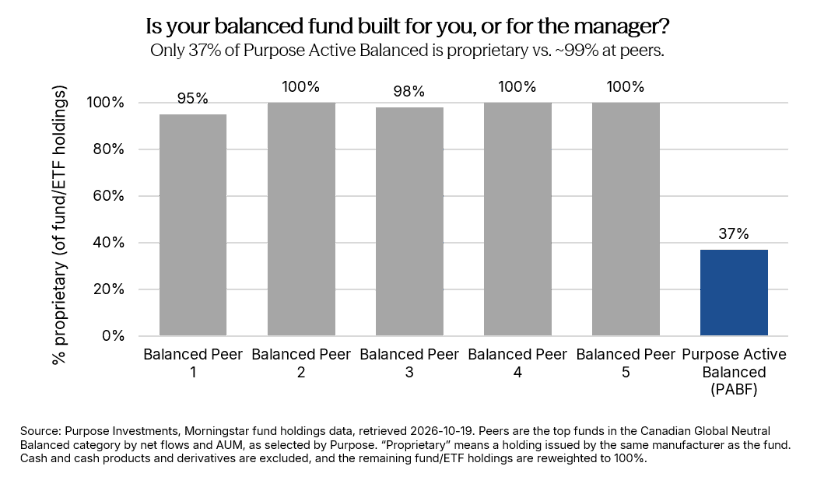
Proprietary products account for an average of 99% of the fund and ETF holdings in the five peer portfolios. For Purpose Active Balanced, that figure is currently 37%.
These figures illustrate a meaningful difference in approach. We don’t believe our product lineup should determine how a portfolio is constructed. Instead, we want the flexibility to evaluate the available options and decide which investments make the most sense for the portfolio as a whole.
This differentiator of a 40% cap on proprietary product could be considered a constraint we place on ourselves. But really? Is it a constraint? We don’t believe so. Many would think we are limiting our own firm by not filling the portfolio with proprietary product. We see it differently: if we believe in our approach to portfolio construction, we should be confident that the results will speak for themselves. In other words, we build them the way we feel they should be built, without any sort of arbitrary restriction on which firms or products we can use.
I want to be clear, the cap is not a declaration that external products are better than the ones we offer, or that using more firms automatically improves diversification. It also doesn't mean we can skip the homework; every outside manager still has to pass the same research and due diligence. An external fund still must justify its place in the portfolio, just as a Purpose fund does.
Ultimately, the cap is a practical expression of our philosophy. It helps keep the focus on the investment decisions themselves, rather than on how much of our lineup we can incorporate.
How Advisors Build Portfolios
It is not a coincidence, but the way we approach portfolio construction is consistent with how many advisors already build portfolios for their clients. We looked at 61 advisor portfolios within the Partnership Program to better visualize how they are constructed.
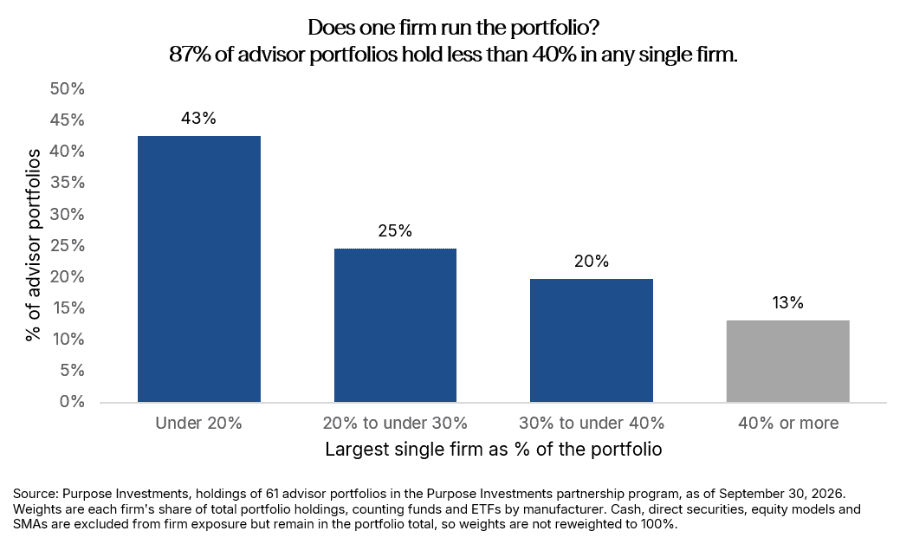
We found that 87% of these portfolios have less than 40% of their holdings with any single firm. In other words, most of the portfolios in our sample were not dominated by a provider. Without having any sort of explicit rule, almost all portfolios kept the max provider exposure below the 40% mark.
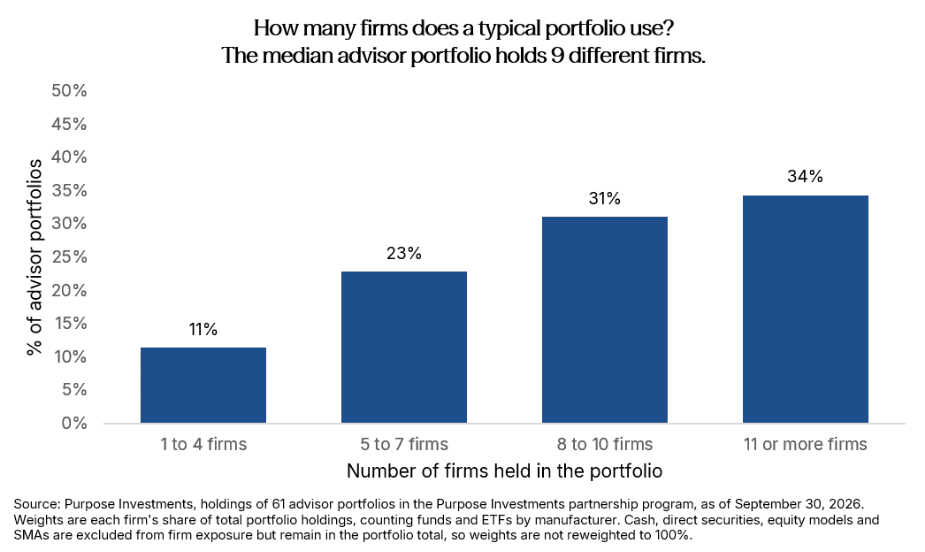
We also looked at how many firms were represented in each portfolio. The median advisor portfolio held investments from nine different firms, with 65% of them using at least 8.
Of course, the number of firms doesn’t tell us whether or not the portfolio is properly constructed. But the findings illustrate that advisors are already drawing on a range of providers when building portfolios. A 40% limit on our own products gives us ample room to express our investment views while considering that advisors are often building portfolios in a similar manner.
We also think this approach makes a difference in how we work with advisors. Advisors are clearly accustomed to evaluating investments across the industry and determining which ones best serve their clients. Our conversations, and ultimately our portfolios, should reflect that same openness.
We want to be part of the conversation about the portfolio, including the areas where Purpose doesn’t have a product to offer. Our role shouldn't begin and end with the investments we manage. It should be about helping advisors think through how all the pieces fit together.
Final Thoughts
We could fill more of our portfolios with Purpose products. It would certainly make things simpler. Fewer outside managers to evaluate, and a lot less explaining why we passed on our own products. But the easier way out does not mean it is the better one.
Three years into the Purpose Active Suite, our 40% cap helps keep us honest, reminding us that even our own strategies need to earn their place. After all, the goal isn't to build the best portfolio of Purpose products. It's to build the best portfolio we can. And we're perfectly comfortable with that meaning someone else gets the occasional nod.
My three-year-old would call this "taking turns." We're still working on it at home. At least the Active Suite has the hang of it.
— Brett Gustafson is an Associate Portfolio Manager at Purpose Investments
Sources: Charts are sourced to Bloomberg L.P., as of October 23.
The content of this document is for informational purposes only, and is not being provided in the context of an offering of any securities described herein, nor is it a recommendation or solicitation to buy, hold, or sell any security. The information is not investment advice, nor is it tailored to the needs or circumstances of any investor. Information contained in this document is not, and under no circumstances is it to be construed as, an offering memorandum, prospectus, advertisement or public offering of securities. No securities commission or similar regulatory authority has reviewed this document and any representation to the contrary is an offence. Information contained in this document is believed to be accurate and reliable, however, we cannot guarantee that it is complete or current at all times. The information provided is subject to change without notice.
Commissions, trailing commissions, management fees, and expenses all may be associated with investment funds. Please read the prospectus before investing. If the securities are purchased or sold on a stock exchange, you may pay more or receive less than the current net asset value. Investment funds are not guaranteed, their values change frequently and past performance may not be repeated. Certain statements in this document are forward-looking. Forward-looking statements ("FLS") are statements that are predictive in nature, depend on or refer to future events or conditions, or that include words such as "may," "will," "should," "could," "expect," "anticipate," intend," "plan," "believe," "estimate" or other similar expressions. Statements that look forward in time or include anything other than historical information are subject to risks and uncertainties, and actual results, actions or events could differ materially from those set forth in the FLS. FLS are not guarantees of future performance and are by their nature based on numerous assumptions. Although the FLS contained in this document are based upon what Purpose Investments and the portfolio manager believe to be reasonable assumptions, Purpose Investments and the portfolio manager cannot assure that actual results will be consistent with these FLS. The reader is cautioned to consider the FLS carefully and not to place undue reliance on the FLS. Unless required by applicable law, it is not undertaken, and specifically disclaimed, that there is any intention or obligation to update or revise FLS, whether as a result of new information, future events or otherwise.