
Big moves are becoming the norm in this market and currency is no exception. Our Canadian Dollar (CAD) has traded down to 70 cents on the dollar. This is only a penny or two away from the extreme lows of COVID (when everyone was hiding in USD/Treasuries) and Tariff Day (remember when tariffs were going to push Canada into a bone crushing recession). Too extreme? Let’s bring it in.
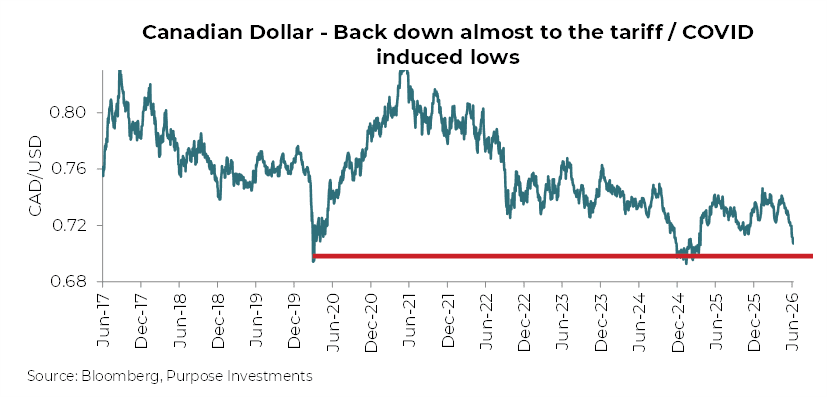
Our initial thoughts on this weakness was that is a Canada problem. Oil prices have come down from $92 to $70/bbl in June 2026, and we are still somewhat of a petro currency. Gold has fallen from $4,500 to just below $4,000/oz, are we a bit of a gold currency now too? 2-year government yields in Canada have fallen a bit from 2.85 to 2.75%, while U.S. Treasury 2-year yields have risen from 4.03 to 4.16% as of June 29, 2026. Canada just printed two quarterly GDP contractions, being labelled a ‘technical’ recession. It isn’t really a recession but positive GDP in the U.S. is clearly better than anything with a negative sign in front of yet.
Going through that list, might we not expect a weaker loonie? But it is not us, it’s them. “Them” in this case is U.S. dollar strength, not Canadian dollar weakness. The Japanese yen has pushed back up to 162 (up is down for the yen), the lowest value for yen vs the U.S. dollar dating back to the early 80s. Not as epic, the euro has recently weakened as well. Since Kevin Warsh was confirmed as Federal Reserve Chair on May 22, 2026, the U.S. dollar has strengthened broadly.
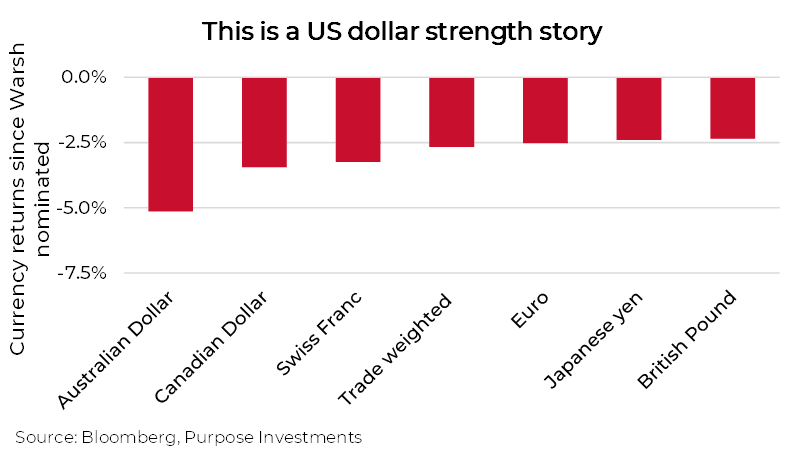
Last year (and the first couple months of 2026), there was a mild debasement trade focused on the U.S. dollar. Erosion of trust in leadership and policy such as tariffs did not sit well. As did deficits continuing to run at recession levels despite the overall U.S. economy doing well. But perhaps the biggest concern was on the transition of the Federal Reserve Chair. President Trump’s vocalizing a strong desire for lower interest rates and other actions raised concerns over Fed independence. The good news, Warsh has a reputation of a bit of an inflation hawk and given early statements emphasizing price stability, Fed independence fears have faded for now.
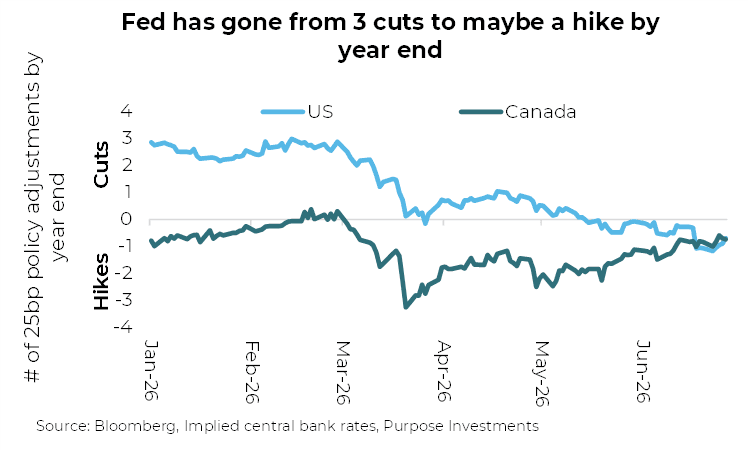
Add an uptick in inflation data, partially caused by the energy impact from the temporary blockage of the Strait of Hormuz, but not just this factor. Economy is strong, employment has picked up as well, in our view, the data may not support cutting at this time. Given the new Fed chair and the market’s view of more data dependency decision making, market expectations for rate cuts appear to have dissipated, in our view. The futures market was expecting the Fed to cut 3 times in 2026 (bad for its currency) but now pricing in no change or even one 25bps hike. Expectations for the Bank of Canada have largely remained in the ‘no change camp’.
As a result, including many other factors as well, we have seen a widening of short-term yield spreads. 2-year yields are 4.07% in the U.S. and 2.75% in Canada, as that spread widens the CAD drops vs USD. At the beginning of May, the spread was 1.0%, now we are 1.32% after touching 1.40%. This is pretty extreme spread territory, which could be somewhat supportive for CAD.
The stronger U.S. dollar is not just a currency story. It is impacting everything from gold, crypto and global equity markets.
Where to Go From Here
In the short term, we are at pretty extreme levels of the CAD/USD exchange rate and yield spreads. And the sudden optimism around U.S. Fed independence could prove short lived. Couple economic data prints that you know who doesn’t like and he could very well crank of the pressure on the Fed to cut rates. This does have us in the camp of things going too far the other way, from USD weakness to USD strength. At 70 cents, we are beginning to consider hedging USD currency exposure more carefully.
Gold too. We are becoming somewhat more constructive. For much of the past year, gold prices were largely influenced by money flows into (or out of) ETFs. Currency, real yields, geopolitical risk, commonly drivers of gold, had taken a back seat to flows. In 2025, that was a good news story. In the first half of 2026, clearly not. But the past couple weeks, gold is starting to behave based on fundamentals again. It may imply gold has reinstituted its defensive characteristics.
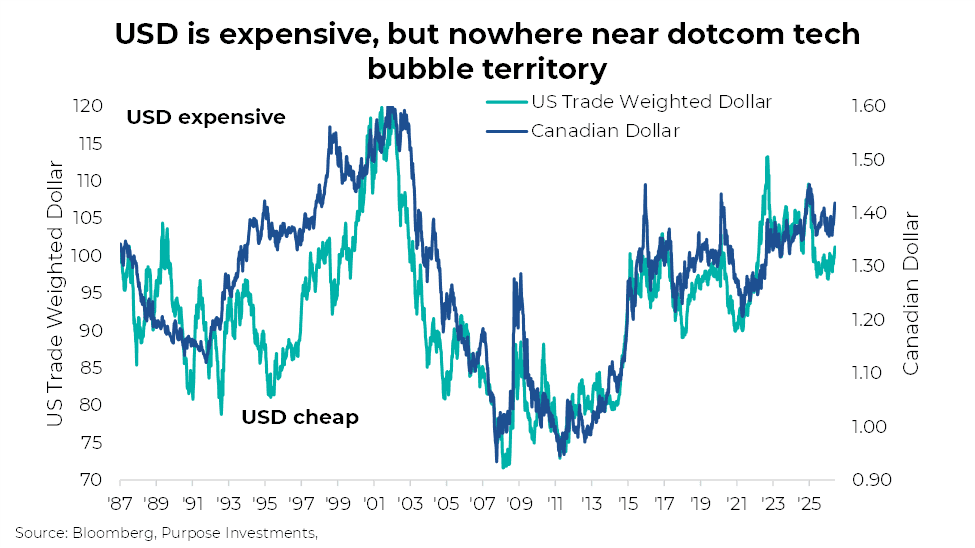
For the CAD/USD exchange rate, one caveat is AI. Investors may be hard pressed to remember, but during the last tech bubble in the late 1990s, the U.S. dollar flew with the CAD down to 65 cent levels. There were a number of different tailwinds, with the tech bubble being a big one as more and more capital flowed into America. This AI bubble is more broad geographically but still with a big U.S. leadership. A continuation could result in more U.S. dollar strength. Conversely, any hiccup and in our view we might expect to see USD weakness.
Final Thoughts
Forecasting currencies? Good luck. That being said, it is a zero-sum game in the really long term and sometimes factors align all in one direction. We think this encapsulates the past few months. After a year of mild USD weakness, most factors became USD bullish (CAD bearish). Oil, relative economic growth, inflation, yields and the market’s best guess on central bank future behaviors. In our view, the only time forecasting currencies become a bit easier is when everyone is on one side of the boat. That feels like today.
At 70 cents, some investors may find it worth revisiting their hedging approach to U.S. denominated assets.
— Craig Basinger at Purpose Investments.
Get the latest market insights in your inbox every week.
All data as of June 26, 2026, sourced from Bloomberg and Purpose Investments.
The content of this document is for informational purposes only and is not being provided in the context of an offering of any securities described herein, nor is it a recommendation or solicitation to buy, hold or sell any security. The information is not investment advice, nor is it tailored to the needs or circumstances of any investor. Information contained in this document is not, and under no circumstances is it to be construed as, an offering memorandum, prospectus, advertisement or public offering of securities. No securities commission or similar regulatory authority has reviewed this document, and any representation to the contrary is an offence. Information contained in this document is believed to be accurate and reliable; however, we cannot guarantee that it is complete or current at all times. The information provided is subject to change without notice.
Commissions, trailing commissions, management fees and expenses all may be associated with investment funds. Please read the prospectus before investing. If the securities are purchased or sold on a stock exchange, you may pay more or receive less than the current net asset value. Investment funds are not guaranteed; their values change frequently, and past performance may not be repeated.
Certain statements in this document are forward-looking. Forward-looking statements (“FLS”) are statements that are predictive in nature, depend on or refer to future events or conditions, or that include words such as “may,” “will,” “should,” “could,” “expect,” “anticipate,” “intend,” “plan,” “believe,” “estimate,” or other similar expressions. Statements that look forward in time or include anything other than historical information are subject to risks and uncertainties, and actual results, actions, or events could differ materially from those set forth in the FLS. FLS are not guarantees of future performance and are, by their nature, based on numerous assumptions. Although the FLS contained in this document are based upon what Purpose Investments and the portfolio manager believe to be reasonable assumptions, Purpose Investments and the portfolio manager cannot assure that actual results will be consistent with these FLS. The reader is cautioned to consider the FLS carefully and not to place undue reliance on them. Unless required by applicable law, it is not undertaken, and is specifically disclaimed, that there is any intention or obligation to update or revise FLS, whether as a result of new information, future events, or otherwise.


