
One of the more recent market ethos, Last Dance, was a good one, and it captures our current moment pretty clearly. The cycle does not look like it's ending, but something does feel a little off – traditional correlations or patterns have been disconnected, which is, of course, typical late-cycle behaviour. But the late cycle can last a long time. Going to cash at this point would be too extreme, but it also does not feel like the point in the night where you order another round.
Late-cycle investing rarely comes with a warning label. We will do our best below to ponder some potential marks to that end, but what typically kills the bull is something unforeseen. Markets can look overbought and continue to run, but abandoning your portfolio is not the strategy. Late-cycle gains have typically captured about 1/3 of the bull market performance. That would be a difficult conversation with clients if a big chunk of that final rally was missed.
Markets can look expensive and still keep going. Leadership can narrow and still get narrower. AI can feel overhyped and still deliver real earnings growth. This is what makes this part of the cycle so challenging. So, the point is not to call the top. The better exercise is to ask whether your portfolio is built for more than one outcome, including when the music does stop.
Cash is King?
The first instinct in a late-cycle environment is often to raise cash. That makes sense emotionally and works great as a ballast in risk-off environments. But the setup for cash has changed, we enjoyed some strong positive real yields on cash the past couple of years, with inflation coming down and yields maintaining a higher level. For those years, we were actually being paid to wait on the sidelines.
With sticky inflation expected for the next few quarters, we are just expected to go back to minimal yield pickup on cash, which we experienced for much of the past decade. The forecasted quarterly real return on cash looks less comfortable through the rest of 2026 before improving into 2027.
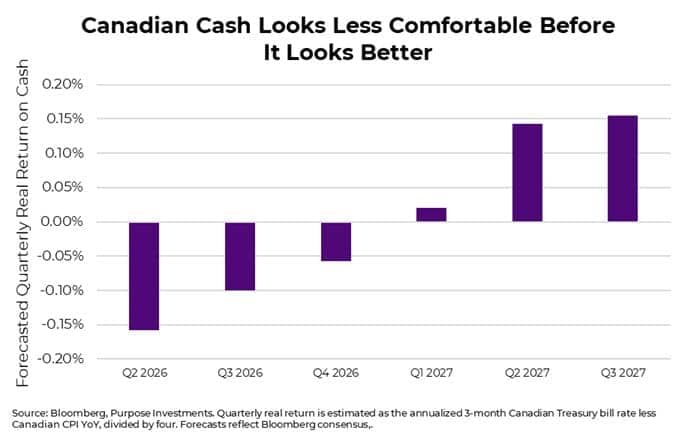
That does not mean cash has no role in portfolios. It still reduces volatility and gives portfolios room to act if opportunities appear. If the cycle ends, cash will be your friend, but timing that is an entirely different discussion. Real gains will be minimal for the foreseeable future, you don’t own the airbags in your car to make the ride better, but you are pretty happy they are there if things go wrong. In the end, the point is that there is a difference between using cash as a tool and turning it into your whole strategy.
Concentration
Once you sort out your ideal cash weighting, check out some of the concentration within your portfolio. This is an easy one to ignore because concentration has built up in portfolios as a result of strong performance. The parts of the portfolio that worked have become more dominant, that’s a tough decision to start paring them back.
Today, that concentration is often tied to a discussion surrounding US equities and the mega-cap growth names. The tricky part is that AI has spread well beyond the obvious names, it is not as narrow as one might think. It touches semiconductors, software, industrials, power demand, utilities and basically any company that can squeeze ‘data centre’ into a quarterly update.
That does not mean the AI theme is a wrong one to be exposed to. The spending is real, and so is the earnings support. The question that remains is, how much of the portfolio now depends on that same story continuing to work?
This is one reason why we have favored equal weight US equity exposure. It reduces the dominance of the largest names and helps manage the concentration risk that has built up in the market-cap-weighted index. It is not a magic shield by any means, it does shift the risk vs eliminating it. The alpha generation in a more economically focused event may not be as much in an event driven by AI, but it should soften the blow either way. Exposure to more naturally defensive sectors will help, but there is still some cyclical exposure and exposure to companies smaller in size.
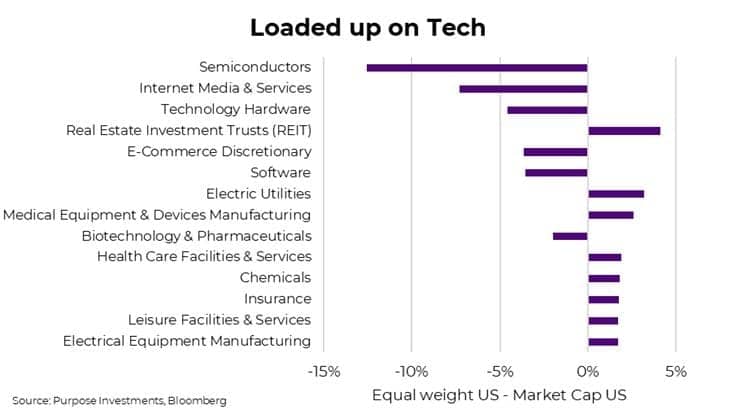
We have certainly missed out on some of this growth in the AI Supercycle, but it has allowed us to be more selective in areas like software and buying market cap on weakness. Sometimes getting a little more sleep at night is worth missing a little upside, especially if the trade-off is a portfolio that is less dependent on one theme continuing to work perfectly.
Correlation
Bond and equity correlations have obviously risen, but nobody complains too much when both are moving higher. The frustration rises when bonds do not do the job investors expect of them, much like the joyous year of 2022.
Recently again, bonds have not exactly been the fun part of the portfolio. But their use case is not lost. They are intended to provide a bit of income, reduce volatility and help when growth really breaks. It has been a long time since we had a true recessionary environment where bonds could fully prove their worth, and recency bias has taken hold. We are increasingly seeing the frustration investors are having with the one part of the portfolio that is supposed to be boring. Very unfair to bonds. They never told you they would be exciting.
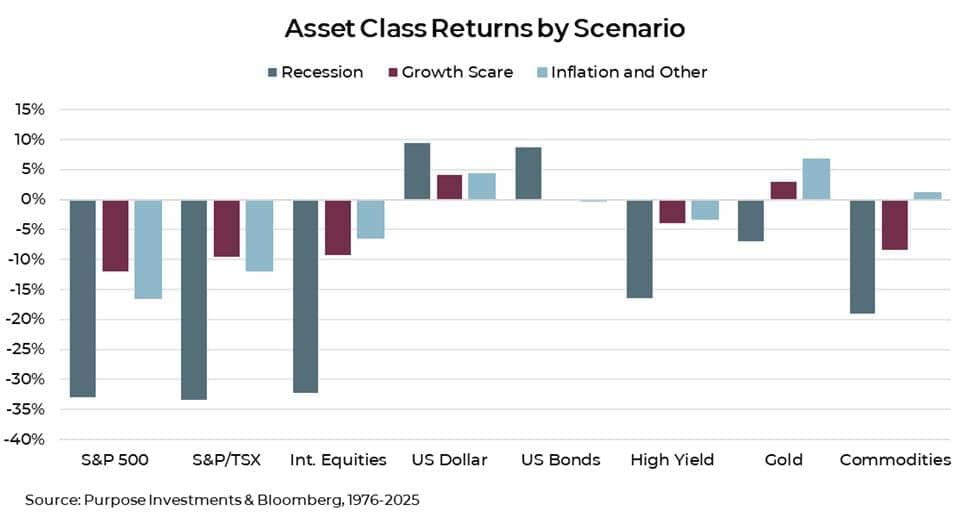
That is why we have a diversified portfolio beyond the two asset classes. The chart below shows that bad environments do not all look the same. In a recession, equities and high-yield bonds have been pretty significant pain points, while US bonds and the US dollar have been strong risk-off contributors. In a growth scare, the damage tends to be less severe, but risk assets still struggle. In an inflation-driven environment, bonds may not offer the same clean offset, but gold and commodities step up to the plate. It reminds us that no single asset class is the hero in every version of a weak market.
Three Scenarios to Ponder
Late cycles rarely end the way we expect, but there are a few scenarios worth considering. The goal is not to forecast the exact trigger but to assign your own probabilities to different outcomes. If the backdrop changes, you can have expectations for how the portfolio might behave.
An AI Unwind would likely come from expectations getting too stretched. The AI theme can still be real, but if earnings or productivity gains fail to keep up with the hype, valuations could have a bit of a reset. The eventual IPOs of more direct AI companies may also give investors a clearer look at the underlying economics, and that information could be eye-opening in either direction. The biggest risk here is not simply owning AI exposure, it is owning the same AI-related expectation across many parts of the portfolio. But let’s be real, if the AI unwind commences, the market will not be a happy place.
A growth scare would be a bit tricky, nothing historically gets pushed down too far, but nothing really works all that well either. Growth would slow, inflation remains sticky, and yields stay high enough to put some pressure on valuations. Diversification will feel frustrating, but historically, the safe haven investments like Gold, US Bonds and the USD will hold the portfolio up.
There would be minimal places to hide in an actual recession, which is the cleaner risk-off scenario. Earnings would fall, credit spreads would widen, and equities would be a serious pain point. This is where your cash, higher-quality bonds and diversifiers will help earn their keep. The problem with this scenario is that by the time everyone agrees we are in a recession, the easy part of the defensive move is already done.
Questions to Ask Yourself
Market moves can quietly change the risk profile, a simple gut check can go a long way. The questions below are not meant to produce perfect answers, but they should help identify where the portfolio may be leaning too heavily on one outcome.
|
Portfolio |
Question to Ask Yourself |
|
Cash |
Am I holding cash for flexibility, or because it feels easier
than making a decision? |
|
Equity Weight |
Has market strength pushed the portfolio above its intended
equity risk? |
|
U.S. Exposure |
Is the portfolio more dependent on U.S. equities than I realise? |
|
AI Exposure |
How much of the portfolio is tied to the same AI-related outcome? |
|
Fixed Income |
Is the bond sleeve there for defence, income, or growth? |
|
Credit |
Am I being paid enough to take on high-yield or lower-quality
credit risk? |
|
Diversifiers |
Do they actually behave differently in a true recession? |
|
Correlations |
What happens to the portfolio if bonds and equities all move
together again? |
Source: Purpose Investments, Bloomberg
Final Thoughts
Something is coming, as we are certainly not in the early stages of the cycle anymore, but that does not mean the right answer is to run for the exits. The late cycle can last longer than expected and can still produce meaningful returns. The focus should be on making sure portfolios are not overly dependent on one outcome.
— Brett Gustafson is an Associate Portfolio Manager at Purpose Investments
Sources: Charts are sourced to Bloomberg L.P.
The content of this document is for informational purposes only, and is not being provided in the context of an offering of any securities described herein, nor is it a recommendation or solicitation to buy, hold, or sell any security. The information is not investment advice, nor is it tailored to the needs or circumstances of any investor. Information contained in this document is not, and under no circumstances is it to be construed as, an offering memorandum, prospectus, advertisement or public offering of securities. No securities commission or similar regulatory authority has reviewed this document and any representation to the contrary is an offence. Information contained in this document is believed to be accurate and reliable, however, we cannot guarantee that it is complete or current at all times. The information provided is subject to change without notice.
Commissions, trailing commissions, management fees, and expenses all may be associated with investment funds. Please read the prospectus before investing. If the securities are purchased or sold on a stock exchange, you may pay more or receive less than the current net asset value. Investment funds are not guaranteed, their values change frequently and past performance may not be repeated. Certain statements in this document are forward-looking. Forward-looking statements ("FLS") are statements that are predictive in nature, depend on or refer to future events or conditions, or that include words such as "may," "will," "should," "could," "expect," "anticipate," intend," "plan," "believe," "estimate" or other similar expressions. Statements that look forward in time or include anything other than historical information are subject to risks and uncertainties, and actual results, actions or events could differ materially from those set forth in the FLS. FLS are not guarantees of future performance and are by their nature based on numerous assumptions. Although the FLS contained in this document are based upon what Purpose Investments and the portfolio manager believe to be reasonable assumptions, Purpose Investments and the portfolio manager cannot assure that actual results will be consistent with these FLS. The reader is cautioned to consider the FLS carefully and not to place undue reliance on the FLS. Unless required by applicable law, it is not undertaken, and specifically disclaimed, that there is any intention or obligation to update or revise FLS, whether as a result of new information, future events or otherwise.